No Australian should stand for inequality

Trash talk precedes most big fights. Boxers have to sell seats and the more bums on them the better their payday.

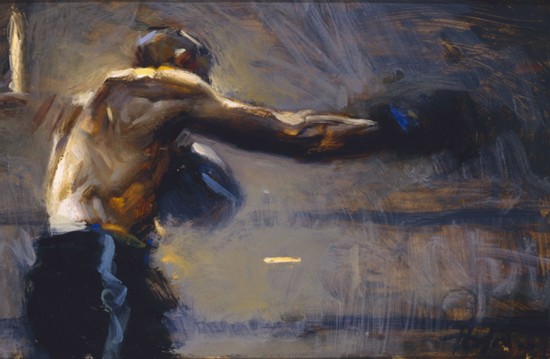
Anthony Mundine’s no stranger to that. He’s been stirring the pot his whole career, drumming up business, psyching out his opponents, giving the public the loud mouth anti-hero some genuinely hate, while others look beyond the words to the fighter, the athlete.

Unlike most scrappers, though, Mundine has rarely wasted these opportunities (which are fewer and further between for him) by talking up simple rivalries.

Five years ago he caused controversy by disputing fellow boxer Daniel Geale’s very Aboriginality.

There has never been anything mundane about Mundine.

Instead he’s used that time as a platform to push debate around indigenous life and to hopefully change it for the better.

He has vowed to sit down during the playing of the national anthem at his rematch with Danny Green on Friday night, calling it “disrespectful” to his people.

And as an Australian, let alone an Aboriginal one, he has every right to do that.

If, as is mooted, promoters get around this by having the anthem played before he enters the ring it would be another stain on this country’s already tarnished history of race relations.

It would be a greater disgrace than what some perceive is Mundine’s snub to Advance Australia Fair.

Mundine should absolutely be allowed to get in that ring and sit on his seat while the anthem is sung. As the headlining boxer he deserves to have that moment – to be more than a piece of meat, making a small fortune for the promoters.

He deserves to be able to rankle the masses and let them know where he stands as an individual, and maybe make them think a bit longer about what it really means to be Australian – both white and black.

Our headlining Aboriginal sportsmen are the ones who get the most column inches when they speak on these issues, even though they are shouted down.

Adam Goodes, one of the most eloquent sports people when talking about racism and the toll of white Australia on native Australians, has paid the price. Derided, bullied, beaten down.

The fact of the matter is there has never been a level playing field for Aboriginals and Torres Strait Islanders in Australia, and we have a long way to go before we get one.

It is not, as Barnaby Joyce insists, about having to say ‘sorry’ for ancestors like his who came to the country as immigrants and had nothing to do with colonial massacres.

It’s simply about recognising things are not fair and working towards making them so.

It’s kinda in the title: Advance Australia Fair.

Only the anthem doesn’t mean ‘fair go’ it means things being nice, good, palatable.

Well it’s not ‘nice’ that indigenous Australians live on average 17 years less than non-indigenous. Nor is it ‘good’ that Aboriginal women are 58 times more likely to be held in police custody than white women. It’s not ‘palatable’ that suicide rates among the indigenous population are three times higher than for everyone else. It’s certainly not ‘fair’.

That’s not the fairness Australia is meant to be about. It’s meant to be about equality.

Equality for blacks and whites, for Asians, for women, for gays and anyone else born with the same irrefutable rights as the next person.

Mundine will continue taking the hits and speaking his mind. And I hope for all Australians, come Friday, that he is allowed to sit on his stool as the anthem rings out and make his point.

That would really advance Australia fair.
Lessons in the cost of silence

It seems wrong that the survivors of the Holocaust are generally only bracketed in the category of victims, and all that that implies. Helplessness, weakness.

Because in truth they are anything but that.

The survivor’s of one of the world’s worst ever acts of genocide have a strength that is difficult to put into words.

And the lessons they teach, cautioning against intolerance, have eclipsed the toxic legacy of Adolf Hitler and the Nazis.

Today their role in educating us about the environment that gave rise to the Holocaust and how governments can manipulate people against one another, is as important as ever.

Their input in teaching critical thinking is a rare boon for us here in Australia, but one with a finite window.

Now aged from their late 70s to 90s, when you meet these remarkable men and women you can’t help notice the twinkle in their eyes. The horrors they have witnessed have not suppressed their inner spirit.

To hear their accounts of survival under Hitler’s regime is much more powerful than to read it in a history book.

We all know the grim statistics. The six million Jews murdered in World War II, as well as the gypsies, Serbs and other persecuted minorities.

But for many Australians the reality of this seems very distant, an event that occurred, now, a long time ago, far away in Europe.

We would all like to think that we would not have stood by and let what was done to the Jews happen.

It’s unfathomable to us how so many could have turned a blind eye, while others were active in the persecution and many more showed little to no compassion for their countrymen.

Historians often cite British prime minister Neville Chamberlain’s disastrous appeasement of Hitler, but he was not alone. Appeasers, cowed into silence, in fear of conflict or punishment, were everywhere, at all levels.

And yet, Germany and other countries under the Nazi yoke, were highly educated, cultured places.

The way in which populations were manipulated over time – through propaganda and fear-mongering – to turn on the Jews remains an important and relevant historical lesson.

If it happened then, it could happen now. We are not that different from our forebears of the 1930s.

Speaking up, speaking out, both for ourselves and others, is not always easy.

Here on the streets of Sydney would you say something if you heard abuse yelled at a woman in a head scarf or two men holding hands.

Remind yourself of the cost of silence and, too, that one voice can inspire the courage in others to also speak out.

The Jews that survived the Holocaust, men and women such as Jack Meister, Yvonne Engelman, Olga Horak and Paul Drexler, have a white-knuckle story to tell, but also a powerful lesson in humanity and how quickly it can unravel.

If you have a bucket list of things you want to do in life, add something really meaningful to it and go down to the Sydney Jewish Museum in Darlinghurst Road and speak to a survivor. I tell you, it will blow your mind.

Listen to Olga explain how an act was passed overnight in her home country, the Slovak Republic, and authorities came the next day and took her 16-year-old sister from the family home. Hearing her say “we never saw her again, they sent her to Auschwitz,” will make your blood run cold.

Her account of life under the Nazis and their collaborators should be compulsory reading for all Australian school students. From her time at Bergen-Belsen (where Anne Frank died) and a meeting with ‘Angel of Death’ Dr Josef Mengele, to witnessing the devastation of the British firebombing of Dresden, Olga’s story is a rich microcosm of some of the key events of WWII.

And, though memories of that conflict recede in time, we should not waste the opportunity to learn from these incredible Australians in our midst.

They are people who lost almost everything, but rebuilt their lives here and, to this day, continue to contribute greatly to the community.

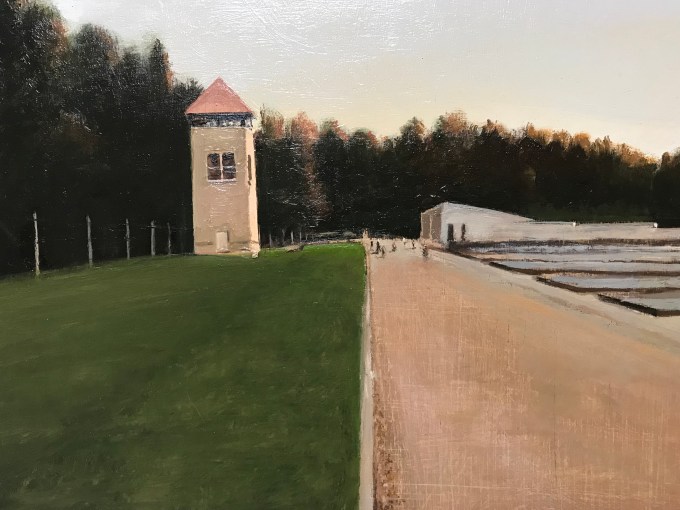
(Originally published in The Daily Telegraph. Painting: Dachau Memorial by Ivan Goodacre.)

Faking it… A dirty campaign to undermine democracy

Fake news comes from all sorts of sources. It’s often characterised as originating with rogue operators, unscrupulous websites cadging a living from Google AdWords or YouTube plays. But it’s not always from them, sometimes it’s from government agencies or political leaders who we are told to trust. Of course, politicians telling lies, governments misleading is in no way a new thing. We used to call it propaganda, which suggested bias but was often outright lying. The Nazis were expert at it, but the ‘good guys’ often used it too.

Today we would call Baghdad cabbie Rafid Ahmad Alwan’s assertion that Saddam Hussein had mobile biological weapons labs as ‘fake news’. It was a charge that in 2003 the US and Britain used to justify the invasion of Iraq. Both governments had been told he was a congenital liar and his claims didn’t stack up, but they ran with the story anyway because it neatly fit their agenda.

This week we were treated to the unedifying claim Donald Trump watched Russian prostitutes urinate on each other in a Moscow hotel room. We were also told Russia was blackmailing the president-elect with a dossier of dirt – essentially making him some type of Manchurian candidate.

The entirely unsubstantiated information was compiled by ex-MI6 agent Christopher Steele, who runs a security company in London called Orbis Business Intelligence, for a political opponent of Trump’s.

The fact a US security agency may have leaked the information on the eve of Trump’s inauguration says a lot about the incumbent government’s desire to influence or derail the incoming government’s relationship with Russia.

Russia incidentally has been portrayed for the past four years as some kind of rogue, expansionist state, rather than one reacting to provocations from outside its borders.

Buzzfeed, which was handed the leaked info, did what pretty much any media company would do and ran it, saying the public could make up its own mind. Of course saying that whilst presenting no balancing information creates a dangerous environment for a large section of the population to believe it.

When information is presented with the caveat ‘make up your own mind’ it invites multiple interpretations. There’s also the distinct danger the reader will form an opinion based on what they might already think of the people involved, i.e. Trump is a gauche, chauvinist, therefore the allegations are believable.

But this is where governments and other agencies have always cleverly used the media to give fake news an air of credence.

We in the media, generally speaking, are better at repeating information than analysing it. Most media organisations lack the critical facility to scrutinise the motives behind leaked information, so happy are they just for the opportunity to set the agenda and break a big story.

The other insidious thing the release of the dodgy dossier on Trump did was to allow the media to validate the claim Russia was involved in hacking the Democrats and influencing the result of the presidential election.

The Democrats, still smarting at their loss, would love everyone to believe this was true. That their loss was the result of a conspiracy and that Trump is actually an illegitimate leader.

Trump had steadfastly denied Russian involvement, as had Russia, as had Wikileaks – which in October released thousands of the emails.

In terms of fake news we’ve seen this snowball effect before, in Libya and in the build-up to the second Iraq war, where one unproven claim gives way to another, to the point where there is a concession that some of it must be true. Where there’s smoke there’s fire – not always.

And so some of the media glibly reported Trump had accepted Russian involvement in the hacking of Clinton-aide John Podesta’s emails.

Trump, clearly feeling the pressure of attacks that had turned personal, said: “As far as hacking, I think it was Russia, but I also think we’ve been hacked by other countries, other people.” He then backtracked adding “you know what, could have been others also”.

The key allegation against Russia presented in the report by America’s Office of the Director of National Intelligence (ODNI) is the hack of the Democratic National Committee used identical methods to a previous alleged hack by Russia.

However, many hackers download pre-programmed scripts available on any exploit database and anyone using them would display the same features. A hacker in the US using a VPN (Virtual Private Network) located in Russia and accessible by anyone on the internet can appear to be staging the hack from Russia, despite being in the US.

Activist Alex Poucher, a professional hacker, claimed from his own detailed analysis of the ODNI report it was not possible to tell where the hack had originated or who was behind it.

He said: “At the end of the day, an insurmountable heap of circumstantial evidence is all this report is, without any proof to back up any of the claims whatsoever, except hearsay.

“I have personally [gone] over every aspect of the attack and what I can tell you, what I have found is that every aspect of the attack, the entry or the payload, is not particularly sophisticated. A 14-year-old script kiddy with download capabilities could have pulled off this hack.”

What we are left with are a lot of untestable allegations (hot air), all designed to discredit Donald Trump’s presidency.

All you can do is ask: Who benefits?