Taking the Lucky Country for granted

There’s a skit the British comedian Michael McIntyre does about disabled parking spaces.

As non-disabled motorists cruising for an elusive spot we tend to look ruefully at those often empty reserved spaces right in front of the shops. And sometimes scrutinise those parking in them to satisfy ourselves they are legit.

“What do we want?” asks McIntyre. “For the door to open and a minute-and-a-half later someone falls out.” He then starts crawling across the stage shouting ‘get me a trolley’.

Peter Dutton’s comments on the Manus Island refugees who flew into New York this week (as part of the deal with the US), wearing sunglasses and looking like tourists, fell into the same basket.

“They’re economic refugees,” he told 2GB. “They got on a boat, paid a people smuggler a lot of money, and somebody once said to me that we’ve got the world’s biggest collection of Armani jeans and handbags up on Nauru waiting for people to collect it when they depart.”

Perhaps he wanted them in rags, walking on crutches… emaciated.

The detention centres in the North Pacific are certainly not holiday camps and even if you’re in agreement with the Manus and Nauru detainees being denied entry to Australia, it’s no time to gloat.

Weighing up the cost of compassion is very different from just being self-righteous.

It’s easy in the affluent country we live in to pontificate about economic refugees and how they don’t deserve what Australia has on offer because they weren’t born here.

Nevermind that our own birthright is a quirk of fate.

I commented to a colleague recently: ‘It’s good being a white bloke.’ He thought about it for two seconds and agreed.

If you’re a ‘white bloke’ born into the middle classes of Australia it doesn’t get much better.

You aren’t born smarter, you aren’t more able. But your path through life inevitably is smoother than if you were born black, or poor, or a woman.

In Australia we have developed an enormous sense of entitlement. We sneer at the poor and dispossessed, blame them for their own misfortune and equate worth with earning potential.

Throughout the 20th century, as immigration became the norm, it was de rigueur to refer to any immigrant or their offspring with some derogatory term, whether it was dago, or slope or Pom. Each new wave of migrants copped it. Each was made to feel that they hadn’t earned the right to be here.

The term ‘assimilation’ has been used like a blunt object to batter people into conforming and often renouncing their own heritage.

How many people do I know who became ‘proper Aussies’ never speaking of their background, brought up with that ignorant, spiteful word ‘wog’ ringing in their ears? Too many.

I’d ban it. Make it a hate crime. Make it like the ‘n’ word.

The ‘w’ word.

The children of immigrants in this country, who were bullied and belittled, will never get an apology. And what lesson did it teach us as a people?

Now, as we trade away human beings to Donald Trump like the unwanted assets of a shop liquidation, let’s not lower ourselves any further.

We are the Lucky Country, but we’ve forgotten what that means. Luck is not about being deserving, it’s providence — a cosmic flip of the coin.

We should never forget that.

(Originally published in The Daily Telelgraph. Photograph by Paul Blackmore.)

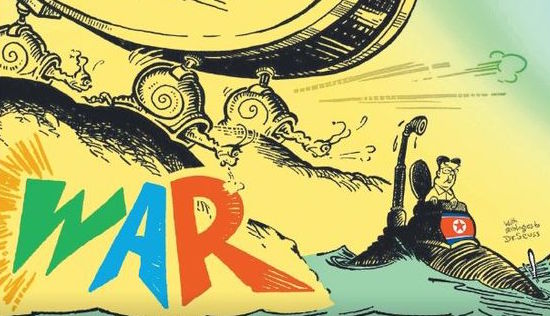
Attacking North Korea would see hundreds of thousands dead on both sides

The ABCs of a war with North Korea make bleak reading.

A for Artillery. B for Barrage. C for Casualties (M for Mass). etc.

And if you want to add maths to the lesson try this: 300,000 dead South Koreans and US servicemen, hundreds of thousands of dead North Koreans.

And that, according to experts, would be in the first 90 days of fighting.

Nevermind that it might spiral out of control and suck in other countries: China, Russia… ourselves.

Despite Kim’s ballistic missile tests and Donald Trump’s proclamation to the UN that he is prepared to “totally destroy North Korea” no sane analysis of the situation predicts an attack by either country.

Well before the current crisis over Kim Jong-un’s nuclear programme North Korea had been deemed too dangerous to confront. Bristling with conventional weaponry, as well as possibly chemical weapons, the toll of war with the North had ruled out all but a diplomatic solution.

But with hawkish calls for North Korea to be ‘dealt with’, the US’s UN ambassador Nikki Haley talking up confrontation and Malcolm Turnbull pledging the support of Australia, analysts around the world mostly agree even a precision pre-emptive strike by the US would only prompt a retaliatory attack on the South, and blow up the entire region.

The notion that Kim is crazy and on a death-by-cop style suicide mission over-simplifies the brinkmanship both sides are employing.

Regional security expert Franz-Stefan Gady, of the EastWest Institute in New York, says: “Even without the use of DPRK weapons of mass destruction, civilian casualties in the larger Seoul metropolitan area might surpass 100,000 within 48 hours and that’s just the low-end estimate.

“Many of these casualties would be foreigners including Chinese Australians and Americans.

“US and Republic of Korea forces would shower North Korea with a combination of cruise missiles, bombs, and artillery rounds; Hundreds of thousands of North Koreans would die in this firestorm.

“DPRK would primarily launch WMD missiles against military targets in South Korea and Japan. A special target would be the US bomber force on Guam.”

In layman’s terms it would be like an international version of Waco, but much, much worse.

North Korea has the second largest army in Asia, some 1.19 million troops and another 600,000 reservists. There are 8,600 artillery batteries around the country, most arranged around the demilitarised zone that separates North and South.

Furthermore, war and the termination of trade with the North would fuel a huge refugee crisis, with estimates of a million or more displaced people flooding across North Korea’s border with China.

Of the 150,000 troops the US has stationed around the world, about 29000 are in South Korea and another 47000 in nearby Japan.

Unless the US is prepared to use the doomsday option of nuclear weapons against North Korea, potentially killing hundreds of thousands of people, the only real option is targeted sanctions and a negotiated peace treaty with Kim.

Jingdong Yuan, a North Korea analyst at Sydney University, said the US has no option but to negotiate.

He says: “China could, if it wanted to, have a very severe impact on North Korea’s economy because 90% of North Korean trade is with China.

“But North Korea could then open its border with China to millions of starving refugees. That is why China is not willing to go to that extreme.”

Professor Yuan says Kim Jong-un is sabre rattling to negotiate his own security and, despite the rhetoric, sees the country’s nuclear weapons programme as defensive. Getting the US, Japan, Russia and China to the negotiating table with Kim is vital.

“Right now is not the time to further escalate because there really is no good outcome there,” he said. “Diplomacy, too, will be seen as appeasement. Some specific stringent sanctions are needed that leave enough room for North Korea to see it as incentive to come to the table.”

There have been numerous previous provocations by North Korea that could have prompted retaliation. In 1968 the country’s navy captured the USS Pueblo, killing a US serviceman in the process. There were naval clashes in 2002 in the Yellow Sea and the South Korean corvette Cheonan was sunk in 2010 with the loss of 46 lives.

Since the end of the Korean War there has been no peace treaty between North Korea and the South and its allies. Reconciliation initiatives, such as the 1972 Joint North-South Korean Communiqué, the 1991 Joint Declaration of South and North Korea on the Denuclearisation of the Korean Peninsula, and the 2000 North–South Joint Declaration, all ended with disappointment.

But 64 years after the war ceased, Korea still serves as a buffer zone which separates the economic interests of the China and Russia dominated Eurasian continent from the US-dominated Pacific rim.

American political analyst Robert E. Kelly writes: “So ritualised are North Korea war-scares that the interesting parts are not the rehearsed statements and events themselves, but how people react to them.

“One regularity I have noticed increasingly is the tendency of Western analysts in particular to, for lack of a better word, freak out over North Korea.

“North Korea has this effect. People kinda’ lose their minds and say gonzo stuff they wouldn’t say about other foreign policy problems.”

He says the US has escalated the problem.

“South Koreans are barely paying attention,” he adds. “The South Korean president and then foreign minister both went on vacation in early August, at the peak of the Kim Jong-un – Donald Trump war of words.”

South Korea is used to living with the provocations of the North.

Furthermore North Korea has become an increasingly paranoid state, convinced that it lacks the full support of China and Russia, while potentially being targeted by the US, which conducts annual war games off its coast and stations troops just over its border.

It is worth remembering that during the Korean War, North Korea was effectively levelled.

The US dropped 635,000 tons of bombs and 32,557 tons of napalm on it. Almost every main building in the country was destroyed and the populace effectively moved underground to survive the bombardment.

Of 22 major North Korean cities 18 had more than half their area destroyed. Bombing of Pyongyang was only halted because there were no worthwhile targets left. About one in seven of nine million North Koreans were killed.

And it is against this background that North Korea views the United States.

Kim Jong-un sees having a viable nuclear deterrent as a way of safeguarding his regime, and the speed at which he is developing its missile programme has taken the major powers by surprise.

“It seems that both Koreas are destined to live in the perpetual fear of war without really experiencing it,” opines Dr Leonid Petrov of the Australian National University.

He believes that as well as there being a humanitarian disincentive to take on North Korea, the strategic problems caused by a unification of the divided countries would change the power balance in the region.

Dr Petrov adds: “If the North and South are unified, peacefully or otherwise, the presence of US troops will be questioned not only in Korea but in Japan as well. US security alliance structures across the Pacific will crumble, followed by economic and technological withdrawal from the region.

“Even the new Cold War against China and Russia won’t help Washington prevent the major rollback of American influence in Asia and the Pacific.”

With America out of the picture Russia and China, he surmises, will resume a power struggle for regional hegemony.

“The unification of Korea would open a new era of regional tensions, which nobody is really prepared to endure,” says Dr Petrov.

“If North Korea is deliberately targeted or attacked and destroyed that would trigger processes far beyond our imagination and control and inevitably lead to tectonic shifts in politics, security and economy of the region, which collectively produces and consumes approximately 19% of the global Gross Domestic Product.

“By removing one piece from the current imperfect but undoubtedly stable structure, one risks a domino effect that is likely to come around the globe and hit those who would dare to trigger this cataclysm.

“One needs to be hell-bent on self-destruction to contemplate such a scenario.”

(Originally published in The Daily Telegraph. Illustration by Terry Pontikos)

Try a little empathy. Four women judged in death

‘It was a sliding doors moment,” Bree Keller’s mum Tania said.

The moment her daughter chose to get into a high-powered sports car with men she may only have met a short time before.

Looking at the multitude of Instagram pics of the young model plastered over the news it’s easy to forget that for four days she remained the unidentified victim of a fiery crash in Sydney’s CBD.

It didn’t take long for the other passengers, all men, to be ID’d. It was one of their cars. They were all mates.

When you’ve registered a car, or paid for a hotel room, you leave a trail and you’re easy to find.

Like the mates at the bucks party who had no idea who the woman they took back to their hotel was, then found her dead the next morning in their shower.

The cause of death is yet to be determined.

The recent deaths of Bree and of Natasha Rowley, who police took 11 days to identify, show that the cost of youthful adventurousness, of taking a chance and foregoing your normal ­secure arrangements can be high.

And while they were adults and they made their own choices, society has a funny attitude to women prepared to take even minor risks.

In stepping outside the bounds of what’s seen as prudent judgment it’s as though they forfeit the same concern we afford to those who stick to the rule book.

So somehow to the public Natasha’s death during a bucks night had to be the result of her own recklessness.

Why else was she there? A 20-year-old with a bunch of much older blokes?

There was concern ­expressed for the “awkward” situation the groom had been placed in, having to explain to his bride why they had brought a young woman home with them.

And Bree getting in the back seat of a Japanese muscle car with men driving too fast, well … you could ­almost hear the empathy seeping away.

As her body lay unidentified for much of the week, she seemed to be a footnote to the central drama of fast cars and furious driving.

It was reminiscent, too, of the death last December of Stacey Tierney in Melbourne, the 29-year-old Briton found one cold morning in a room at a strip club. The “gentlemen” she was entertaining having long gone home to their families.

She died a lonely death in a place far from home.

Like Bree she had been described as a “free spirit”, someone not afraid to take life by the collar and shake it.

Whether they were too impulsive I don’t know, but the care that was lacking in the last moments of their lives should not be echoed in how we, as a community, view them.

That community, of friends and strangers alike, should always be one that is protective, especially towards those who find themselves suddenly in a moment of life-threatening ­vulnerability. It is what philosophers call the social contract.

There is a picture by the famous Mexican photographer Agustin ­Casasola of the body of a young American woman called Hazel Walker, who was shot dead in a hotel room in the wild city of Juarez, Mexico.

Little is recorded of her death, but her companion skipped town shortly afterwards, leaving her corpse abandoned on a slab in the Juarez Hospital mortuary for an inquest to speculate if she had killed herself or been murdered.

The fact no one cared enough to ever determine this speaks volumes. She was out of her depth and mixing with the wrong crowd.

That was around 1922 — 95 years later, not much is different.

(Originally published in The Daily Telegraph. Photo of Bree Keller)

This life!

In a tower block in Redfern I take the lift up 10 floors to Theresa’s parents’ flat, where she is stoically navigating her wheelchair around a tight cluster of chairs, tables and couches.

A white cat darts about and her son Sparrow is watching YouTube videos on a laptop. An assistant, Nick, sits off to the side looking at his phone while mum Lorraine hustles up tea and coffee.

Amidst this bustle artist Theresa stops, unable to go forward or back. She sits there, her legs strapped together, a red beret on her head (her hair recently shorn for a performance). She is beautiful, lean and intense.

Despite, or perhaps because of, her disabilities she’s got a strength.

“I have to be strong,” she says. “I have to be a warrior.”

Her speech, affected by her condition, is laboured and I lean in to focus on her words, piecing together unfamiliar sequences of sounds.

“Dealing with other people’s reactions to my world is really interesting. I care about being real. We need to learn whatever we can.”

At 17, Theresa Byrnes was diagnosed with Friedreich’s ataxia, a terminal disease that attacks the nervous system, slowly debilitating sufferers, rendering them immobile, sending them deaf and blind in some cases and dramatically shortening their life.

Having an increasingly difficult existence seems to have only spurred her on more. Theresa has lived an extraordinary life, something she won’t ever admit to. But it’s true.

In her memoir, published at the ripe old age of 30, she wrote: “Courage has nothing to do with the limits of the body but everything to do with the limits of the mind.”

That was 18 years ago. By then she was already in a wheelchair, had been named Young Australian of the Year and exhibited in several shows. Her photo by Greg Weight is in the National Portrait Gallery collection.

In Sydney she had family around her, friends, gallerists, security. But for her, it was too comfortable.

So, in 2000, she surprised many by packing up and moving to New York. She surprised more people by not hurrying back, daunted by the scale of what she had attempted.

Instead she has lived there since and her quick visit to her parents in Redfern is just a stop in between a performance for Maruku Arts in the Central Desert and an exhibition at Sydney’s Janet Clayton Gallery.

She is a mum now – a single mum. Another challenge. But she’s up to it. Son Sparrow, three, a happy, alert child, is her greatest work. She took him to Uluru this past week to acquaint him with the “centre of the earth”.

“I want Sparrow to realise his connection with the earth,” she opines. “But in the end I cannot promise him anything at all.”

In New York her condition has continued to deteriorate and she now requires regular assistance to carry out basic functions.

But her dream of pursuing her career as an artist in New York has never dimmed.

“I was always a misfit, and I found myself when I arrived in New York City,” she says. “Australia made me who I am – rooted in the rich, red earth and the crashing surf – but I have no time to reminisce. I am the amalgamation of all of it.

“The America I know is a place of creative freedom where you can leave your mark and no one will judge or ridicule you. You can be an outsider, a misfit and blossom in a garden of unknowns and who-cares.”

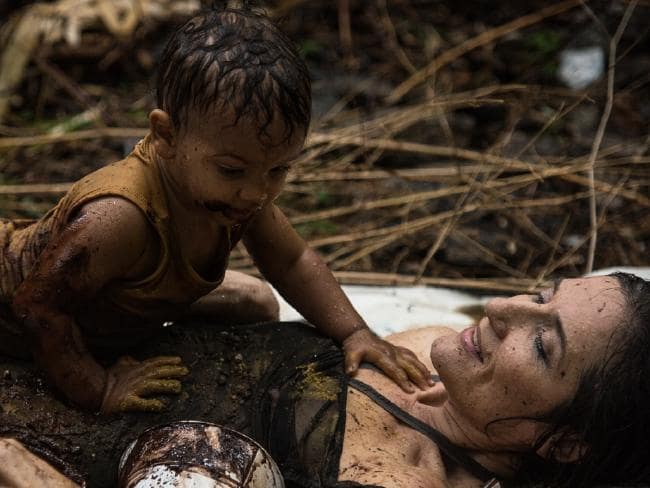
And there is nothing safe about Theresa’s art. She is one of the most visceral, edgy performance artists in the city, confronting her audience with uncomfortable visions, and putting her whole body into her art, from being doused in diesel or ink to crawling through mud along a canvas.

It seems it’s disturbing to everyone but Theresa, who is both unselfconscious and unstoppable.

“I am not afraid to get dirty. I am not afraid of the cold or to hack my hair off; I have a high discomfort tolerance and am not captive to expectations of normalcy,” she explains.

“I accept the limited way my body moves. No one else is wired to move the way I do. Challenge is life and life demands struggle. I want to explore what it is to be human.”

When Theresa first moved to New York she lived in a Lower East Side store front for 13 years.

“I lived alone. My first boyfriend in NYC was an activist priest. We curated events together.

“He broke my heart, but the Lower East Side had totally won mine.

“I put in a pole, ceiling to floor, to help me get out of bed, grab rails by the toilet and a Perspex shelf in my shower. I would pull myself in and out of the shower in lotus. I found a way around my changing mobility to keep independent.”

She revelled in her independence, spending hours writing and planning new performances, organising events, and writing about her work – between making it.

“Three times a week I would go to the gym and pump iron,” she says. “No money for fancy gyms or a trainer, I joined City Gym for $60 per year. I worked out hard and didn’t give a shit how tragic I may look.

“I was aware that what may seem really hard now may soon be impossible – like sliding from chair to floor to stretch and then struggling to get back. I cannot do that alone now.

“One day in 2009 I realised I couldn’t dress, or get ready alone anymore. I took 30 minutes to put my shoes on. I did not want to scald my thighs by dropping a hot coffee pot on my lap again.

“It took me four hours just to get to the door.

“Always with tears of frustration to get through the mundane, I would mop my floor by hand with a soapy towel, leaning over in my wheelchair, wiping, inching the wheels back, whipping.”

But when she did get out into the community it energised her.

“My struggle got my blood pumping,” she says. “It was a good workout, physically, emotionally and spiritually.

“I got an aide for the morning to help me (in Australia you call them carers). I fast realised I was not losing freedom, just understanding it more fully.”

Theresa’s second New York gallery was tellingly named Suffer. It opened in 2010 on East 9th Street.

At an opening of her paintings she met Sparrow’s father. “He was the most beautiful man I had ever seen in my life,” she says.

“I had to avert my eyes. We became friends, then, a year later, committed lovers.”

Louis, a direct descendant of the heavyweight boxer Joe Louis, was a model and actor. They had been seeing each other for a bit over a year when Theresa became pregnant.

“I realised that if I went through with the pregnancy I would perhaps never have precious alone time again,” she says. “The end of my Bohemian dream.

“I could just barely look after myself and Louis was afraid to be a father. I understood his concerns but it was no longer about me or us.”

Five months after Sparrow was born Louis was diagnosed with stage four lung cancer, which had spread to his brain.

Before his death the couple had time to baptise Sparrow under the Williamsburg Bridge by the East River.

“I fought hard through all the stress to keep my studio/gallery,” Theresa says.

“I would paint while Sparrow breastfed or slept on my lap. He has done three performances with me, painted with me.

“In my transition into motherhood I lost some physical independence, my ability to stand, my voice now slurs at times beyond being understood.”

Today Theresa and Sparrow live in a rent-controlled two-bedder in Manhattan’s East Village, a block from her current gallery TBG.

When I first met her at a book launch in London 17 years ago she told me she may be dead by now. The life expectancy for sufferers of Friedreich’s ataxia is about 50. At 48 that’s uncomfortably close, but for Theresa uncomfortable is the norm.

“I am halfway through writing my second book,” she says. “I give myself two years. I will finish it at 50. I look forward to the privilege of being an old wise woman.

“Maybe I can teach something about freedom, how to harness the power of a mistake.”

* Theresa Byrnes’ Mud Bird is showing at Janet Clayton Gallery, 406 Oxford Street, Paddington, Sydney.

September 1-4. janetclaytongallery.com.au

(Originally published in The Daily Telegraph. Pic of Theresa and Sparrow by Rainer Hosch)
Meet the Gadigals

IF you’ve attended your child’s school assembly or gone to pretty much any official event in Sydney in recent years, you will have heard the “Welcome to Country” — a recognition of the traditional aboriginal tribe of the area.

Collectively known as the Eora Nation, there are about 29 clan groups, or tribes, in the Sydney metropolitan region, belonging to several major language groups, including Guringai, Darug, Dharawal and Gundungurra.

By far the most mentioned though, covering a swath of Sydney that takes in Port Jackson, the CBD, the inner west, the eastern suburbs and extending south to Botany Bay, is the Gadigal.

But exactly who are the Gadigal? And what does it feel like to be name-checked from international sporting events to the cutting of a ribbon at the local library.

“Pretty good,” Des Madden, a father of two from Western Sydney, says matter-of-factly.

“It’s a really special occasion, any welcome ceremony. The kids are very proud and they tell everyone.”

Des, 33, who works as an Aboriginal Programs officer at the Environmental Trust, is the youngest of 10 kids who grew up in Redfern and Marrickville.

He went to Cleveland Street High in Alexandria, playing junior rep league and tagging around with his dad Allen, who carried out heritage site surveys and taught him about their tribe.

He met his wife Nezmia, 31, a member of the Riverina Mahdi Mahdi tribe, a decade ago and they have two kids, a daughter Shyla, eight, and son Jobie, six, while also giving a hand bringing up their niece Jannali, five.

Des and his family don’t need any reminders of who they are or where they’re from and talk about it often.

While inner westies might associate Petersham with Instagrammed shots of Portuguese chicken, to the Maddens it’s just one of the boundaries of Gadigal country.

“Every time we’re close by we always mention, ‘we’re in Gadigal country now’,” says Des, who moved the family to Penrith seven years ago.

Nezmia, a business support officer, says: “We’ll tell the kids we’re not far now, and there’s always a sense of relief at being back in country.”

While the Maddens are a very ordinary family with ordinary worries (the mortgage, the heating bills, the kids’ homework), unlike most Sydneysiders they express a clearer affinity to the land and impart that to their children.

Des, who estimates there are about 50 or 60 Maddens living in Sydney, knows educating people about his tribe and others is important to keep traditions alive and continue to build on the positive steps being taken to recognise indigenous Australia.

His dad Allen, 69, who now officiates at some of the Welcome to Country ceremonies, remembers a very different scenario.

“I grew up in Redfern, which was very poor for both blacks and whites,” he said.

“We were all in the same boat, the working class mob. We’d drink together at the pub and we’d do what we could to make a living.

“Before land rights there was no real recognition of us as a people with a history. Now the younger generation are coming along and saying, ‘Hang on, we haven’t been told about this’. Aboriginal people were just stereotyped.

“It makes me feel very good that at last there is some recognition there and people know who we are and what we are.”

Nezmia adds: “My daughter was one of the flag bearers for the permanent flag flying at Government House and she was part of that and will always hold that very dear.

“We’re also very involved with their schools. If they’ve got homework or we know a certain subject is being taught we try to help the teacher out with Aboriginal perspectives.

“I think too, being in Sydney, it’s hard to keep that sense of identity in the city, everything’s so fast moving and changing before your eyes.

“It keeps you grounded knowing when you are coming back into Gadigal country.

“We try and remind the kids of what it would have looked like before. And that it was common to see the women out fishing in the boats in the harbour.

“We try to tell Shyla that so she has a sense of being a strong Gadigal woman.”

Just over 70,000 indigenous Australians live in metropolitan Sydney, about a third of the state’s 216,000 population, but only a small proportion are Gadigal.

The national census is yet to provide a breakdown of tribal affiliations.

Jakelin Troy, the director of Aboriginal and Torres Strait Islander Research at Sydney University, said there may be as few as 100 members of the original Gadigal clan living in Sydney today.

The Gadigal tribe that lived on the land for thousands of years before Arthur Phillip’s arrival in 1788, she said, bore many similarities to modern-day Sydneysiders.

“They would spend a lot of time at the beach and around the foreshores in summer and move inland in winter.

“Captain Cook came through in winter and commented that the area wasn’t heavily populated, but when Arthur Phillip sailed in the middle of summer he found the beaches full of people.”

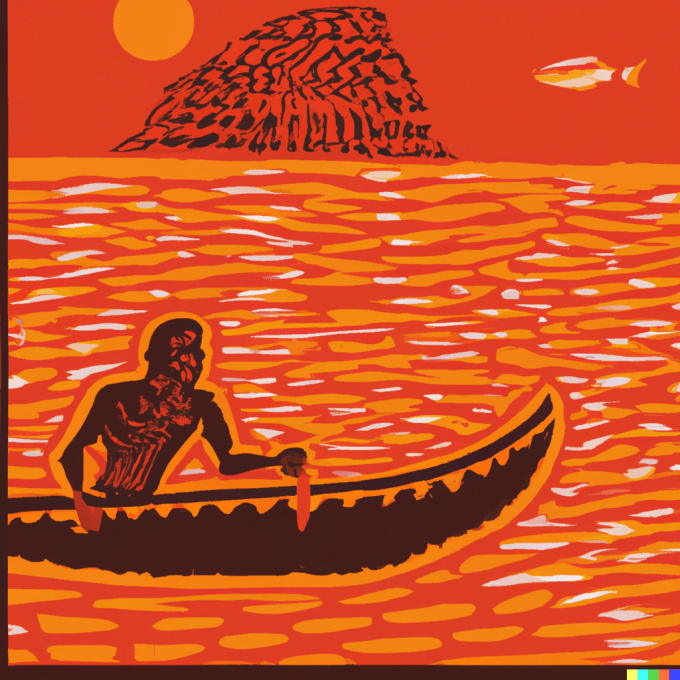
The Gadigal were primarily a fishing people, who made hooks from shells and carved bone, and often cast them from bark canoes paddled into Sydney Harbour.

“Sydney’s Aboriginals settled in areas very similar to the way immigrant communities settled in. Each different group had its own traditions and would invite each other over. It wasn’t that dissimilar from Vietnamese migrants settling in Cabramatta or Pakistanis in Lakemba.

“They were big meat eaters in winter and ate a lot of seafood in summer, when they would use the sandstone overhangs along the harbour for shelter,” said Ms Troy.

“When it got colder they had very lightweight and portable gunyas they would carry around and take further inland, where it was warmer.

“The First Fleet would not have survived without the knowledge the Gadigal people shared with them. They warned them off stone fish and showed them what leaves to avoid and how to prepare certain foods.

“I often come across something in day-to-day life in Sydney and think ‘the Gadigal taught us that’.”

She said Gadigal influences were evident in many words and place names we use today and, as the first language encountered by British settlers, they were exported back to Britain in descriptions of the land.

“It was pretty unique how the Gadigal people used to fish, and they would be all over the harbour gathering and hunting,” Des says.

“That’s the pretty unique connection with the Gadigal people that they belong to the waters as well. I’ve always felt a strong connection to the harbours and the foreshores.

“It’s quite special to be part of the Gadigal people given this was one of the first points of contact and from there things declined a bit with smallpox and other diseases.

“It’s special to be a part of that survival and continuation of culture.”

(Originally published in The Daily Telegraph)


It’s not all fun and games in social media

They say imitation is the sincerest form of flattery, but in the super-competitive world of social media the copycats go for the kill.

In digital, where the cost of developing products of your own is increasingly weighed up against that of simply mimicking someone else’s successful idea, a war is being waged over selfie filters.

At stake is the future of Facebook and Instagram, and the growing monopolies they control.

Because to stay relevant beyond the generation of millennials that have hoisted them up among the world’s most lucrative and influential companies they are desperate for a younger demographic.

Pioneered by Snapchat, filters (quirky, fun graphics superimposed on photos and videos) are in mobile phone terms the addictive equivalent to young people of making slime, collecting Shopkins or worshipping unicorns.

Four years ago Mark Zuckerberg offered $3 billion for the company in an “if you can’t beat them, buy them” approach, but was turned down. Since then things have turned nasty.

Evan Spiegel’s Snapchat app facially maps features and dubs them with moving graphics such as rabbit ears or sunglasses. Music and other special ­effects add to the variety.

They have been an enormous success for the company, recently valued at $30 billion, as were their “Stories” posts that lasted for 24 hours.

All of these features have been unashamedly imitated by their rivals.

Facebook and Instagram (which Facebook owns) even took the same name “Stories” for their daily picture and video collections. And by doing so they’ve eaten into Snapchat’s value and arrested its progress.

Instagram’s copycat filter has been so successful it boasts 200 million daily users, more than Snapchat’s.

Those waking up to Instagram’s new filters yesterday could not have failed to notice some appeared to be virtual copies of Snapchat.

As intellectual property rights expert Kimberlee Weatherall, from Sydney Uni’s law department, says: “No one gets to own a good idea.”

She added: “When it comes to competing over a great business idea there is no IP, no trademark, no Passing Off law that applies.”

But Snapchat isn’t the only trendsetter and ideas leader in the sights of Facebook and Instagram.

The company’s live video streaming functionality has already driven the originator, Meerkat, out of the market and blown its key competitor, Twitter’s Periscope, out of the water.

Using their enormous global audiences, Facebook and Instagram are increasingly flexing their muscles to drive competitors out of business and to even influence the news cycle.

Jonathan Taplin, author of Move Fast and Break Things: How Facebook, Google and Amazon have ­Cornered Culture, said yesterday: “Data is king… and they are in control of it.”

(Originally published in The Daily Telegraph)

No Australian should stand for inequality

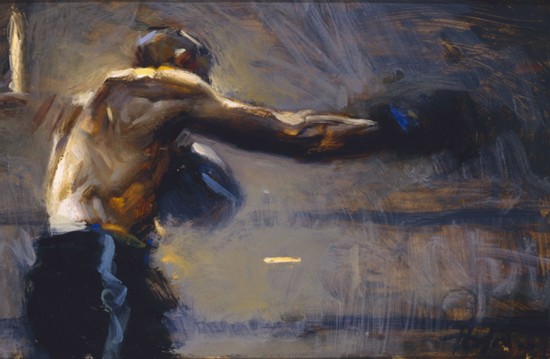
Trash talk precedes most big fights. Boxers have to sell seats and the more bums on them the better their payday.

Anthony Mundine’s no stranger to that. He’s been stirring the pot his whole career, drumming up business, psyching out his opponents, giving the public the loud mouth anti-hero some genuinely hate, while others look beyond the words to the fighter, the athlete.

Unlike most scrappers, though, Mundine has rarely wasted these opportunities (which are fewer and further between for him) by talking up simple rivalries.

Five years ago he caused controversy by disputing fellow boxer Daniel Geale’s very Aboriginality.

There has never been anything mundane about Mundine.

Instead he’s used that time as a platform to push debate around indigenous life and to hopefully change it for the better.

He has vowed to sit down during the playing of the national anthem at his rematch with Danny Green on Friday night, calling it “disrespectful” to his people.

And as an Australian, let alone an Aboriginal one, he has every right to do that.

If, as is mooted, promoters get around this by having the anthem played before he enters the ring it would be another stain on this country’s already tarnished history of race relations.

It would be a greater disgrace than what some perceive is Mundine’s snub to Advance Australia Fair.

Mundine should absolutely be allowed to get in that ring and sit on his seat while the anthem is sung. As the headlining boxer he deserves to have that moment – to be more than a piece of meat, making a small fortune for the promoters.

He deserves to be able to rankle the masses and let them know where he stands as an individual, and maybe make them think a bit longer about what it really means to be Australian – both white and black.

Our headlining Aboriginal sportsmen are the ones who get the most column inches when they speak on these issues, even though they are shouted down.

Adam Goodes, one of the most eloquent sports people when talking about racism and the toll of white Australia on native Australians, has paid the price. Derided, bullied, beaten down.

The fact of the matter is there has never been a level playing field for Aboriginals and Torres Strait Islanders in Australia, and we have a long way to go before we get one.

It is not, as Barnaby Joyce insists, about having to say ‘sorry’ for ancestors like his who came to the country as immigrants and had nothing to do with colonial massacres.

It’s simply about recognising things are not fair and working towards making them so.

It’s kinda in the title: Advance Australia Fair.

Only the anthem doesn’t mean ‘fair go’ it means things being nice, good, palatable.

Well it’s not ‘nice’ that indigenous Australians live on average 17 years less than non-indigenous. Nor is it ‘good’ that Aboriginal women are 58 times more likely to be held in police custody than white women. It’s not ‘palatable’ that suicide rates among the indigenous population are three times higher than for everyone else. It’s certainly not ‘fair’.

That’s not the fairness Australia is meant to be about. It’s meant to be about equality.

Equality for blacks and whites, for Asians, for women, for gays and anyone else born with the same irrefutable rights as the next person.

Mundine will continue taking the hits and speaking his mind. And I hope for all Australians, come Friday, that he is allowed to sit on his stool as the anthem rings out and make his point.

That would really advance Australia fair.

Lessons in the cost of silence

It seems wrong that the survivors of the Holocaust are generally only bracketed in the category of victims, and all that that implies. Helplessness, weakness.

Because in truth they are anything but that.

The survivor’s of one of the world’s worst ever acts of genocide have a strength that is difficult to put into words.

And the lessons they teach, cautioning against intolerance, have eclipsed the toxic legacy of Adolf Hitler and the Nazis.

Today their role in educating us about the environment that gave rise to the Holocaust and how governments can manipulate people against one another, is as important as ever.

Their input in teaching critical thinking is a rare boon for us here in Australia, but one with a finite window.

Now aged from their late 70s to 90s, when you meet these remarkable men and women you can’t help notice the twinkle in their eyes. The horrors they have witnessed have not suppressed their inner spirit.

To hear their accounts of survival under Hitler’s regime is much more powerful than to read it in a history book.

We all know the grim statistics. The six million Jews murdered in World War II, as well as the gypsies, Serbs and other persecuted minorities.

But for many Australians the reality of this seems very distant, an event that occurred, now, a long time ago, far away in Europe.

We would all like to think that we would not have stood by and let what was done to the Jews happen.

It’s unfathomable to us how so many could have turned a blind eye, while others were active in the persecution and many more showed little to no compassion for their countrymen.

Historians often cite British prime minister Neville Chamberlain’s disastrous appeasement of Hitler, but he was not alone. Appeasers, cowed into silence, in fear of conflict or punishment, were everywhere, at all levels.

And yet, Germany and other countries under the Nazi yoke, were highly educated, cultured places.

The way in which populations were manipulated over time – through propaganda and fear-mongering – to turn on the Jews remains an important and relevant historical lesson.

If it happened then, it could happen now. We are not that different from our forebears of the 1930s.

Speaking up, speaking out, both for ourselves and others, is not always easy.

Here on the streets of Sydney would you say something if you heard abuse yelled at a woman in a head scarf or two men holding hands.

Remind yourself of the cost of silence and, too, that one voice can inspire the courage in others to also speak out.

The Jews that survived the Holocaust, men and women such as Jack Meister, Yvonne Engelman, Olga Horak and Paul Drexler, have a white-knuckle story to tell, but also a powerful lesson in humanity and how quickly it can unravel.

If you have a bucket list of things you want to do in life, add something really meaningful to it and go down to the Sydney Jewish Museum in Darlinghurst Road and speak to a survivor. I tell you, it will blow your mind.

Listen to Olga explain how an act was passed overnight in her home country, the Slovak Republic, and authorities came the next day and took her 16-year-old sister from the family home. Hearing her say “we never saw her again, they sent her to Auschwitz,” will make your blood run cold.

Her account of life under the Nazis and their collaborators should be compulsory reading for all Australian school students. From her time at Bergen-Belsen (where Anne Frank died) and a meeting with ‘Angel of Death’ Dr Josef Mengele, to witnessing the devastation of the British firebombing of Dresden, Olga’s story is a rich microcosm of some of the key events of WWII.

And, though memories of that conflict recede in time, we should not waste the opportunity to learn from these incredible Australians in our midst.

They are people who lost almost everything, but rebuilt their lives here and, to this day, continue to contribute greatly to the community.

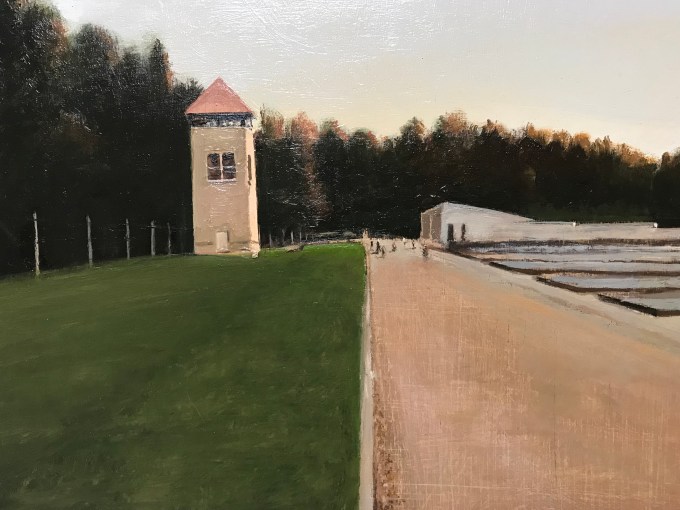
(Originally published in The Daily Telegraph. Painting: Dachau Memorial by Ivan Goodacre.)

Faking it… A dirty campaign to undermine democracy

Fake news comes from all sorts of sources. It’s often characterised as originating with rogue operators, unscrupulous websites cadging a living from Google AdWords or YouTube plays. But it’s not always from them, sometimes it’s from government agencies or political leaders who we are told to trust. Of course, politicians telling lies, governments misleading is in no way a new thing. We used to call it propaganda, which suggested bias but was often outright lying. The Nazis were expert at it, but the ‘good guys’ often used it too.

Today we would call Baghdad cabbie Rafid Ahmad Alwan’s assertion that Saddam Hussein had mobile biological weapons labs as ‘fake news’. It was a charge that in 2003 the US and Britain used to justify the invasion of Iraq. Both governments had been told he was a congenital liar and his claims didn’t stack up, but they ran with the story anyway because it neatly fit their agenda.

This week we were treated to the unedifying claim Donald Trump watched Russian prostitutes urinate on each other in a Moscow hotel room. We were also told Russia was blackmailing the president-elect with a dossier of dirt – essentially making him some type of Manchurian candidate.

The entirely unsubstantiated information was compiled by ex-MI6 agent Christopher Steele, who runs a security company in London called Orbis Business Intelligence, for a political opponent of Trump’s.

The fact a US security agency may have leaked the information on the eve of Trump’s inauguration says a lot about the incumbent government’s desire to influence or derail the incoming government’s relationship with Russia.

Russia incidentally has been portrayed for the past four years as some kind of rogue, expansionist state, rather than one reacting to provocations from outside its borders.

Buzzfeed, which was handed the leaked info, did what pretty much any media company would do and ran it, saying the public could make up its own mind. Of course saying that whilst presenting no balancing information creates a dangerous environment for a large section of the population to believe it.

When information is presented with the caveat ‘make up your own mind’ it invites multiple interpretations. There’s also the distinct danger the reader will form an opinion based on what they might already think of the people involved, i.e. Trump is a gauche, chauvinist, therefore the allegations are believable.

But this is where governments and other agencies have always cleverly used the media to give fake news an air of credence.

We in the media, generally speaking, are better at repeating information than analysing it. Most media organisations lack the critical facility to scrutinise the motives behind leaked information, so happy are they just for the opportunity to set the agenda and break a big story.

The other insidious thing the release of the dodgy dossier on Trump did was to allow the media to validate the claim Russia was involved in hacking the Democrats and influencing the result of the presidential election.

The Democrats, still smarting at their loss, would love everyone to believe this was true. That their loss was the result of a conspiracy and that Trump is actually an illegitimate leader.

Trump had steadfastly denied Russian involvement, as had Russia, as had Wikileaks – which in October released thousands of the emails.

In terms of fake news we’ve seen this snowball effect before, in Libya and in the build-up to the second Iraq war, where one unproven claim gives way to another, to the point where there is a concession that some of it must be true. Where there’s smoke there’s fire – not always.

And so some of the media glibly reported Trump had accepted Russian involvement in the hacking of Clinton-aide John Podesta’s emails.

Trump, clearly feeling the pressure of attacks that had turned personal, said: “As far as hacking, I think it was Russia, but I also think we’ve been hacked by other countries, other people.” He then backtracked adding “you know what, could have been others also”.

The key allegation against Russia presented in the report by America’s Office of the Director of National Intelligence (ODNI) is the hack of the Democratic National Committee used identical methods to a previous alleged hack by Russia.

However, many hackers download pre-programmed scripts available on any exploit database and anyone using them would display the same features. A hacker in the US using a VPN (Virtual Private Network) located in Russia and accessible by anyone on the internet can appear to be staging the hack from Russia, despite being in the US.

Activist Alex Poucher, a professional hacker, claimed from his own detailed analysis of the ODNI report it was not possible to tell where the hack had originated or who was behind it.

He said: “At the end of the day, an insurmountable heap of circumstantial evidence is all this report is, without any proof to back up any of the claims whatsoever, except hearsay.

“I have personally [gone] over every aspect of the attack and what I can tell you, what I have found is that every aspect of the attack, the entry or the payload, is not particularly sophisticated. A 14-year-old script kiddy with download capabilities could have pulled off this hack.”

What we are left with are a lot of untestable allegations (hot air), all designed to discredit Donald Trump’s presidency.

All you can do is ask: Who benefits?

Long Tan row reminds Australia of the differing perspectives on war

We call it the Vietnam War, but in that country it’s popularly known as the Resistance War Against America or the American War.

It has never in Vietnam been regarded as a noble confrontation between two legitimate foes, but a tooth and nail fight for survival against a foe seeking nothing less than subjugation.

That’s why the decision by its government to limit Australian involvement in a memorial service commemorating the 50th anniversary of the Battle of Long Tan should not be such a surprise to us.

While the Vietnamese have been more keen than anyone to put the 20-year war behind them, that doesn’t mean its forgotten and it doesn’t mean the repercussions from it are still not felt.

It’s estimated close to 600,000 civilians were killed in the war, many in intensive carpet bombings of small villages. Military deaths on the North Vietnamese side are estimated between 444,000 and 1.1 million. The South Vietnamese, fighting with the allies, lost between 220,000 and 313,000 soldiers. Over 1.5 million civilians and fighters were wounded.

By comparison around 58,000 US troops died and 521 Australians.

For 10 years from 1961-1971 the US dumped millions of gallons of toxins on the country to defoliate jungle areas and reduce hiding places for the North Vietnamese. It affected some 5 million people. To this day children are still being born with deformities attributed to the long-term affects of Agent Orange, while those directly exposed to it have suffered from cancer, skin and nervous disorders, liver damage and heart disease.

Though the war ended in 1975 tough economic embargoes imposed by the US lasted until 1995, further damaging the country.

It’s a human right to grieve, no one should be denied it. But it’s difficult for us as a nation, Vietnamese Australians excepted, to properly understand the turmoil and destructiveness of that war to the people of Vietnam, Cambodia and Laos.

Our own perspective has been very different, watched from afar.

The after affects for us, our soldiers dealing with post traumatic stress while serious and significant, pale alongside the suffering experienced by the Vietnamese.

There is nothing malicious or deliberately insensitive about Australia’s view of the war, but we just can’t know what they know.

The Vietnamese for decades have facilitated good relationships with Australian war veterans. They have shown they not only don’t have a problem with Aussie war vets memorialising our soldiers deaths, but they have also helped us do it.

Matters came to an uncomfortable head on Thursday  over the involvement of 1,000 Australian mourners at the Long Tan ceremony, which the Vietnamese government cancelled in favour of a smaller service.

It didn’t happen because of the Vietnam government’s insensitivity to our soldiers, more their sensitivity to the history of their own people and how they have been treated by foreign countries, including the imperial regimes of China and France.

Despite the Australian government’s claim the Long Tan ceremony had been agreed well beforehand, it is clear the large number of Australians planning to visit the site was felt to be inappropriate. Instead small groups were let in.

Some Australians reacted with outrage at the decision. Veterans associations described it as a “kick in the guts”. The Turnbull government jumped into negotiate a compromise. But not much could be done. A raw nerve had been hit.

In Turkey, the annual memorial to the Australian fallen at Gallipoli has become a significant and large scale pilgrimage by Australians. Super-sized TV screens are set up around the site as thousands of Australians journey there.

The Turks themselves have been incredibly magnanimous. They appreciate the significance to Australians of this battle above all others in any war we have fought in. They were also the victors on that occasion, repelling the Allied invasion, and a century after it happened few, if any, are left alive who remember it.

I don’t doubt the Vietnam government wants to avoid a similar scenario where the grief of the Vietnamese is overshadowed by large numbers of Australians mourning the deaths of our own war dead – and at Long Tan that was 18 soldiers.

It is a matter of perspective.

In Australia’s enthusiasm to reconcile past conflicts and to gain a degree of closure for our veterans we perhaps don’t get how that war affected Vietnam and how it still resonates with them, in a way that is very different from us or from events in WWI.

The reaction to the Long Tan anniversary is a reminder to us that the right of a people to grieve and memorialise their past in their own country outweighs our right to travel there and do the same.

As a nation we need to appreciate the wounds of Vietnam run deep on both sides.