Ukraine reporting shows bias of Western media

In the space of a few months Ukraine has been embroiled in two uprisings.

Both have appeared equally legitimate, both have been bloody and both have had the backing of differently aligned foreign governments.

So why has the media characterised the US-backed one as a democratic right and the other as troublemaking by Russia?

And why does one bloody crackdown provoke press outrage and another not?

Reporting on Ukraine has been singularly one-sided with the media and the government moulding public perceptions by omitting information, or slanting it one way or another.

At the height of the first uprising in February Viktor Yanukovych was portrayed in the strongest terms as a corrupt leader responsible for killing civilian protestors. Those civilian deaths were seen as a catalyst for a change of government by force.

There has been no such outrage expressed for the more than 100 pro-Russian separatists killed by the new government, the most recent in heavy-handed attacks on Donetsk.

The Maidan protests, backed by the US, Germany and Britain, have been given fair, at times favourably biased, coverage, while those of pro-Russians have been scandalously under-reported or ignored.

More so the language used to describe each varies damningly.

It has been accompanied by a concerted and completely over-the-top demonisation of Russia, which culminated last week in Prince Charles comparing Vladimir Putin to Hitler and ‘Red’ Ed Miliband seeming to support the remarks.

Opponents of Yanukovych were often described in the media as peaceful protesters, despite scenes of some of the most ferociously violent attacks on Ukraine’s police – attacks for which the only UK parallel might be the Broadwater Farm riots in which PC Keith Blakelock was murdered.

In Kiev 16 police officers were killed by protesters. Can you imagine the reaction to that if it had occurred in Britain?

By contrast the western media routinely describes pro-Russian separatists as rebels, militants, insurgents, Chechens, terrorists, militia.

It is often slyly suggested they have less claim on being Ukrainian, that they are insurgents from across the border or puppets of Russia, despite the overwhelming evidence that they are local, multi-generational Ukrainian residents with real gripes against the new right-wing government.

Earlier this month a fire in the Odessa Trade Union building killed 38 pro-Russian protesters, but the media quickly accepted the Kiev government’s claim they were killed by a blaze they had begun.

Pictures of teenagers merrily making molotov cocktails outside the building didn’t change the media’s attitude. Nor was there much comment on the chants about roasting ‘Colorado beetles’ (a derogatory term for the pro-Russians) that rang out as the protesters burned. Video showed those trying to flee the blaze set upon by right-wing thugs.

The apparent strangulation murder of a pregnant women in the same building in a room in which government supporters unfurled a flag out the window, has not been investigated or commented on in the press.

And though video evidence emerged on the web of government supporters in collusion with police staging false attacks dressed in pro-Russian armbands it was not written about or reported in the mainstream media.

The truth about what happened at Odessa has only emerged through social network sites.

Instead there was an overriding willingness by press, broadcasters and online news groups to not blame government supporters for the deaths and to quickly move on.

By comparison the shooting of civilians during riots in Kiev against Yanukovych were denounced in the harshest of terms around the world. Germany and the US piled pressure on the government with threats of sanctions, and when Yanukovych eventually retreated from the capital an arrest warrant was issued accusing him of ‘mass murder’.

Days later, when a leaked EU phone call raised the prospect some civilians may have been deliberately shot by the Maidan opposition to inflame the situation, little was said. An investigation by the new authorities into deaths in Kiev during the protests has so far gone nowhere.

Each day across Ukraine’s restive east more and more pictures are posted on Twitter of the bodies of civilians  – middle aged women, casually dressed men – lying dead by the roadside.

But how many do we see in the press, on TV or online news agencies?

Typically such reports are omitted or tempered with claims of trouble being stirred up by Russian infiltrators – legitimising the killings.

It’s a common propaganda technique, but we see it more and more from our governments and our media.

While the referendum in Crimea and the east for more autonomy was decried as illegal by the West and reported as such, the election of a new government in Kiev has been given legitimacy by the world’s media, even though breakaway regions boycotted the vote.

Residents in those regions have now been dubbed ‘bandits’ and ‘terrorists’ by the newly elected hardline president Petro Poroshenko.

Underlying the entire conflict are claims the US encouraged the Maidan revolution to create another Nato state on one of Russia’s most sensitive borders, and where its Black Sea Fleet is moored at Sevastopol in Crimea.

In the press Russia’s subsequent annexation of Crimea was denounced as a shameless land grab and Vladimir Putin accused of trying to rebuild the old Soviet Union.

Despite there being a majority of Russian citizens living in Crimea and clear parallels with the Nato-backed independence of Kosovo, relations between Russia and the US deteriorated to the point of talk about a new Cold War.

That has filtered down to the man in the street and one in the palace.

Ironically, the groups now in control in Ukraine are more right-wing than any European government since the Nazis.

But this bias in the media has existed for a long time and extends beyond the Ukraine today.

Reports on the Syria conflict are horrendously one-sided. Unsubstantiated charges of chemical weapons use by the Assad government are reported as fact.

The killing of pro-Assad voters at an election booth last week given no more than lip service.

Yes Assad has committed some terrible acts, but what of the al-Qaeda groups ranged against him? What of the beheadings, the mass killings, the torture and religious discrimination they have brought with them?

When rebels fighters deliberately cut off the water supply to 2.5million residents of Allepo a fortnight ago, only The Independent reported on it. Even Ban Ki Moon’s condemnation of this act went unreported in the mainstream media.

Similarly there has been no outrage about the Kiev authorities attempts to cut off the water supply to the Crimea.

These are actions that can force a humanitarian crisis, and yet there is no outrage and the general public remain uninformed.

Going back to the reporting on the Balkan wars, Serbia was demonised and accused of ethnic cleansing and running rape camps. The latter was not proven and the former described tactics used across the board by all sides in the conflict.

And while the massacre by the Bosnian-Serb army at Srebrenica is the worst and defining atrocity of the wars, little is ever mentioned of the 50 villages razed to the ground and 5,000 Serb civilians murdered by muslim raiding parties in the same region in the run-up to it.

Decades on Serbia is still characterised simplistically as the bad guy while equally reprehensible war crimes committed by other sides barely get mentioned. To do that would muddy the narrative that the media demands.

Having worked in Fleet Street for almost two decades I know there is no one pulling the strings. There is no secret plot to subvert particular information while promoting the other.

No one calls up editors to exert pressure, and nor do the editors dictate to their journalists. And yet with great predictability they fall in line with a prevailing mood.

The media promotes a concept of good and bad, with no in-between.

It needs a simple, familiar narrative for its readers to understand (perhaps for its journalists too), one that is often, although not exclusively, still based on old world prejudices.

Known story patterns are repeated with rare deviation.

Passion, outrage and righteous indignation sell papers and (today) get page hits.

But what of the full facts? What of the other side of the story?

Our written history is at risk if it is based on the perception given by media and governments pushing their own blinkered or negligent agendas rather than the true, full story.

Nowhere is this hypocrisy more evident than in the current reporting on Ukraine.

(Originally published in The Huffington Post)

Salivating press won’t let fantasy get in way of ‘serial killer’ story

Her story came out of the blue. A seemingly unnecessary, unprompted confession to a local newspaper reporter that she had committed anywhere between 22 and 100 murders.

In the general run of things such admissions are normally made to detectives, psychologists or prison pastors, and checked over before any such notion is taken to the press and the public.

But from the out self-confessed serial killer Miranda Barbour’s story was front page news.

More than two months after her arrest Sunbury’s unprepossessingly named newspaper The Daily Item obtained an interview with the 19-year-old after much shenanigans with local prison authorities.

By this time, while not known outside of East Coast America, Barbour was already big news in the small Pennsylvania town.

Nestled behind an imposing flood wall on the Susquehanna River near the point it empties into Lake Augusta, Sunbury has a population of less than 10,000 people, limited job opportunities and a burgeoning drugs problem.

For a small place it has its fair share of problems with residents more than twice as likely to be the victim of violent crime than the national average. But while having a disproportionate number of rapes and assaults the murder of Troy LaFerrara on 11 November last year was still out of the ordinary.

The 42-year-old married man was lured by an advertisement for sex on the Craigslist website and allegedly stabbed to death by Miranda Barbour as her husband of three-weeks, Elytte, strangled him with a cord from the backseat of their car.

The Daily Item seized on the tale, running some 36 stories in the paper and online between Barbour’s arrest and her eventual ‘confession’ to reporter Francis Scarcella.

Because of the couple’s supposed interest in Satanism the paper ran at least two stories reporting on and theorising about Satanic links to the murder.

Barbour having read the extensive coverage of her case in the Item wrote a letter to the paper requesting a meeting on 7 January. It was initially denied by the Northumberland County Prison authorities but after calls for staff to be stood down for breaching the prisoner’s rights it went ahead on 14 February.

It may be fair to surmise that at this point Barbour had already made up her mind about ‘revealing all’ to the paper and had either held back from talking to the authorities or never intended to, despite another five weeks passing.

She told the Item she was a serial killer and had stopped counting after 22 murders, but added that she had killed less than 100 people.

Barbour also claimed to be able to pinpoint each of the murders and lead investigators to the bodies.

By going to the press first she ensured her outlandish claim would get prominent exposure even if it later fell apart under scrutiny.

Police had no choice but to take it seriously and investigate fully, especially as they already had one murder on their books she had been charged for.

Within hours The Daily Item’s grisly scoop was making headlines around the world and Barbour was being billed as possibly the worst serial killer in America’s rich history of psychopaths.

In the UK the Express asked ‘Is this the world’s worst serial killer?’ (Harold Shipman.. Luis Garavito anyone?)

But despite the police having had no time to test the validity of her claims few media outlets cast doubt on the story.

Having played on fears of Satanism in the weeks following the ‘thrill killing’ of LaFerrara The Daily Item’s prison interview revealed sensational claims of Barbour’s induction into a Satanic cult at the age of 12 in North Alaska and her first murder committed the following year with the man who had recruited her.

Despite professing to be one of the devil’s acolytes Barbour contradictorily told the paper she only killed ‘bad people who do bad things’ and so was justified.

For most law enforcement officers, however, the mere mention of Satanic cults is generally met with eye rolling. A popular unfounded fear in middle America the existence of such groups in any real sense is extremely rare. It is far more common that claims turn out to be the figment of the imagination of delusional, often mentally unstable individuals.

The killing of LaFerrara too did not sit easily with the tale of a young girl committing regular murders for several years without raising an eyebrow of suspicion or leaving a trail of bodies behind her, as she claimed to have done across Alaska, Texas, North Carolina, Pennsylvania and California.

To get away with such a spree would require extreme care and cunning.

But the LaFerrara murder was anything but clever. The alleged killers, having placed a traceable ad on Craigslist, were in phone contact with the victim and left their 2001 Honda CRV dripping with blood. Not even the cleaning fluid and towels they were caught on CCTV buying shortly after the murder were enough to wipe away the evidence. And having killed LaFerrara they then dumped his body in an alleyway where it was quickly found.

This was the most telling indication that Miranda Barbour had made up her killing spree.

But the media attention did not abate and, instead, latching on to her claim to have only killed ‘bad people’ some media firms enthusiastically branded her ‘The Dexter killer’, after the fictional TV serial killer who murders only other baddies.

Nevermind insulting the dead and that her only known ‘alleged’ victim LaFerrara had done nothing worse than answer an online sex ad.

To this day Barbour has provided no credible evidence to detectives of any murder other than the one she has been charged with.

As scepticism grows around her story, the infamous murders of her home state serial killer Robert Hansen (the story of which was recently made into the movie The Frozen Ground with Nicholas Cage) might have inspired her to make up the story. Her incarceration also coincided with British serial killer Joanna Dennehy’s boastful and unapologetic admissions of three brutal knife murders of men she felt slighted by.

While inquiries continue, the question remains could she have been involved in any previous killing?

Given her frenzied attack on LaFerrara, you may say it’s possible.

But if she has, it cannot be on the industrial scale claimed and it’s more likely the police have caught her at the start of a spree rather than the conclusion of one – her claims being nothing more than attention-seeking fantasy.

For the media, who too readily embraced a big story that defied all conventional logic, the question is will they be more scrupulous next time or have they, in the drive to sell more copies and generate more online page hits, forever sacrificed getting it right first time round in favour of enticing in readers?

(Originally published in The Huffington Post)
New Literalism: How internet misfittery is warping the news

Someone apologised on Tuesday, although they hadn’t done anything wrong.

Unusual you might say, but it’s something we’re going to see a lot more of.

The reason for that is we have come to a time when misinformation, supposition and the tidal bores of online outrage are treated in the media with the same reverence as fact – provided they have an audience.

In the massively expanded and ever expanding world of online social networking and commentary there is now a sizeable section of the community who take everything they find on the internet at face value and who do not inquire. This amorphous, shape-shifting group regards what they see online, mistakes and all, literally and farms it out as fact to their connections.

Context has been thrown away for many people online and in its place is a new and dangerously ignorant reality.

By the time art collector Dasha Zhukova issued her grovelling apology on Tuesday afternoon for having been photographed sitting on a Bjarne Melgaard chair in the form of a black woman, millions of people around the world had already got a completely wrong opinion of her.

It was fuelled by the media, who reported the ‘outrage’ of regular people, which it then stoked and re-reported on. Many publishers seemed to leave out crucial information that would have explained the context of the photo, perhaps to not diminish the suggestion of racism.

Some punters even thought the chair was a real woman, made to pose semi-naked in subjugation.

And as if the existence of the picture, published digitally on the pop culture website Buro 24/7 about Garage magazine (of which Zhukova is editor), might not be enough to stir people up, others proffered that it had been doubly offensive coming on Martin Luther King Day (or MLK Day).

Nevermind that this was a Russian website and MLK Day is only celebrated in the US, and oddly Hiroshima and Toronto, and that elsewhere in the world few people are aware of it.

Online those boundaries are forgotten and made indistinguishable.

The digital community in the US, and quick to follow the media, quickly concluded this was some added racist slight by backward Europeans.

And because of this US-centric addition to the controversy the rest of the world suddenly was given the impression that the entire event had occurred in America rather than in cyberspace somewhere over the Urals.

Few people saw it for what it was – an edgy piece of political art designed to underline Zhukova’s serious industry credentials as a collector of modern art.

Not everyone’s cup of tea, sure, but not a malicious or even clumsy act of bigotry.

Created by the New York-based Norwegian artist and sculptor Bjarne Melgaard the piece first appeared at a Paris exhibition last year, titled Empire State, New York Art Now.

Because it deliberately and closely referenced the 1960s forniphilia (human furniture) works of British sculptor Allen Jones, who created similar works with white women as subjects, it was not at the time regarded as racist.

At the height of Pop Art Jones, now aged 76, created a series of furniture pieces based on bound white women, that inspired the sexualised female props in Stanley Kubrick’s A Clockwork Orange.

But in Tuesday’s digital furore few knew this or bothered to find it out. Instead this one unexplained picture fuelled a completely unnecessary racism row.

Zhukova, the partner of billionaire Roman Abramovich, and the publishers of Buro 24/7 fell on their swords, aware once the ball was rolling no sensible explanation would be enough to satisfy the online hornets’ nest that had been stirred up. While drawing a line under it their apologies, though, only gave those way-off claims of racism the appearance of credibility.

On Wednesday, the story is front page news and the truth even more obscured amidst the blustering, ignorant hubbub.

But this is hardly an isolated incident.

Increasingly misinformation peddled online is being repeated enough to make people believe it. And if enough people believe it the media starts to report it as though it were real.

In the past week a picture reportedly of a Syrian child sleeping between the graves of his parents swept the internet. It seemed to perfectly and dramatically underline the futile loss of lives in the Syrian conflict and further condemn the country’s leadership.

The only problem was it wasn’t a Syrian child and they weren’t graves. The picture set up and taken in Saudi Arabia by an artist had been appropriated because it fit the subject matter the original disseminator wanted to convey.

When photographer Abdul Aziz al Otaibi contacted the person who had first deliberately misrepresented it on Twitter as an example of Syrian atrocities, the response he got was: “Why don’t you just let go and claim it is a picture from Syria and gain a reward from God.”

The damage, in any case, had already been done with more people viewing the viral image than will ever read the truth about it.

On a less important level this week there was also the ‘bikini bridge’ hoax, picked up by the mainstream media as fact.

Writing in the Telegraph, Radhika Sangani noted: “Apparently all it takes for the internet to believe something is a trend is a few celebs tweets, blog posts and a hashtag.. behind all of this is something much darker: we all believed it because it sounds plausible.”

And commenting on the number of hoax YouTube videos reported as fact in the press last year Caitlin Dewey in the Washington Post described 2013 as “the year the media decisively elevated social media phenomenon, real or imagined, to the level of actual news”.

She cited the cheapness of sourcing it, the growth of social media and the lust for page views – tactics pioneered by high turnover news sites like Mail Online.

The often valueless sourcing of opinion from Twitter has meant you can find anyone online for comment on a particular angle to a story.

Gone are the days where a journalist would always seek out an expert in a field for their view. Now they take their pick from any number of anonymous postings, no matter how ill-informed, biased or stark-raving mad they are.

Reaction, any reaction, is reportable, no matter how right or wrong it is.

And now that everyone has a voice to express themselves the new literalists even make objections to the use of metaphors. No article can run online today describing a rivalry as a ‘war’ without several po-faced readers commenting self-righteously that war is nothing like that and the author’s an idiot for suggesting it.

The value of harnessing an online audience for news outlets has never been greater. We now measure the success and therefore the value of companies by the membership or readership they command. And it is so large now papers and broadcasters are unable to preclude it from mainstream news.

Unfortunately the upshot is facts, context and the full story have increasingly become a casualty.

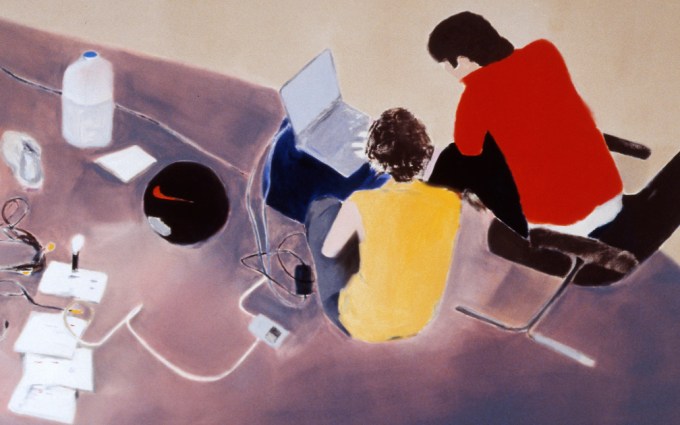
(Originally published in The Huffington Post. Illustration: Internet Painting by Miltos Manetas)

Hermaphrodites fight for rights and recognition

“I grew up with no role models,” says XXXora, as she flicks her black hair from her face.

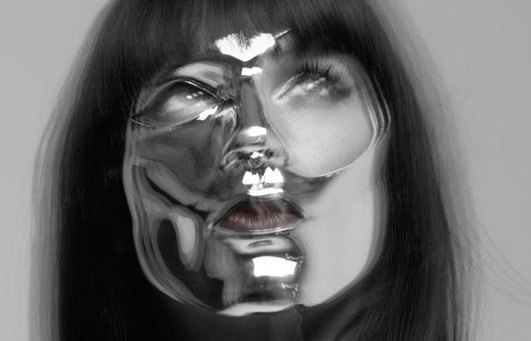
“I’ve had to live in the binary. Now I only ever dress in black and white. It’s my political statement. I do wear a silver mask. It makes me feel comfortable, safer, confident, I feel very vulnerable not having anything.”

I describe XXXora as ‘she’ and ‘her’ because it’s simpler for me to do that. I’ve not been taught any other way and I’m not sure how to explain her accurately with the appropriate personal pronoun. This is the loophole in the gender ‘binary’ that treats all people as either male or female.

The 33-year-old artist looks, acts and dresses like a woman, but she knows she is more than that, being one of the 30,000 plus people in the UK born with ambiguous sex organs – male and female.

Raised as a boy by her working-class Spanish parents she grew up in Ealing, West London, consciously uncomfortable wearing male clothes. She went through art school at Goldsmith’s College living as a man but later switched to a female persona, with which she more readily identifies.

Now comfortable in herself XXXora is in a stable relationship for the first time and is using her art to further inform and campaign on rights for ‘unisex’ people (the newly preferred term). 

She no longer refers to her previous male identity, but rejects being described as either male or female – and wants the government to recognise her as both, with a legal addition to official gender categories.

Exhibiting over the past two years, her art work focuses on androgyny and naturally occurring hermaphroditic species – flora and fauna, which she uses to bring greater awareness and promote more debate on the topic.

Her latest show, the Captured Hermaphrodite, finished on Friday in the City of London and she was last week nominated for an emerging talent prize at the Southwark Art Awards.

“Most people do not realise quite the number of hermaphroditic species that occur naturally in the world and so this show is an entertaining yet also an educative experience,” she says.

“My physical aesthetic and my work is always in black and white.

“I will continue to enforce these unnecessary binary limitations on my work and appearance until the UK recognises the hermaphrodite in law and adds a third box to the category of gender in passports, following in the footsteps of countries like Australia, New Zealand and India. 

“Evidence that the hermaphrodite exists is obviously overwhelmingly supported by science yet our society and its laws still ignore people like me.”

And she is not alone in wanting change. 

There is a growing recognition of the inadequate and often damaging treatment given to children born with both male and female sexual organs.

The medical community has long regarded hermaphrodism as something that can be ‘solved’ (Disorders of Sex Development – DSD) by corrective surgery or by picking what gender to raise a child based on the extent of their physical development. This is usually decided not long after birth and within the first 18 months of a child’s life.

Damagingly, it doesn’t take into account a person’s natural sexual inclination, which does not manifest until much later. And so many unisex children, like XXXora, are raised as a gender they don’t identify with, leading to confusion, depression and feelings of shame. 

To further complicate the situation it has been accepted medical practice in some quarters to keep the truth from the individual and sometimes the parents.

Dr Jay Hayes-Light, of the UK Intersex Association, says one in 2,000 people worldwide are born with ‘ambiguous’ sexual organs, making it a more common phenomenon than cystic fibrosis or autism.

He adds: “Currently, the UK does not recognise gender markers other than ‘male’ or ‘female’ on official documents such as passports although it is likely that this will change in the future.

“Those intersex people who identify as neither male nor female are in the minority in the UK. 

“Most intersex people do have a distinct gender identity as either male or female (irrespective of anatomy). What is important however, is that the government acknowledge that some do reject binary sex labels.”

Back in 2004 Dr Naomi O’Keefe, a psychologist from Argosy University in California, testifying on human rights violations against hermaphrodites, noted that much psychological harm was done to intersex people because society continued to keep it hidden behind a veil of secrecy and shame.

Meanwhile, Zwischengeschlect.org, a human rights advocacy group based in Germany, has attacked what it calls the extermination of hermaphrodites through corrective surgery, arbitrary decisions made at birth about the most appropriate sex to raise children and an unwillingness to speak about the issue.

It noted: “By the end of the 20th Century, after 50 years of systematic surgical and hormonal ‘corrections’ and ‘repairs’, as a species hermaphrodites are virtually extinct, both in real life and in public perception.” 

The group advocates respecting the physical integrity of unisex people and the self-determination of children born with atypical genitals.

The term hermaphrodite derives from the mythological Hermaphroditus, the son of Greek gods Hermes and Aphrodite, who was fused with the nymph Salmacis.

While there are lesser manifestations of it, ‘true’ hermaphrodites have a completely different chromosomal make-up to men and women with their karyotype having both XX and XY chromosome pairs.

In her art XXXora (her pseudonym a reference to chromosomes not porn) also focuses on human subjects that are androgynous, either by nature or deliberately. Stars like David Bowie, Marilyn Manson and Lady Gaga or women political leaders who take on male traits: Margaret Thatcher, Golda Meir, Hillary Clinton.

“These for me are the only role models I could even grasp,” she says. “People who displayed androgyny. The question is did these people display androgyny viscerally, are they innately androgynous, or did they manipulate their gender variance for other reasons.

“Performers like Lady Gaga have used that androgyny to further their careers.” 

Other works by XXXora include an oak tree (another hermaphrodite species) intertwined with bodies. There is a recurrent theme of torture in her art that draws on Hieronymus Bosch and Francis Bacon. Clerical liturgy is represented as insects, irritants attacking the populace – a comment on the church’s unwillingness to even acknowledge unisex people.

These images convey both optimism and pain, and while XXXora is outwardly well-spoken and quite flamboyant (recently disrupting a Damien Hirst launch at Blain Southern’s Candy exhibition in Hanover Square by leaping into a large pile of sweets – an untitled work by Felix Gonzales-Torres) there is an awkward shyness there at times that hints at her struggles.

She intends to create works for the rest of her life on the theme, taking as her inspiration the thousands of naturally occurring dual sex species.

“When I was younger I was put into a boys school,” she says. “I had predominantly male organs so therefore the decision was made that I had to live like that, but it’s not my instinct in any way shape or form. Sexually, I feel completely feminine.

“My works show the slaughterhouse of being a hermaphrodite today.”

(Originally published in The Huffington Post. Photo of XXXora)

Groundhog Day for the Middle East

We’ve seen it all before. It’s like Groundhog Day, the location is different – Syria not Iraq or Libya – but the rhetoric remains the same.

While the discredited ‘Weapons of Mass Destruction’ mantra is gone, in its place the same humanitarian tipping point pared down – chemical weapons.

It is widely agreed that historic stockpiles of chemical weapons still exist in military facilities in Syria, but there has been no evidence of the Assad regime carrying out the attack on Ghouta or any other locations.

There have been indications, however, over the past year that Syrian rebels themselves may have obtained, tested and even used chemical weapons.

In May it was reported members of Syria’s militant Al Nusra group were arrested in Turkey with 2kg of sarin. While in July a Turkish jihadist site claimed rebels had obtained chemical weapons from a military base they had overrun in Allepo.

Further back in 2012 of last year the purported rebel faction Kateebat A Reeh Sarsar (Brigade of Chemical) released a propaganda video showing poison gas tests on rabbits.

The video showed an array of chemicals from the Tekkim company, including sodium nitrite, potassium permanganate and potassium chlorate (all oxidisers that can be used in the creation of gas). Masked militants threatened to use them on Assad’s people if the West did not intervene.

But this isn’t talked about.

William Hague instead insists the rebels have no chemical capabilities and do not possess the ‘weapons systems’ or motivation to deliver them.

In saying this he ignores documented evidence of the rebels use of median range rockets, never mind the fact sarin nerve gas (if that’s what it is) can be disseminated into the atmosphere using a simple handheld humidifier (something the Japanese doomsday cult Aum Shinrikyo demonstrated in its 1994 attack over a wide area in Matsumoto that killed eight and injured 200).

On other points the Foreign Secretary has misled.

“Over the past year we have seen evidence of the repeated small-scale use of chemical weapons by the Syrian regime,” he said.

In actual fact there has been no documented evidence of the Syrian government using chemical weapons against the rebels, only the claims of the rebels.

An investigation in May by the UN Independent Commission of Inquiry on Syria into an alleged attack by the Syrian government on a rebel area concluded that it was in fact probably carried out by the rebels.

The UN’s Carla del Ponte, one of the world’s most respected war crimes investigators, said: “There are strong, concrete suspicions but not yet incontrovertible proof of the use of sarin gas, from the way the victims were treated. This was used on the part of the opposition, the rebels, not by the government authorities.”

Despite this previous finding of rebel groups possibly gassing their own people and then blaming Assad, Britain, France and the US have stuck steadfastly to the line that the rebels could not kill their own people.

No evidence has been produced, nor a motive for the Syrian government carrying out an act that would almost guarantee Western military intervention.

For it to happen on the day weapons inspectors arrived made even less sense.

Over the past few months the Syrian government has staged several convincing defeats of the rebels, recapturing the city of Qusair and the Baba Amr district of Homs.

Though the New York Times reported in February that large shipments of arms, paid for by Saudi Arabia, had been smuggled to the rebels across the Jordanian border, the Government still enjoys overwhelming military superiority.

It begs the question: Why would the Assad regime need to deploy chemical weapons at all?

Since Saddam Hussain’s gassing of the Kurds in Halabja in 1988 there have been few more incendiary actions to initiate then a chemical attack. Any government in the world understands the significance of it, but so does the opposition.

The prospect of Colonel Gaddafi using chemical weapons was also raised in the build-up to bombing Libya, further demonising a regime that had primarily been criticised for shelling rebel towns in its civil war. Gaddafi was repeatedly accused of breaking a ceasefire with rebels, even though it was clear from reports by journalists on the ground that the rebels were continuing to attack government positions.

Rebel groups have learnt how to get the upperhand in the PR war against their enemy, particularly where it fits in with foreign policy objectives in the West. Such tactics have been honed since the Yugoslav conflict, when Bosnia and Croatia, and then the rebel ‘Republic of Kosovo’ were represented by American PR firms such as Ruder Finn, who lobbied on their behalf in the US.

Unquestioning acceptance of the inaccurate and of the unsubstantiated has become the norm.

Even the alleged death toll of up to 1,300 from the chemical weapons attack in the suburbs of Ghouta remains unproven and backed mainly by YouTube footage. Doctors Without Borders have independently estimated 355 dead.

And yet the higher undocumented figure is still repeated ad nauseum to further dramatise the tragedy and increase the drive for military action.

Without wanting to suggest there wasn’t a gas attack (because there clearly was) there has been a lack of the most basic factual indicators including no autopsy findings of the physiological changes that sarin gas causes in the human body. In the rebel-controlled area where it occurred facts are being obscured.

What we have had are the highly emotive pictures of dead children, evidence of a brutal atrocity but on what scale and carried out by whom?

Last night’s reluctant decision by the government to delay missile strikes and allow UN weapons inspectors more time may only prove a hiccup in the snowballing momentum to bomb Syria.

The US say they believe the Assad regime has perpetrated chemical weapons attacks based on samples taken from various sites, but again this is not proof of who did it. Instead the very existence of chemical weapons is being taken as a tacit example of the Syrian government’s culpability.

Perhaps the most galling aspect of Hague and David Cameron’s bullish pursuit of military action against Syria is its transparency.

They use the same tactic Tony Blair employed in the build-up to the 2nd Iraq War – ‘repeat an accusation enough and you can pass it off as fact’. Perhaps like Blair the PM wants to believe the public too callow to tweak to this lack of substance.

In the meantime Blair, the Middle East’s so-called envoy for peace, is advocating missile strikes on Syria by employing the bogus assertion that by not taking action we instead dither and allow a humanitarian crisis to unfold.

“We have collectively to understand the consequences of wringing our hands instead of putting them to work,” he intoned in his most evangelical pronouncement yet.

Hague has parroted the same view stating we “cannot allow diplomatic paralysis to be a shield”.

Blair also claimed Syria would become a breeding ground for extremists, ignoring video footage of summary executions of soldiers and civilians by the rebels, some factions of whom have vowed to wipe all Alawite Shias off the face of the earth.

And much like Blair’s ‘Dodgy Dossier’ claim, prior to the 2003 invasion of Iraq, that Saddam Hussain could launch chemical weapons strikes on UK targets within 45minutes, Hague has more subtly introduced the concept of a direct threat to the UK.

“We must proceed in a careful and thoughtful way, but we cannot permit our own security to be undermined by the creeping normalisation of the use of weapons that the world has spent decades trying to control and eradicate,” he wrote in the Telegraph.

The lone voice of common sense has been Russia, which quite rightly has asked for evidence before action.

There is a long and chequered history of opposition groups providing false information to the West or staging outrages to justify military assistance.

Iraqi defector Rafid Ahmed Alwan al-Janabi admitted he made-up WMD claims that were the basis for the invasion of Iraq – in order to oust Saddam. And in Libya rebel claims of massacres of the civilian populace were not supported by recorded mortality rates.

It must be asked if the chemical attack in Ghouta was planned by Syria’s rebels to escalate US and European intervention, paving the way for the type of rout we saw in Libya.

If Iraq taught us nothing else it should be that our leaders respect the truth and not regard manipulation of the facts as a justifiable means to an end – the means to a war.

(Originally published in The Huffington Post.)

Bitter mourning for a soldier’s murder but defiant of the far-right

Yesterday morning I drove to work, as I always do, past the Woolwich garrison.

Down Ha Ha Road young servicewomen were exercising their horses on the common, straight-backed on mounts, whose muscles rippled under gleaming, well-cared-for equine flanks.

For those soldiers there was no hint on a crisp morn of what was to come or of the brutality soon to be visited upon one of their own.

Behind them the flat expanse of the Royal Artillery Barracks parade ground lay empty before its long Georgian edifice.

I’ve seen them often, horses and riders trotting around adjacent streets, and on some occasions drawing a vintage gun carriage behind them.

It’s a sight that locals find quirkily comforting in an area with a long history, stretching back hundreds of years, of military attachment.

The people of Woolwich and nearby Plumstead have a strong bond with the army, one forged as much from living cheek to jowl as through mutual suffering.

In WWII, with the armaments at the Royal Arsenal on the Thames and the military academy at the top of the hill, the whole area was a target for bombing raids by the Luftwaffe. Hundreds died.

At the end of my street are two modern houses built to replace the terraces destroyed by a V2 rocket, destined perhaps for the barracks further down the road, the brass foundry or the docks.

This neighbourhood is pockmarked with bomb craters from that time, now mostly covered over by new buildings or patched up with tarmac and brick.

The most visible remaining scar is the garrison chapel St George’s, now preserved as a historic ruin, which sits opposite the barracks, its roofless, torn structure the victim of a direct hit in 1944. Behind its locked iron gates are the names of the units, batteries and brigades based there and the conflicts they fought and died in.

The building and its contents are a poignant reminder of the great cost of service to your country.

But the men and women of the Foot Guards and the Royal Artillery keep a relatively low profile around Woolwich. Beyond the barracks they are not a highly visible group, briefed to wear civilian clothing at all times when off duty.

Generally you only ever see them in uniform at the Firepower Museum in lower Woolwich, running school children through training drills or helping educate them at the Heritage Centre about the role of women in the army.

During a recent exhibition there my young daughter asked a female sergeant what it was like.

‘Hard,’ she replied.

And that’s the truth. The Army is hard. Soldiers have an unforgiving life of manual labour and low pay. They go not where they want to, but where they are told.

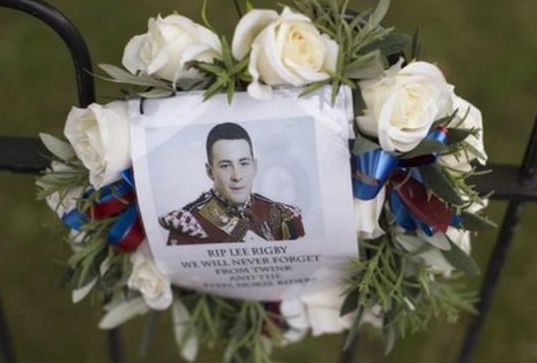
The reaction of women who tried to protect Fusilier Lee Rigby, hacked to death yesterday afternoon, does not surprise me at all. Strong, compassionate characters the local mothers are also protective of the men and women among us who must serve in places like Afghanistan at the behest of their country.

And the neighbourhood is a diverse one. The Greenwich Islamic Centre on Plumstead Road has almost completed a large extension, testament to the thriving Muslim community.

While one or two pubs in the area can be readily identified as BNP/EDL supporting by their year-round flying of the cross of St George, they enjoy little support from locals now well used to the eclectic mix of races and religions.

The EDL and its rally last night in the town centre will hold no sway over the response of the community in dealing with this horrific crime.

Yesterday’s brutal murder of a serving soldier shocked the nation, but for the people of Woolwich it was particularly cruel and will be taken quite personally.

When a sixth generation waterman drowned in an accident on the Woolwich ferry two years ago there was a similar outpouring of grief here for a hard-working son taken unfairly.

Today my wife and I will walk up the hill to the garrison and lay flowers for 25-year-old Rigby. We will be joined by many other local people who will also want to pay their respects and reassure the soldiers at Woolwich barracks that the community, as ever, is behind them.

(Originally published in The Huffington Post)
Poor portrait of Kate Middleton achieves the impossible

She’s the most vibrant, photogenic woman in Britain, winning over even the most cynical observers with her sense of style, her broad, open smile and common touch.

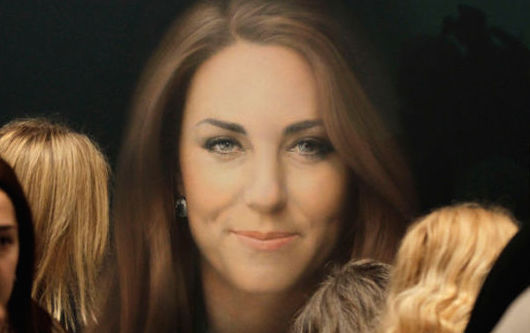
So artist Paul Emsley has managed quite a feat making the future Queen consort look like a dowdy 45-year-old.

This horrible, soft-lens style painting – which the Duchess emerges from in an almost ghostly way – robs her of any of the sparkle and life she is loved for.

It is like an ‘In Memoriam’ picture etched onto the front of a dark marble gravestone or one of those paintings on black velvet that co-habitate the hallways of everyone’s less discerning grandmother.

Her mouth appears old and pursed and – at odds with what we know about Kate – her eyes portray a kind of wise knowingness that comes with age.

Instead of fashionable, the loosely tied scarf on Kate’s dress looks like a maven’s noose extracted from a moth-balled tea chest.

For £20 and 15 minutes of your time you can get roughly the same treatment from one of the footpath artists that ply their trade off Piccadilly Circus.

Royal portraiture is always hit and miss. For every memorable painting of the Queen there have been 10 others that were erased from our minds for their mediocrity.

Sadly Kate, the Duchess of Cambridge’s first royal portrait falls into the latter category.

It might have been a marvellous picture of a graceful matriarch entering middle-age, but of course Kate isn’t. She’s a young woman, 31 years old and in full bloom (and now, post-sitting for her portrait with a baby in her belly).

Emsley, 65, is a respected and decorated portrait painter, who won the £25,000 BP Portrait Award six years ago with his eery, photo realistic depiction of Michael Simpson.

He has won a host of other prizes for painting and drawing, so has nothing to prove in terms of his prowess. But this, his biggest commission must rank as an abject disappointment.

(Originally published in The Daily Mirror)

Is Australia racist? Anthony Mundine says ‘Yes’

He boastfully calls himself ‘The Man’ – it oughta be ‘The Mouth’.

Australia’s most controversial sportsman, boxer Anthony Mundine, has a track record of putting his foot in it or, in the Aussie vernacular, shit-stirring.

Accused of racism himself in the past week for effectively telling a fellow Aboriginal boxer that he wasn’t black enough, Mundine came out and laid all his cards on the table over the issue.

The country itself was racist, its institutions were racist and its flag and its anthem excluded Aboriginals, the 37-year-old claimed.

It was the kind of red rag to a bull remark that Mundine is good at making.

In Australia, where he polarises opinion between those that can’t stand that ‘big mouth’ and those who admire a talent that’s seen him win three world titles at two weights, reaction to his comments was quick and mostly negative.

‘Below the belt’ opined one article, focusing on his ill-chosen words to rival boxer Daniel Geale, while an Aboriginal campaigner rather hysterically branded him a ‘neo-Nazi’.

The much-liked Geale, the current WBA and IBF middleweight champion, is a descendent of Tasmanian aborigines, most of whom were wiped out in the 1830s in perhaps the most near to comprehensive genocide ever pursued against a people that we know of.

Mundine at first disputed if there was such a thing as a Tasmanian Aborigine because of that genocide, but later retracted his remarks.

He was accused of shock tactics and several of his sporting peers, Aboriginals included, denounced him and trumpeted the usual line that he should just play his sport and keep his mouth shut.

But Mundine didn’t back off too far and used the opportunity of apologising to turn the accusations around and launch an embarrassing attack on his country’s race record.

In a counter move similar to Australian PM Julia Gillard’s own recent robust attack on the Opposition Leader Tony Abbott’s alleged ‘misogyny’, Mundine told reporters: “Everyone that comes here, and a lot of my close friends and family members, we feel that Australia is one of the most racist countries.

“I want to move forward, I want to unite the people.

”We’ve never had any representation on the flag, yet I see representation of the Union Jack, something that symbolises the invasion, the murder, the pillaging, and on and on. I think we need to address that – it’s dividing Australia, rather than uniting Australia.

“At the moment, I can’t fly it. And I want to fly the Australian flag. I want to fly it for the Australian people. But let’s do it together.”

He went on to describe the national anthem, Advance Australia Fair, as a legacy of the White Australia policy.

He added: ”I think that we need to move forward together, unite together, move forward as people, move forward as Australians, no matter what you are – brown, black, brindle, white – and move forward together.”

What of those comments though? And how valid are they?

Australia’s Aboriginal population is relatively small, 517,000 at the last census, about 2.5% of the population**, with three-quarters residing in cities and country towns, while 25% live in remote communities.

Despite a decent welfare system nowadays the life-expectancy of Aboriginals is about 17 years less than the national average*, a statistic that is twice as bad as comparable nations with an indigenous population.

Unemployment among Aboriginals is three times higher than the non-indigenous population** and Aboriginal women are 58 times more likely to be held in police custody than non-Aboriginals – for Aboriginal men it is 28 times higher***.

Alcoholism, drug abuse, domestic violence and, in some communities, child abuse are endemic problems. The rate that Aboriginals are admitted to hospital, commit suicide or are diagnosed with mental health problems or disease is between two and three times higher than the non-indigenous population****.

All of these facts point to problems that are either not being addressed properly or not being addressed at all.

And the level of indifference to Aboriginals by the non-indigenous population has only begun to turn around in the past decade or two.

In Australia a national Sorry Day has been held every year since 1998 and four years ago the then prime minister Kevin Rudd apologised in parliament for laws and policies that “had inflicted profound grief, suffering and loss” for Aborigines. The previous incumbent John Howard had refused to make an official apology and was backed by about one in three Australians.

Foremost in Rudd’s mind was the controversy over the ‘stolen generation’ of children.

In reality the term used to describe them represented many generations of Aboriginal children, forcibly taken from their families from the 1900s to the 1960s and given to white families to raise in a heartless and bureaucratic attempt at integration.

But the apology was also for the numerous bloody, one-sided massacres committed by settlers, whalers, sealers, police detachments and the British armed forces, carried out since the early days of colonisation right up until the late 1920s.

While the benefits system is now supportive of Aboriginals, they were not entitled to a pension and other welfare until 1959.

It was not until 1962 that Aboriginals nationally were given the right to vote and it was only made compulsory, in line with the non-indigenous population, in 1983. There were bans on Aboriginals entering some town centres, right up until 1948 when the Western Australia capital Perth finally relented.

Among Mundine’s incendiary comments was the claim that Geale didn’t represent the Aboriginal community, citing his ‘white’ wife and kids.

He told a press conference for the fight: “I don’t see him representing black people, or coloured people. I don’t see him in the communities, I don’t see him doing the things I do to people, and fighting for the people. But he’s his own man. He’s got a white woman, he’s got white kids. I keep it real, all day every day.”

To outside observers it was a bit like Muhammad Ali’s portrayal of Joe Frasier and George Foreman as white stooges, part trash talk, but with the kernel of a real issue buried far beneath.

Explaining it later he added: “I wasn’t attacking her (Geale’s wife), or attacking her race. My outlook is, as an Aboriginal man, our people, we’re probably the most endangered species. We’re a dying race, and we’ve just got to embrace our sisters. There’s too many footy stars and too many other stars in powerful positions that don’t. And I don’t know why. That’s how we’re going to keep our people going.’

“Our women are the backbone of our community, and the Aboriginal community is weak if our women are weak, we need to bring our women up with us and embrace that.

“Our mortality rate is far worse than our birth rate. We are probably one of the only races on Earth like that right now.”

As crass as it seemed to direct those comments at the amiable Geale it was the type of view once espoused in 1960s America by Black Power activists – respect the sisters, nurture your own race, don’t fall victim to trying to meet the expectations of the majority.

Mundine has been attracting attention since the early 90s when he had his first amateur fights aged 17.

A top junior rugby league player at the time he was also the son of Tony Mundine, a fearsome hard-hitting Aboriginal middleweight boxer who had fought the legendary Carlos Monzon and ‘Bad’ Bennie Briscoe among others.

From an early stage in his life there was some air of anticipation about what Anthony Mundine would achieve, having already been earmarked as a gifted athlete in at least three sports (there was talk of him playing in Australia’s National Basketball League).

Since those early mutterings of potential Mundine’s won 44 fights and given up a successful career in rugby league, where he represented NSW in the game’s teak-tough State of Origin series.

He’s now 37 and, perhaps too late, is trying to attract some big money fights in the U.S. where it’s taken more than a decade for the heat to go out of acrimony at remarks he made blaming the country’s foreign policy for the 9/11 attacks.

And the Mundine mouth has continued to see the boxer run foul of the press and public.

But Aboriginal Australians need champions and not just successful sports people that tick all the right boxes for the white community. They need individuals with a profile that are prepared to speak up.

Mundine may not be the most eloquent orator, and he may not be the obvious choice as a mouthpiece for political change in Australia, but maybe he has a decent point or two to make.

Does that dour Federation-era anthem reflect anything about Australia today?

Should the country keep flying one of the many identikit flags that dot the South Pacific featuring the Union Jack in the top corner?

And do its people care enough about the Aboriginals to improve their life expectancy and their general well-being to a point equal to their own?

National Sorry Day (now called the the Day of Healing) is worth nothing if it’s just an apology for a distant past.

If Aboriginal kids continue to grow up with few opportunities and little self-esteem what good is saying ‘sorry’ to make ourselves feel better?

More people like Mundine are needed to start talking about solutions.

And not just Aboriginals – white folk too.

* Australian Institute of Health and Welfare

** Australian Bureau of Statistics

*** Australian Institute of Criminology

**** The Medical Journal of Australia

(Originally published in The Huffington Post)
Tough play shining a light on broken care home system

I had a friend years ago. We were close for a while, but she was complicated and when she was through with you that was it. So I knew her for a year then never saw her again. She was the same age as me, we were born a few days apart, and despite her not having seen anything at all of the world outside London and Slough she seemed to have lived a much longer life. She told me things that made my hair stand on end.

She’d been in the care system and she’d been raped. She’d been slashed with a knife by a gang. She had no connection with her two younger sisters, who had been abandoned with her, but had both been fostered out to a ‘nice’ family. For her the care system was a series of failed placements and homes where she was preyed upon by older children and on one occasion a carer.

If you met her in the street you’d never think she had a problem in the world because she had the brightest smile there was. But she’d beaten a crack habit, was semi-literate, dissolute and scarred permanently by her experiences. No amount of love or care, it seemed, could make any of it right again.

Working on a newspaper I learnt over the years that her story was not unique, but part of a pattern of abuse within a system where children could not be properly protected. The care system in Britain as a whole is a very poor substitute for the love and affection children need to develop.

In the past few days two things have reminded me of this: A powerful new theatre production about being in care and a warning from Barnados that served to validate what the play had to say.

The Finborough Theatre’s Fog, about a returned serviceman’s attempts to reunite his family after leaving his kids in care for a decade where they were abused, is harrowing. But it is a very matter-o-fact kind of harrowing. It tells us awful things that somehow aren’t as shocking as they should be, because in a way we have already come to accept that things like that occur when you are a ward of the state in Britain.

Barnados warned this week that children older than 10 in the care system are being “forgotten” and have become almost unplaceable among foster carers. The charity said 12,000 kids entering care last year (43%) were over 10, and while it didn’t give the figure on the number placed in foster homes, Government statistics tell us that just 3% of children aged over 10 in care were adopted out last year. Of these 84% were white, giving a less than 1% chance that a black or Asian child aged over 10 will find a home.

Some will be unfortunate enough to live out their childhoods in one of the 17 secure care homes for children that operate throughout Britain. In these the majority (66%) are detained or placed by the Youth Justice Board, while the vulnerable remainder are neglected or abused children who have been removed from their homes by local councils.

Throughout the wider care system a much higher figure of 62% are placed because of neglect or abuse. Just as worryingly, the standard of these childrens’ education is well below the norm, with just 45% attaining the basic level of education for their age. Barnardo’s say at least 8,750 new foster families must be found within the next year to avoid a catastrophic increase in the number of emotionally damaged children. And while homes are more likely to be found for babies and toddlers, UK adoption figures show that only 60 children under one were adopted out last year.

At the Finborough, on the outskirts of Chelsea in West London, hard-hitting Fog is selling out fast with its mixture of powerful acting and devastatingly pointed writing.

Penned by Tash Fairbanks, a 63-year-old feminist playwright, and her partner’s 27-year-old actor son Toby Wharton it is funny at times, disturbing and very, very real. It is also mesmerisingly sad.

Many people who have been in care may find it hard to watch.

Played by Wharton, in a riveting performance, the main character Gary or Fog (his nickname ‘F*** off Gary’) sets his sights low. He wants a big TV and a council block flat with a view. His dad Cannon (Victor Gardener) wants to provide much more, but can’t stomach working for £12k a year as a security guard. In the end Cannon’s half-hearted efforts will prove futile, an outcome the audience can sense from the first sighting of director Che Walker’s bleak concrete set.

Meanwhile sister Louise (Annie Hemmingway) has been ostracised by Gary and hates her father for leaving them. Going in the other direction, Gary’s best friend Mike (Benjamin Cawley) is doing well at school and heading for Oxford – he comes from a poor home but a supportive one, in the form of his nagging sister Bernice (Kanga Tanikye-Buah). There family provides the contrast between those with hope for a future and those crippled by their experiences.

While in care Lou has deliberately put herself in harms way to protect her younger brother from the predators around them. But her efforts have only mitigated the abuse. Hemmingway plays her bolshy and tough, but with a fraught tenderness. Her first appearance on stage made me well up, even though I knew little about her, such was the hurt she conveyed in her eyes. Her character is the only one that really cares about Fog and the audience knows intuitively that this ex-drug addict is the one hope he has – even though he rejects her. Lou has ‘put out’ in the children’s home ‘Brock House’ to protect Fog and been dubbed a whore, but she understands his pain and fear, as she shares it.

Some see the play as being about dad Cannon, about him being unable to adjust to coming back to a ‘Broken Britain’ that doesn’t care, to messed up kids he can’t get through to. There ARE real issues about returned soldiers in Britain – I see them everyday on my drive in to work, manning the check points at Docklands. War-hardened veterans forced to work in ‘by comparison’ Mickey Mouse security jobs, given no counselling for adjusting from a war zone to civilian life.

But this play is not about that, and it is only about Fog’s father in so much that it is to do with the effect his selfish desertion of his children has had. Played by the muscular, physically impressive Gardener, Cannon’s naïveté about the tough upbringing his children have endured provides the few moments where he shows his weakness. He’s a tough army man who can’t face up to the fact his kids have been abused in his absence…because of his absence.

Fog is a subtly rich play, at times a whirlwind of words, at others a bleak place of silence where pleas go unanswered. But for the verbose, black street slang spouting Fog, the script is remarkably restrained and often minimalistic in its detail. It releases information about the characters like secrets, and never labours explanation. But it gives us enough to piece together the tragedy of their lives. There are no formulaic responses, no cop outs and no pat ending.

That one-time friend of mine is out there somewhere, and hopefully in a better place, but the things that messed her up are still very real and they’re messing up a new generation of children.

Go see Fog – if you care.

Until January 28. The Finborough Theatre, 118 Finborough Road, London SW10 9ED. 020 7244 7439

www.finboroughtheatre.co.uk

(Originally published in The Huffington Post)
One Tree, Three Years, Fifty Paintings

When artist Stephen Taylor’s mother and father and an ex love all died within a year of each other, his own life began to unravel.

Having spent years studying and teaching painting, quietly honing his craft, he suddenly crashed emotionally and psychologically, under the burden of his misfortune, unsure of his place in the world.

But for Taylor the answer to this identity crisis would take time and devotion. Without fully comprehending what he was doing the artist, now in his 40s, immersed himself in his work and developed an obsession with a single tree – one that would take over his life and define him.

He cast himself into the wild, shunned company, and for three years set up his easel every day in a farmer’s field in East Anglia. Taylor assembled himself and his materials in front of a magnificent 250-year-old oak tree – one that he had picked out after examining numerous others in the area and decided it was ‘the one’.

Day after day he trudged through the wheat and rape, in all weathers and at different times of the day and night to paint the tree.

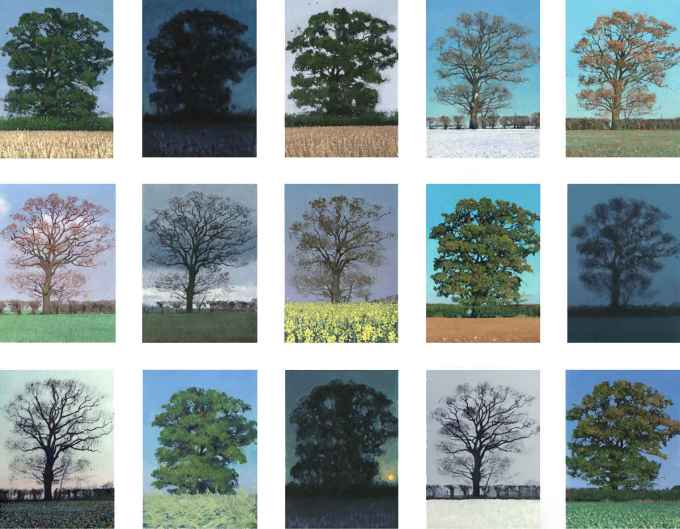
He painted it in detail and in abstract, he painted it so it filled his canvas, and he painted it as a distant dot on the horizon. Among the branches of the great tree he documented the inhabitants: crows, beetles, larks and lichen.

He sat, he lay on the ground, he stood on a ladder. His perspective, moreover, changed with the seasons, the one constant being the farmer and his tractor – who would appear in the distance occasionally, going about their enmeshed business with not so much as a wave or a snort of acknowledgement.

The philosopher Alain de Botton mentions Taylor in his book The Pleasures and Sorrow of Work, alluding to the tragedies which led him to this point and how the business of work had somehow helped him in a stoic, meditative way.

There have been many artists and writers who have dealt with their own sense of personal despair, their sense of failure or perhaps just the fear of failure, by walking alone into a field and lying down to die with a gun or a razor in their hand.

But the story of Taylor, his box of paints and the beat-up old Citroen he would coax through the English countryside each day to his field, bears little correlation to Vincent Van Gogh or Ernest Hemingway.

His is a story that is uplifting in its universal ethos that you do what you know, and you make all that you can of it.

Now, five years after Taylor packed up his easel and left the field for the last time, a book has been published of 50 of his paintings from that time.

Entitled simply Oak, it is itself a workmen like volume, full of analysis of sunlight and shadow, of gradients of paint and how the eye plays tricks on the mind. It is the diary of an artisan, obsessive in its chronicling of technique and the thought processes that led to the final image.

But on personal details it is scant, and on the subject of the tragedies he suffered – which had brought him to the field in the first place – he devotes just five lines in the entire book.

This is the measure of the man, rather than the artist. He does not seek out the limelight, which is why he has never spent much time in it. Nor does he seek some material advantage in mixing his personal life with his craft as a painter. That is too much a foreign concept to him.

What little we know of Taylor has been wheedled out of him by people more astute in the selling of paintings and books, and yet even that is slight and no more than a footnote to a great canvas.

I spoke to Taylor for just over an hour on the phone one day recently to fill in some of the blanks.

He had been living in Colchester at the time of his ‘mid-life crisis’ and when the paintings were made between 2003 and 2006, but now resides in Ely in Cambridgeshire.

Immediately prior to this Taylor’s mother Lillian, 70, died of a brain tumour and his father Jack suffered a stroke not long after, succumbing finally to a heart attack within the year, at the age of 76. In between Taylor’s former girlfriend, the woman he describes as being ‘the closest woman to me after my mother’, also died of a brain tumour. It’s still a sensitive point and he will say no more about her.

Taylor told me: “Father’s death was the last straw. You lose your sense of identity when you lose friends and family and I suddenly didn’t know who I was. I think it helps you to work out who you are if you know where you are, and I think that’s what was going on.

“I walked into this field one day and just sat down and started to paint. I painted the tree from every angle, in oils and watercolours, I drew it and photographed it. I did start to wonder why I felt it so easy to work in this field on my own for such a long period of time. I think I was trying to feel at home.

“I was trying to connect with something much bigger than me and all my concerns.”

Taylor, who studied at Leeds, Essex and Yale universities, said the process was cathartic and the tree was a link to pictures he grew up with in his family home in Wolverhampton, in the West Midlands.

His grandfather, a brewery worker, painted in his spare time, and a picture of an oak tree in a field hung prominently in Taylor’s boyhood home, alongside watercolours of birds painted by his father, a postman.

But his career as an artist had taken him around the world and, for prolonged periods, away from his family.

He added: “My family had been there for 100 years and when that was all finished I was left wondering ‘what am I going to do with my life?’ I went through a mid-life crisis brought about by the deaths of important people in my life that I was coping with.

“At the time I started painting the tree I didn’t think about why I was doing it, but looking back now I think I needed a sense of place. I had lost everything that anchored me. By taking this one little area of England and feeding off it spiritually I found some redemption. I got to know the history of the place and its links to John Constable. I built up this little world that seemed to confirm who I was.”

Taylor was aware, too, of the oak’s powerful symbolism, its solidity and defiance of time and change, adding: “The oak has a feeling of permanence.

“You find it crops up a lot in the paintings of Constable, in Virginia Woolf’s Orlando and also in War and Peace, where it takes on a symbolic meaning – the oak tree carries on and that helps Andre make sense of all the loss he’s had.

“And the paintings themselves are very much like ones in my family, ones my grandfather did. Painting was how we knew who we were.”

The time spent in the field also expanded his artistic range.

“I began to work on ways that would help me paint nature in a fresh way and to help me make visual contact with this new place,” he wrote in the book.

“By being in the field so often and by working so carefully in colours belonging to particular conditions, I had developed an understanding of the limitless of natural colour.”

Since the oak, Taylor has spent time in the Rheidol Valley in Wales where he took on a new project, determined to properly understand and depict falling water.

Now his attention has turned to the great expanse of clear sky over the rush-covered fens.

He speaks cheerily of his work and his life. He is keen to discuss theory, both traditional and that which is technologically innovative, and our conversation wanders over Cezanne and Pissaro, Constable and Warhol, colour grids and Adobe Photoshop.

“I embraced as much science as I could. I spoke to scientist friends and found ways to use science to help me see more clearly,” he said.

“You can define a field of colour using photoshop, pick out one colour and see where it falls across a landscape. That’s an amazing tool to analyse how light appears to the viewer.

“I think it’s important to embrace new technology where it helps our understanding of how we see objects and how we see them interact with other objects in a landscape.”

Painting the oak hasn’t given him all the answers though, it hasn’t eradicated problems from his life. He speaks ruefully, almost apologetically, about a rejected recent marriage proposal and how his unrequited love interest is happily ensconced in matrimony with another.

Such is life!

He is guarded about his age, because he feels artists, like every other profession, get pigeon-holed and discriminated against if they have not ‘made it’ within a decreed timetable for success.

But he is grounded once more and happy within his own skin.

He ended our conversation as breezily as it began, and on a positive note about reconnecting with his past and finding himself.

“What I got from my dad,” he said, “was how nice it is to be alive.”

Oak: One Tree, Three Years, Fifty Paintings By Stephen Taylor (Princeton Architectural Press £19.99)

(Originally published in The Huffington Post and mirror.co.uk)