In a tower block in Redfern I take the lift up 10 floors to Theresa’s parents’ flat, where she is stoically navigating her wheelchair around a tight cluster of chairs, tables and couches.
A white cat darts about and her son Sparrow is watching YouTube videos on a laptop. An assistant, Nick, sits off to the side looking at his phone while mum Lorraine hustles up tea and coffee.
Amidst this bustle artist Theresa stops, unable to go forward or back. She sits there, her legs strapped together, a red beret on her head (her hair recently shorn for a performance). She is beautiful, lean and intense.
Despite, or perhaps because of, her disabilities she’s got a strength.
“I have to be strong,” she says. “I have to be a warrior.”
Her speech, affected by her condition, is laboured and I lean in to focus on her words, piecing together unfamiliar sequences of sounds.
“Dealing with other people’s reactions to my world is really interesting. I care about being real. We need to learn whatever we can.”
At 17, Theresa Byrnes was diagnosed with Friedreich’s ataxia, a terminal disease that attacks the nervous system, slowly debilitating sufferers, rendering them immobile, sending them deaf and blind in some cases and dramatically shortening their life.
Having an increasingly difficult existence seems to have only spurred her on more. Theresa has lived an extraordinary life, something she won’t ever admit to. But it’s true.
In her memoir, published at the ripe old age of 30, she wrote: “Courage has nothing to do with the limits of the body but everything to do with the limits of the mind.”
That was 18 years ago. By then she was already in a wheelchair, had been named Young Australian of the Year and exhibited in several shows. Her photo by Greg Weight is in the National Portrait Gallery collection.
In Sydney she had family around her, friends, gallerists, security. But for her, it was too comfortable.
So, in 2000, she surprised many by packing up and moving to New York. She surprised more people by not hurrying back, daunted by the scale of what she had attempted.
Instead she has lived there since and her quick visit to her parents in Redfern is just a stop in between a performance for Maruku Arts in the Central Desert and an exhibition at Sydney’s Janet Clayton Gallery.
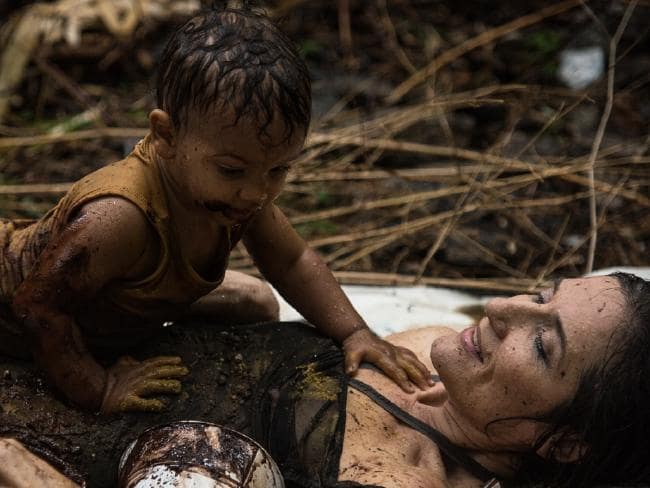
She is a mum now – a single mum. Another challenge. But she’s up to it. Son Sparrow, three, a happy, alert child, is her greatest work. She took him to Uluru this past week to acquaint him with the “centre of the earth”.
“I want Sparrow to realise his connection with the earth,” she opines. “But in the end I cannot promise him anything at all.”
In New York her condition has continued to deteriorate and she now requires regular assistance to carry out basic functions.
But her dream of pursuing her career as an artist in New York has never dimmed.
“I was always a misfit, and I found myself when I arrived in New York City,” she says. “Australia made me who I am – rooted in the rich, red earth and the crashing surf – but I have no time to reminisce. I am the amalgamation of all of it.
“The America I know is a place of creative freedom where you can leave your mark and no one will judge or ridicule you. You can be an outsider, a misfit and blossom in a garden of unknowns and who-cares.”
And there is nothing safe about Theresa’s art. She is one of the most visceral, edgy performance artists in the city, confronting her audience with uncomfortable visions, and putting her whole body into her art, from being doused in diesel or ink to crawling through mud along a canvas.
It seems it’s disturbing to everyone but Theresa, who is both unselfconscious and unstoppable.
“I am not afraid to get dirty. I am not afraid of the cold or to hack my hair off; I have a high discomfort tolerance and am not captive to expectations of normalcy,” she explains.
“I accept the limited way my body moves. No one else is wired to move the way I do. Challenge is life and life demands struggle. I want to explore what it is to be human.”
When Theresa first moved to New York she lived in a Lower East Side store front for 13 years.
“I lived alone. My first boyfriend in NYC was an activist priest. We curated events together.
“He broke my heart, but the Lower East Side had totally won mine.
“I put in a pole, ceiling to floor, to help me get out of bed, grab rails by the toilet and a Perspex shelf in my shower. I would pull myself in and out of the shower in lotus. I found a way around my changing mobility to keep independent.”
She revelled in her independence, spending hours writing and planning new performances, organising events, and writing about her work – between making it.
“Three times a week I would go to the gym and pump iron,” she says. “No money for fancy gyms or a trainer, I joined City Gym for $60 per year. I worked out hard and didn’t give a shit how tragic I may look.
“I was aware that what may seem really hard now may soon be impossible – like sliding from chair to floor to stretch and then struggling to get back. I cannot do that alone now.
“One day in 2009 I realised I couldn’t dress, or get ready alone anymore. I took 30 minutes to put my shoes on. I did not want to scald my thighs by dropping a hot coffee pot on my lap again.
“It took me four hours just to get to the door.
“Always with tears of frustration to get through the mundane, I would mop my floor by hand with a soapy towel, leaning over in my wheelchair, wiping, inching the wheels back, whipping.”
But when she did get out into the community it energised her.
“My struggle got my blood pumping,” she says. “It was a good workout, physically, emotionally and spiritually.
“I got an aide for the morning to help me (in Australia you call them carers). I fast realised I was not losing freedom, just understanding it more fully.”
Theresa’s second New York gallery was tellingly named Suffer. It opened in 2010 on East 9th Street.
At an opening of her paintings she met Sparrow’s father. “He was the most beautiful man I had ever seen in my life,” she says.
“I had to avert my eyes. We became friends, then, a year later, committed lovers.”
Louis, a direct descendant of the heavyweight boxer Joe Louis, was a model and actor. They had been seeing each other for a bit over a year when Theresa became pregnant.
“I realised that if I went through with the pregnancy I would perhaps never have precious alone time again,” she says. “The end of my Bohemian dream.
“I could just barely look after myself and Louis was afraid to be a father. I understood his concerns but it was no longer about me or us.”
Five months after Sparrow was born Louis was diagnosed with stage four lung cancer, which had spread to his brain.
Before his death the couple had time to baptise Sparrow under the Williamsburg Bridge by the East River.
“I fought hard through all the stress to keep my studio/gallery,” Theresa says.
“I would paint while Sparrow breastfed or slept on my lap. He has done three performances with me, painted with me.
“In my transition into motherhood I lost some physical independence, my ability to stand, my voice now slurs at times beyond being understood.”
Today Theresa and Sparrow live in a rent-controlled two-bedder in Manhattan’s East Village, a block from her current gallery TBG.
When I first met her at a book launch in London 17 years ago she told me she may be dead by now. The life expectancy for sufferers of Friedreich’s ataxia is about 50. At 48 that’s uncomfortably close, but for Theresa uncomfortable is the norm.
“I am halfway through writing my second book,” she says. “I give myself two years. I will finish it at 50. I look forward to the privilege of being an old wise woman.
“Maybe I can teach something about freedom, how to harness the power of a mistake.”
* Theresa Byrnes’ Mud Bird is showing at Janet Clayton Gallery, 406 Oxford Street, Paddington, Sydney.
September 1-4. janetclaytongallery.com.au
(Originally published in The Daily Telegraph. Pic of Theresa and Sparrow by Rainer Hosch)
 rtg
rtg 