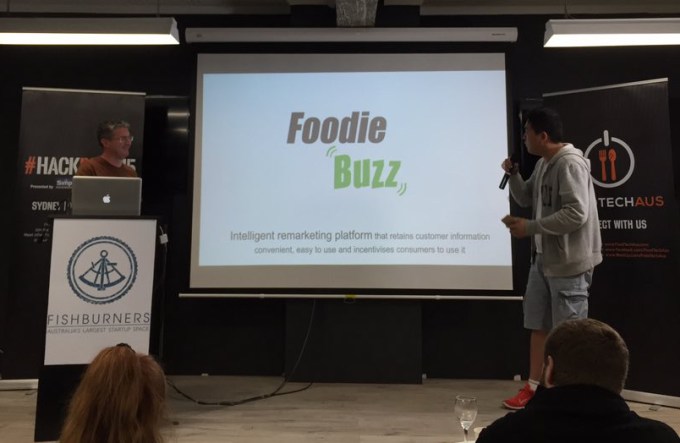
It was late in the afternoon of Day 3 at HackFood 2015 that my moment of clarity pivoted for, what proved to be, the final time.
The weals on the back of the crumpled print-out of the lean canvas were testament to how often it had been ‘gone over’ and ‘last’ reckonings scratched out.
Our FoodieBuzz app had been socialled within an inch of its life, promos made and terminated and the pitch turned on its head from a platform for customer acquisition to customer retention.
Epiphanies generally strike once and are final, but when you keep turning inside out an idea, until a new beast emerges that is different enough to stand on its own, those moments arrange themselves in a thread made of compromises, insights and brutal reasoning.
Held at Fishburners in Sydney’s Ultimo by FoodTechAus, HackFood was a case in point – a mongrel dog of DIY and vision for sale.
The first food tech industry hackathon in Australia, it came with a rough agenda and loads of enthusiasm.
But anyone expecting coruscating wisdom to kickstart a new and unique product were set straight on the first night when a succession of similar pitches strained to uniquely distance themselves from products already in the marketplace.
The 24 60-second proposals on day one boiled down to 12 teams formed in a loose endosmosis of like minds, and by the end of that first evening one team (maybe the best) was already gone – Skipper Dan (direct-to-market seafood sourcing), hooked by one of the industry ‘observers’ that came along on the first night to find something that could be sold and spirit it off.
Most products took their cues from known applications. Old ideas repackaged, re-angled from impossible expectations to mundane reality. It was all about redefinition and agility in an industry still slow coming off its mark into a digital today.
By the end of the weekend Chewsr, a menu ordering app that narrows choice rather than expands on it, had won the taste test. A cattle temperature monitoring device and app to stop cows getting sick in container ships was the even more prosaic runner-up.
The lessons were clear: Small ideas not big, simplicity over complexity, the quickly achievable over the problematic, take what works and make it better, or different enough to find its own stream of custom.
The market, as often as not, is your competition and your rival may become your investor or your buyer.
Cannibalisation by established firms is the chief threat to this way of thinking but the ability to redefine your goals without flipping the logic behind them keeps your place at the table.
And in food tech that is the only game in town.
 rtg
rtg 