Calling Aboriginal massacres what they were – war!

Sometimes they gunned them down or poisoned their bread or water. In other accounts groups were driven off cliffs into deep gorges.

There were many gruesome ways to die if you were an Aboriginal in the ‘Frontier Wars’, which researchers say covered a time from 1788 to well past Federation.

In schools this has been taught as a bunch of disparate massacres – a byproduct of nation-building. Not a war, but a collection of executions of small groups by soldiers, farmers, sealers and various other ad hoc militia.

As poorly as American indians have been treated, US historians have at least painted a fair if unapologetic picture of a protracted, one-sided frontier war on a native population unwilling to cede their land to a superiorly armed invader.

The New Zealand Wars, too, were recognised as a conflict over a legitimate prize – ownership of land and the right to use it.

In Australia we’ve well-rehearsed the presentation of our history from a colonist’s perspective.

From the label terra nullius (nobody’s land) considered applicable to Australia since settlement, to the myth Aboriginals were entirely nomadic when there was plenty of evidence to the contrary (read Bruce Pascoe’s Dark Emu). All of these heavily-weighted descriptions favoured the colonists’ land grab.

The idea of ownership is at the heart of everything our society is built on. To have an asset is to have leverage. Leverage to eat well, to sleep safely, to raise a family and be proud of your place.

Ownership weaves our lives inextricably into the society around us.

Not owning anything is not encouraged in Australia.

And the idea of the indigenous population having no ownership of where they had lived, or of not being organised to defend what they had, is a very convenient perspective.

Professor Jakelin Troy, the director of Aboriginal and Torres Strait Islander Research at Sydney University, laments that the history of Aboriginals in Australia has been taught in isolation.

“Aboriginal massacres have been an open wound since 1788, no one talks about them,” she tells me.

“At least we have a recognition in this country of Aboriginal rights, but we need to teach all the things that have happened.”

To look fairly at the confrontations that occurred when Britain colonised this country, those convenient myths must be stripped back.

That includes acknowledging the indigenous population fought a real war to protect its rights – rights to land, rights to hunt and feed their families. Maybe not an organised war the way the British military would conduct them, but a war nonetheless.

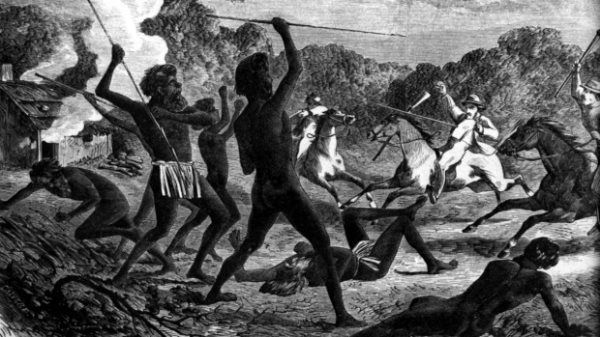
Historian Lyndall Ryan’s ‘massacre map’ which has plotted over 250 such incidents is ample proof that the armed defence by Aboriginals of this land was taking place across the country at hundreds of sites.

You’ve probably heard of the Dharug warrior Pemulwuy, but what about these names: Windradyne, Jandamarra, Yagan or Bussamarai?

They all led a resistance by their tribes to settlers pushing into their territory, and there’s no good reason they shouldn’t be remembered in the same way Americans remember Geronimo, Cochise or Sitting Bull. Heroically.

Aboriginal culture has given plenty to be proud of, but more remains hidden behind this skewed history.

(Originally published in The Daily Telegraph. Illustration of The Battle of Parramatta.)
Lessons in the cost of silence

It seems wrong that the survivors of the Holocaust are generally only bracketed in the category of victims, and all that that implies. Helplessness, weakness.

Because in truth they are anything but that.

The survivor’s of one of the world’s worst ever acts of genocide have a strength that is difficult to put into words.

And the lessons they teach, cautioning against intolerance, have eclipsed the toxic legacy of Adolf Hitler and the Nazis.

Today their role in educating us about the environment that gave rise to the Holocaust and how governments can manipulate people against one another, is as important as ever.

Their input in teaching critical thinking is a rare boon for us here in Australia, but one with a finite window.

Now aged from their late 70s to 90s, when you meet these remarkable men and women you can’t help notice the twinkle in their eyes. The horrors they have witnessed have not suppressed their inner spirit.

To hear their accounts of survival under Hitler’s regime is much more powerful than to read it in a history book.

We all know the grim statistics. The six million Jews murdered in World War II, as well as the gypsies, Serbs and other persecuted minorities.

But for many Australians the reality of this seems very distant, an event that occurred, now, a long time ago, far away in Europe.

We would all like to think that we would not have stood by and let what was done to the Jews happen.

It’s unfathomable to us how so many could have turned a blind eye, while others were active in the persecution and many more showed little to no compassion for their countrymen.

Historians often cite British prime minister Neville Chamberlain’s disastrous appeasement of Hitler, but he was not alone. Appeasers, cowed into silence, in fear of conflict or punishment, were everywhere, at all levels.

And yet, Germany and other countries under the Nazi yoke, were highly educated, cultured places.

The way in which populations were manipulated over time – through propaganda and fear-mongering – to turn on the Jews remains an important and relevant historical lesson.

If it happened then, it could happen now. We are not that different from our forebears of the 1930s.

Speaking up, speaking out, both for ourselves and others, is not always easy.

Here on the streets of Sydney would you say something if you heard abuse yelled at a woman in a head scarf or two men holding hands.

Remind yourself of the cost of silence and, too, that one voice can inspire the courage in others to also speak out.

The Jews that survived the Holocaust, men and women such as Jack Meister, Yvonne Engelman, Olga Horak and Paul Drexler, have a white-knuckle story to tell, but also a powerful lesson in humanity and how quickly it can unravel.

If you have a bucket list of things you want to do in life, add something really meaningful to it and go down to the Sydney Jewish Museum in Darlinghurst Road and speak to a survivor. I tell you, it will blow your mind.

Listen to Olga explain how an act was passed overnight in her home country, the Slovak Republic, and authorities came the next day and took her 16-year-old sister from the family home. Hearing her say “we never saw her again, they sent her to Auschwitz,” will make your blood run cold.

Her account of life under the Nazis and their collaborators should be compulsory reading for all Australian school students. From her time at Bergen-Belsen (where Anne Frank died) and a meeting with ‘Angel of Death’ Dr Josef Mengele, to witnessing the devastation of the British firebombing of Dresden, Olga’s story is a rich microcosm of some of the key events of WWII.

And, though memories of that conflict recede in time, we should not waste the opportunity to learn from these incredible Australians in our midst.

They are people who lost almost everything, but rebuilt their lives here and, to this day, continue to contribute greatly to the community.

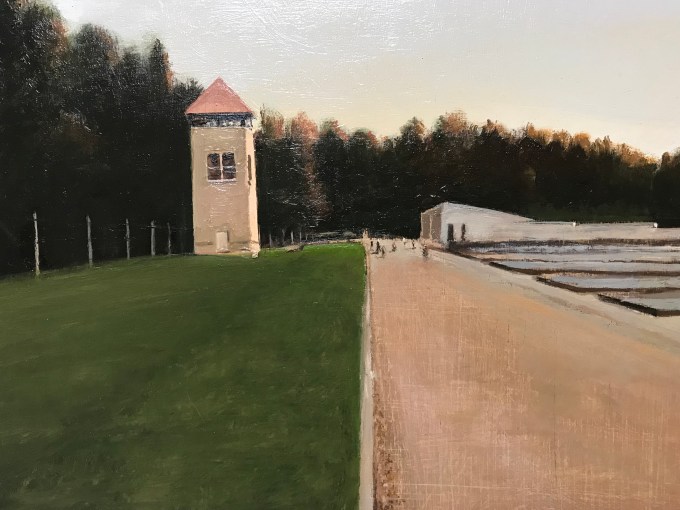
(Originally published in The Daily Telegraph. Painting: Dachau Memorial by Ivan Goodacre.)