Calling Aboriginal massacres what they were – war!

Sometimes they gunned them down or poisoned their bread or water. In other accounts groups were driven off cliffs into deep gorges.

There were many gruesome ways to die if you were an Aboriginal in the ‘Frontier Wars’, which researchers say covered a time from 1788 to well past Federation.

In schools this has been taught as a bunch of disparate massacres – a byproduct of nation-building. Not a war, but a collection of executions of small groups by soldiers, farmers, sealers and various other ad hoc militia.

As poorly as American indians have been treated, US historians have at least painted a fair if unapologetic picture of a protracted, one-sided frontier war on a native population unwilling to cede their land to a superiorly armed invader.

The New Zealand Wars, too, were recognised as a conflict over a legitimate prize – ownership of land and the right to use it.

In Australia we’ve well-rehearsed the presentation of our history from a colonist’s perspective.

From the label terra nullius (nobody’s land) considered applicable to Australia since settlement, to the myth Aboriginals were entirely nomadic when there was plenty of evidence to the contrary (read Bruce Pascoe’s Dark Emu). All of these heavily-weighted descriptions favoured the colonists’ land grab.

The idea of ownership is at the heart of everything our society is built on. To have an asset is to have leverage. Leverage to eat well, to sleep safely, to raise a family and be proud of your place.

Ownership weaves our lives inextricably into the society around us.

Not owning anything is not encouraged in Australia.

And the idea of the indigenous population having no ownership of where they had lived, or of not being organised to defend what they had, is a very convenient perspective.

Professor Jakelin Troy, the director of Aboriginal and Torres Strait Islander Research at Sydney University, laments that the history of Aboriginals in Australia has been taught in isolation.

“Aboriginal massacres have been an open wound since 1788, no one talks about them,” she tells me.

“At least we have a recognition in this country of Aboriginal rights, but we need to teach all the things that have happened.”

To look fairly at the confrontations that occurred when Britain colonised this country, those convenient myths must be stripped back.

That includes acknowledging the indigenous population fought a real war to protect its rights – rights to land, rights to hunt and feed their families. Maybe not an organised war the way the British military would conduct them, but a war nonetheless.

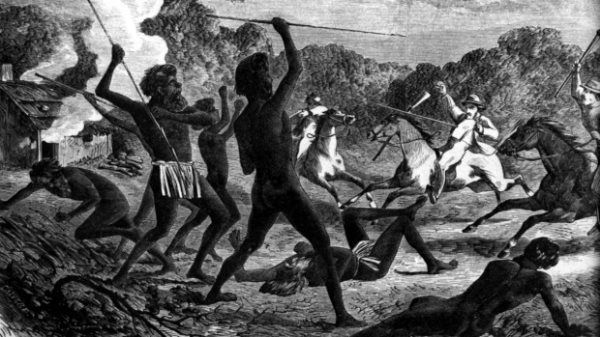
Historian Lyndall Ryan’s ‘massacre map’ which has plotted over 250 such incidents is ample proof that the armed defence by Aboriginals of this land was taking place across the country at hundreds of sites.

You’ve probably heard of the Dharug warrior Pemulwuy, but what about these names: Windradyne, Jandamarra, Yagan or Bussamarai?

They all led a resistance by their tribes to settlers pushing into their territory, and there’s no good reason they shouldn’t be remembered in the same way Americans remember Geronimo, Cochise or Sitting Bull. Heroically.

Aboriginal culture has given plenty to be proud of, but more remains hidden behind this skewed history.

(Originally published in The Daily Telegraph. Illustration of The Battle of Parramatta.)

Meet the Gadigals

IF you’ve attended your child’s school assembly or gone to pretty much any official event in Sydney in recent years, you will have heard the “Welcome to Country” — a recognition of the traditional aboriginal tribe of the area.

Collectively known as the Eora Nation, there are about 29 clan groups, or tribes, in the Sydney metropolitan region, belonging to several major language groups, including Guringai, Darug, Dharawal and Gundungurra.

By far the most mentioned though, covering a swath of Sydney that takes in Port Jackson, the CBD, the inner west, the eastern suburbs and extending south to Botany Bay, is the Gadigal.

But exactly who are the Gadigal? And what does it feel like to be name-checked from international sporting events to the cutting of a ribbon at the local library.

“Pretty good,” Des Madden, a father of two from Western Sydney, says matter-of-factly.

“It’s a really special occasion, any welcome ceremony. The kids are very proud and they tell everyone.”

Des, 33, who works as an Aboriginal Programs officer at the Environmental Trust, is the youngest of 10 kids who grew up in Redfern and Marrickville.

He went to Cleveland Street High in Alexandria, playing junior rep league and tagging around with his dad Allen, who carried out heritage site surveys and taught him about their tribe.

He met his wife Nezmia, 31, a member of the Riverina Mahdi Mahdi tribe, a decade ago and they have two kids, a daughter Shyla, eight, and son Jobie, six, while also giving a hand bringing up their niece Jannali, five.

Des and his family don’t need any reminders of who they are or where they’re from and talk about it often.

While inner westies might associate Petersham with Instagrammed shots of Portuguese chicken, to the Maddens it’s just one of the boundaries of Gadigal country.

“Every time we’re close by we always mention, ‘we’re in Gadigal country now’,” says Des, who moved the family to Penrith seven years ago.

Nezmia, a business support officer, says: “We’ll tell the kids we’re not far now, and there’s always a sense of relief at being back in country.”

While the Maddens are a very ordinary family with ordinary worries (the mortgage, the heating bills, the kids’ homework), unlike most Sydneysiders they express a clearer affinity to the land and impart that to their children.

Des, who estimates there are about 50 or 60 Maddens living in Sydney, knows educating people about his tribe and others is important to keep traditions alive and continue to build on the positive steps being taken to recognise indigenous Australia.

His dad Allen, 69, who now officiates at some of the Welcome to Country ceremonies, remembers a very different scenario.

“I grew up in Redfern, which was very poor for both blacks and whites,” he said.

“We were all in the same boat, the working class mob. We’d drink together at the pub and we’d do what we could to make a living.

“Before land rights there was no real recognition of us as a people with a history. Now the younger generation are coming along and saying, ‘Hang on, we haven’t been told about this’. Aboriginal people were just stereotyped.

“It makes me feel very good that at last there is some recognition there and people know who we are and what we are.”

Nezmia adds: “My daughter was one of the flag bearers for the permanent flag flying at Government House and she was part of that and will always hold that very dear.

“We’re also very involved with their schools. If they’ve got homework or we know a certain subject is being taught we try to help the teacher out with Aboriginal perspectives.

“I think too, being in Sydney, it’s hard to keep that sense of identity in the city, everything’s so fast moving and changing before your eyes.

“It keeps you grounded knowing when you are coming back into Gadigal country.

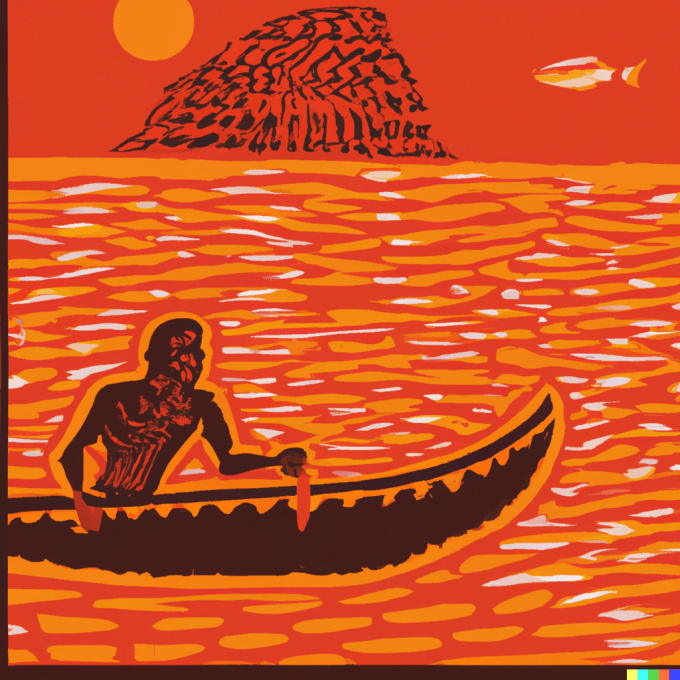
“We try and remind the kids of what it would have looked like before. And that it was common to see the women out fishing in the boats in the harbour.

“We try to tell Shyla that so she has a sense of being a strong Gadigal woman.”

Just over 70,000 indigenous Australians live in metropolitan Sydney, about a third of the state’s 216,000 population, but only a small proportion are Gadigal.

The national census is yet to provide a breakdown of tribal affiliations.

Jakelin Troy, the director of Aboriginal and Torres Strait Islander Research at Sydney University, said there may be as few as 100 members of the original Gadigal clan living in Sydney today.

The Gadigal tribe that lived on the land for thousands of years before Arthur Phillip’s arrival in 1788, she said, bore many similarities to modern-day Sydneysiders.

“They would spend a lot of time at the beach and around the foreshores in summer and move inland in winter.

“Captain Cook came through in winter and commented that the area wasn’t heavily populated, but when Arthur Phillip sailed in the middle of summer he found the beaches full of people.”

The Gadigal were primarily a fishing people, who made hooks from shells and carved bone, and often cast them from bark canoes paddled into Sydney Harbour.

“Sydney’s Aboriginals settled in areas very similar to the way immigrant communities settled in. Each different group had its own traditions and would invite each other over. It wasn’t that dissimilar from Vietnamese migrants settling in Cabramatta or Pakistanis in Lakemba.

“They were big meat eaters in winter and ate a lot of seafood in summer, when they would use the sandstone overhangs along the harbour for shelter,” said Ms Troy.

“When it got colder they had very lightweight and portable gunyas they would carry around and take further inland, where it was warmer.

“The First Fleet would not have survived without the knowledge the Gadigal people shared with them. They warned them off stone fish and showed them what leaves to avoid and how to prepare certain foods.

“I often come across something in day-to-day life in Sydney and think ‘the Gadigal taught us that’.”

She said Gadigal influences were evident in many words and place names we use today and, as the first language encountered by British settlers, they were exported back to Britain in descriptions of the land.

“It was pretty unique how the Gadigal people used to fish, and they would be all over the harbour gathering and hunting,” Des says.

“That’s the pretty unique connection with the Gadigal people that they belong to the waters as well. I’ve always felt a strong connection to the harbours and the foreshores.

“It’s quite special to be part of the Gadigal people given this was one of the first points of contact and from there things declined a bit with smallpox and other diseases.

“It’s special to be a part of that survival and continuation of culture.”

(Originally published in The Daily Telegraph)


Is Australia racist? Anthony Mundine says ‘Yes’

He boastfully calls himself ‘The Man’ – it oughta be ‘The Mouth’.

Australia’s most controversial sportsman, boxer Anthony Mundine, has a track record of putting his foot in it or, in the Aussie vernacular, shit-stirring.

Accused of racism himself in the past week for effectively telling a fellow Aboriginal boxer that he wasn’t black enough, Mundine came out and laid all his cards on the table over the issue.

The country itself was racist, its institutions were racist and its flag and its anthem excluded Aboriginals, the 37-year-old claimed.

It was the kind of red rag to a bull remark that Mundine is good at making.

In Australia, where he polarises opinion between those that can’t stand that ‘big mouth’ and those who admire a talent that’s seen him win three world titles at two weights, reaction to his comments was quick and mostly negative.

‘Below the belt’ opined one article, focusing on his ill-chosen words to rival boxer Daniel Geale, while an Aboriginal campaigner rather hysterically branded him a ‘neo-Nazi’.

The much-liked Geale, the current WBA and IBF middleweight champion, is a descendent of Tasmanian aborigines, most of whom were wiped out in the 1830s in perhaps the most near to comprehensive genocide ever pursued against a people that we know of.

Mundine at first disputed if there was such a thing as a Tasmanian Aborigine because of that genocide, but later retracted his remarks.

He was accused of shock tactics and several of his sporting peers, Aboriginals included, denounced him and trumpeted the usual line that he should just play his sport and keep his mouth shut.

But Mundine didn’t back off too far and used the opportunity of apologising to turn the accusations around and launch an embarrassing attack on his country’s race record.

In a counter move similar to Australian PM Julia Gillard’s own recent robust attack on the Opposition Leader Tony Abbott’s alleged ‘misogyny’, Mundine told reporters: “Everyone that comes here, and a lot of my close friends and family members, we feel that Australia is one of the most racist countries.

“I want to move forward, I want to unite the people.

”We’ve never had any representation on the flag, yet I see representation of the Union Jack, something that symbolises the invasion, the murder, the pillaging, and on and on. I think we need to address that – it’s dividing Australia, rather than uniting Australia.

“At the moment, I can’t fly it. And I want to fly the Australian flag. I want to fly it for the Australian people. But let’s do it together.”

He went on to describe the national anthem, Advance Australia Fair, as a legacy of the White Australia policy.

He added: ”I think that we need to move forward together, unite together, move forward as people, move forward as Australians, no matter what you are – brown, black, brindle, white – and move forward together.”

What of those comments though? And how valid are they?

Australia’s Aboriginal population is relatively small, 517,000 at the last census, about 2.5% of the population**, with three-quarters residing in cities and country towns, while 25% live in remote communities.

Despite a decent welfare system nowadays the life-expectancy of Aboriginals is about 17 years less than the national average*, a statistic that is twice as bad as comparable nations with an indigenous population.

Unemployment among Aboriginals is three times higher than the non-indigenous population** and Aboriginal women are 58 times more likely to be held in police custody than non-Aboriginals – for Aboriginal men it is 28 times higher***.

Alcoholism, drug abuse, domestic violence and, in some communities, child abuse are endemic problems. The rate that Aboriginals are admitted to hospital, commit suicide or are diagnosed with mental health problems or disease is between two and three times higher than the non-indigenous population****.

All of these facts point to problems that are either not being addressed properly or not being addressed at all.

And the level of indifference to Aboriginals by the non-indigenous population has only begun to turn around in the past decade or two.

In Australia a national Sorry Day has been held every year since 1998 and four years ago the then prime minister Kevin Rudd apologised in parliament for laws and policies that “had inflicted profound grief, suffering and loss” for Aborigines. The previous incumbent John Howard had refused to make an official apology and was backed by about one in three Australians.

Foremost in Rudd’s mind was the controversy over the ‘stolen generation’ of children.

In reality the term used to describe them represented many generations of Aboriginal children, forcibly taken from their families from the 1900s to the 1960s and given to white families to raise in a heartless and bureaucratic attempt at integration.

But the apology was also for the numerous bloody, one-sided massacres committed by settlers, whalers, sealers, police detachments and the British armed forces, carried out since the early days of colonisation right up until the late 1920s.

While the benefits system is now supportive of Aboriginals, they were not entitled to a pension and other welfare until 1959.

It was not until 1962 that Aboriginals nationally were given the right to vote and it was only made compulsory, in line with the non-indigenous population, in 1983. There were bans on Aboriginals entering some town centres, right up until 1948 when the Western Australia capital Perth finally relented.

Among Mundine’s incendiary comments was the claim that Geale didn’t represent the Aboriginal community, citing his ‘white’ wife and kids.

He told a press conference for the fight: “I don’t see him representing black people, or coloured people. I don’t see him in the communities, I don’t see him doing the things I do to people, and fighting for the people. But he’s his own man. He’s got a white woman, he’s got white kids. I keep it real, all day every day.”

To outside observers it was a bit like Muhammad Ali’s portrayal of Joe Frasier and George Foreman as white stooges, part trash talk, but with the kernel of a real issue buried far beneath.

Explaining it later he added: “I wasn’t attacking her (Geale’s wife), or attacking her race. My outlook is, as an Aboriginal man, our people, we’re probably the most endangered species. We’re a dying race, and we’ve just got to embrace our sisters. There’s too many footy stars and too many other stars in powerful positions that don’t. And I don’t know why. That’s how we’re going to keep our people going.’

“Our women are the backbone of our community, and the Aboriginal community is weak if our women are weak, we need to bring our women up with us and embrace that.

“Our mortality rate is far worse than our birth rate. We are probably one of the only races on Earth like that right now.”

As crass as it seemed to direct those comments at the amiable Geale it was the type of view once espoused in 1960s America by Black Power activists – respect the sisters, nurture your own race, don’t fall victim to trying to meet the expectations of the majority.

Mundine has been attracting attention since the early 90s when he had his first amateur fights aged 17.

A top junior rugby league player at the time he was also the son of Tony Mundine, a fearsome hard-hitting Aboriginal middleweight boxer who had fought the legendary Carlos Monzon and ‘Bad’ Bennie Briscoe among others.

From an early stage in his life there was some air of anticipation about what Anthony Mundine would achieve, having already been earmarked as a gifted athlete in at least three sports (there was talk of him playing in Australia’s National Basketball League).

Since those early mutterings of potential Mundine’s won 44 fights and given up a successful career in rugby league, where he represented NSW in the game’s teak-tough State of Origin series.

He’s now 37 and, perhaps too late, is trying to attract some big money fights in the U.S. where it’s taken more than a decade for the heat to go out of acrimony at remarks he made blaming the country’s foreign policy for the 9/11 attacks.

And the Mundine mouth has continued to see the boxer run foul of the press and public.

But Aboriginal Australians need champions and not just successful sports people that tick all the right boxes for the white community. They need individuals with a profile that are prepared to speak up.

Mundine may not be the most eloquent orator, and he may not be the obvious choice as a mouthpiece for political change in Australia, but maybe he has a decent point or two to make.

Does that dour Federation-era anthem reflect anything about Australia today?

Should the country keep flying one of the many identikit flags that dot the South Pacific featuring the Union Jack in the top corner?

And do its people care enough about the Aboriginals to improve their life expectancy and their general well-being to a point equal to their own?

National Sorry Day (now called the the Day of Healing) is worth nothing if it’s just an apology for a distant past.

If Aboriginal kids continue to grow up with few opportunities and little self-esteem what good is saying ‘sorry’ to make ourselves feel better?

More people like Mundine are needed to start talking about solutions.

And not just Aboriginals – white folk too.

* Australian Institute of Health and Welfare

** Australian Bureau of Statistics

*** Australian Institute of Criminology

**** The Medical Journal of Australia

(Originally published in The Huffington Post)