Game of Thrones-style twist few Australians saw coming

It was the classic Game of Thrones twist that hooked millions of people around the world.

Author George R.R. Martin was adept at building up a character, dropping them in a life threatening situation, offering hope they would escape, then withdrawing it – bloodily.

It happened in the very first episode when Bran was pushed from the tower and continued on its merry way through the execution of Ned Stark, the red wedding and the murder of Jon Snow.

But without Martin’s books as a guide the last two series have been more Lord of the Rings – predicatable and shockless – with the final episode seeming little more than a set-up for a sequel.

The real Game of Thrones moment, the gut-churning twist, the realisation of loss and betrayal Australian fans had sought from the show, came instead on Saturday night – in real life.

As incumbent PM Scott Morrison carried the field in the 2019 federal election, millions of voters anticipating a Labor win looked on in horror.

With bad result after bad piling up around him, quickly and brutally Bill Shorten’s run at leading the country slid inexorably into the abyss.

The celebrations of gleeful Coalition voters felt as painful as watching Robb Stark’s headless body paraded around on horseback. The King of the North.

Shorten, the king of the working class, was just as dead – politically.

In the lead up to the election, it had misleadingly seemed as though everything had gone right for Labor and Bill.

A usually reliable measure of preferences, the leaders’ debates had been twice won by Shorten, clearly.

Even a story suggesting he was misusing his mother’s memory backfired, turning into a ball ache for the Liberals.

Most deaths are regarded as untimely, but the passing of widely-revered former PM Bob Hawke was the opposite. It was incredibly timely. And it seemed to augur success for Labor.

With Paul Keating, Hawke had come out two weeks before to endorse Shorten and a Labor ascendency.

But while Bob’s death wiped a number of anti-Shorten stories off the front pages of the next day’s papers, it may also have acted as a reminder to voters how underwhelming the Labor leader was compared to the greats of the past.

The Coalition had its own moments of luck. An egg aimed at the PM hit but did not break. For God-fearing Morrison, the unexpected recipient of the leadership after Peter Dutton’s failed tilt, it was another miracle, ahead of his ‘miracle win’.

But despite an uncomfortably narrow two per cent lead in the two party preference vote, the media almost unanimously predicted a Labor victory.

Post-election it then turned around to unanimously blame the pollsters rather than its own analysis for getting it wrong. A repeat of the Trump victory. Of Brexit. Of Gladys.

The media has grown fond of asking this question: Can polls be trusted?

Unfortunately, what has been repeatedly revealed is the mainstream media’s inability to analyse accurately.

It’s nothing unusual, factoring in protest voters and those who haven’t thought about it hard yet, that a two per cent poll lead can evaporate or be reversed. That’s all John Hewson had when he went into the ’93 election as favourite and got thumped by Conservative Australia, not prepared to cast their votes for the GST.

An insider in the Liberals’ campaign team told me it had been a source of constant incredulity within the party how wrong the media’s interpretation had been over the past few weeks.

“We focused on 10 key seats in every state, winning those,” she said. “The strategy was clear and we knew the polls were misleading. We were still strong in the first party preferred vote and our own polling showed that seat by seat we could win. Although, we believed by only a narrow margin.”

She added: “We couldn’t understand the single-focus of most of the media on the national poll trend. They just didn’t look beyond it. Nor did they listen.”

So Scott “The Accidental PM” Morrison, now has a genuine mandate to roll out his policies, while fans of fantasy adventures are reminded life provides enough of its own bitter pills to swallow.

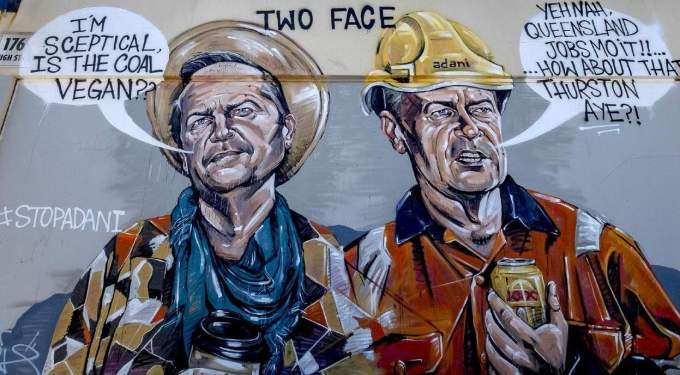
Picture: Street art in Melbourne

Taking the Lucky Country for granted

There’s a skit the British comedian Michael McIntyre does about disabled parking spaces.

As non-disabled motorists cruising for an elusive spot we tend to look ruefully at those often empty reserved spaces right in front of the shops. And sometimes scrutinise those parking in them to satisfy ourselves they are legit.

“What do we want?” asks McIntyre. “For the door to open and a minute-and-a-half later someone falls out.” He then starts crawling across the stage shouting ‘get me a trolley’.

Peter Dutton’s comments on the Manus Island refugees who flew into New York this week (as part of the deal with the US), wearing sunglasses and looking like tourists, fell into the same basket.

“They’re economic refugees,” he told 2GB. “They got on a boat, paid a people smuggler a lot of money, and somebody once said to me that we’ve got the world’s biggest collection of Armani jeans and handbags up on Nauru waiting for people to collect it when they depart.”

Perhaps he wanted them in rags, walking on crutches… emaciated.

The detention centres in the North Pacific are certainly not holiday camps and even if you’re in agreement with the Manus and Nauru detainees being denied entry to Australia, it’s no time to gloat.

Weighing up the cost of compassion is very different from just being self-righteous.

It’s easy in the affluent country we live in to pontificate about economic refugees and how they don’t deserve what Australia has on offer because they weren’t born here.

Nevermind that our own birthright is a quirk of fate.

I commented to a colleague recently: ‘It’s good being a white bloke.’ He thought about it for two seconds and agreed.

If you’re a ‘white bloke’ born into the middle classes of Australia it doesn’t get much better.

You aren’t born smarter, you aren’t more able. But your path through life inevitably is smoother than if you were born black, or poor, or a woman.

In Australia we have developed an enormous sense of entitlement. We sneer at the poor and dispossessed, blame them for their own misfortune and equate worth with earning potential.

Throughout the 20th century, as immigration became the norm, it was de rigueur to refer to any immigrant or their offspring with some derogatory term, whether it was dago, or slope or Pom. Each new wave of migrants copped it. Each was made to feel that they hadn’t earned the right to be here.

The term ‘assimilation’ has been used like a blunt object to batter people into conforming and often renouncing their own heritage.

How many people do I know who became ‘proper Aussies’ never speaking of their background, brought up with that ignorant, spiteful word ‘wog’ ringing in their ears? Too many.

I’d ban it. Make it a hate crime. Make it like the ‘n’ word.

The ‘w’ word.

The children of immigrants in this country, who were bullied and belittled, will never get an apology. And what lesson did it teach us as a people?

Now, as we trade away human beings to Donald Trump like the unwanted assets of a shop liquidation, let’s not lower ourselves any further.

We are the Lucky Country, but we’ve forgotten what that means. Luck is not about being deserving, it’s providence — a cosmic flip of the coin.

We should never forget that.

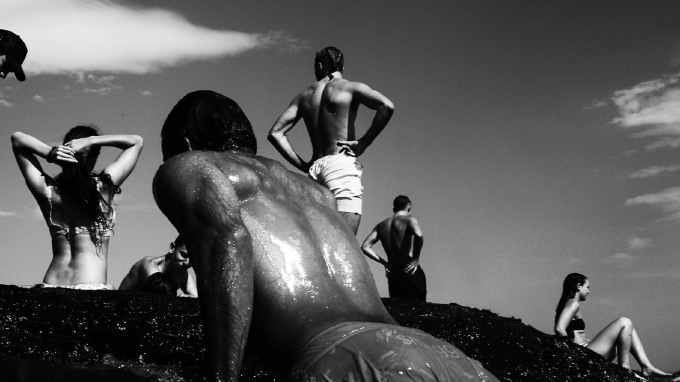
(Originally published in The Daily Telelgraph. Photograph by Paul Blackmore.)

Faking it… A dirty campaign to undermine democracy

Fake news comes from all sorts of sources. It’s often characterised as originating with rogue operators, unscrupulous websites cadging a living from Google AdWords or YouTube plays. But it’s not always from them, sometimes it’s from government agencies or political leaders who we are told to trust. Of course, politicians telling lies, governments misleading is in no way a new thing. We used to call it propaganda, which suggested bias but was often outright lying. The Nazis were expert at it, but the ‘good guys’ often used it too.

Today we would call Baghdad cabbie Rafid Ahmad Alwan’s assertion that Saddam Hussein had mobile biological weapons labs as ‘fake news’. It was a charge that in 2003 the US and Britain used to justify the invasion of Iraq. Both governments had been told he was a congenital liar and his claims didn’t stack up, but they ran with the story anyway because it neatly fit their agenda.

This week we were treated to the unedifying claim Donald Trump watched Russian prostitutes urinate on each other in a Moscow hotel room. We were also told Russia was blackmailing the president-elect with a dossier of dirt – essentially making him some type of Manchurian candidate.

The entirely unsubstantiated information was compiled by ex-MI6 agent Christopher Steele, who runs a security company in London called Orbis Business Intelligence, for a political opponent of Trump’s.

The fact a US security agency may have leaked the information on the eve of Trump’s inauguration says a lot about the incumbent government’s desire to influence or derail the incoming government’s relationship with Russia.

Russia incidentally has been portrayed for the past four years as some kind of rogue, expansionist state, rather than one reacting to provocations from outside its borders.

Buzzfeed, which was handed the leaked info, did what pretty much any media company would do and ran it, saying the public could make up its own mind. Of course saying that whilst presenting no balancing information creates a dangerous environment for a large section of the population to believe it.

When information is presented with the caveat ‘make up your own mind’ it invites multiple interpretations. There’s also the distinct danger the reader will form an opinion based on what they might already think of the people involved, i.e. Trump is a gauche, chauvinist, therefore the allegations are believable.

But this is where governments and other agencies have always cleverly used the media to give fake news an air of credence.

We in the media, generally speaking, are better at repeating information than analysing it. Most media organisations lack the critical facility to scrutinise the motives behind leaked information, so happy are they just for the opportunity to set the agenda and break a big story.

The other insidious thing the release of the dodgy dossier on Trump did was to allow the media to validate the claim Russia was involved in hacking the Democrats and influencing the result of the presidential election.

The Democrats, still smarting at their loss, would love everyone to believe this was true. That their loss was the result of a conspiracy and that Trump is actually an illegitimate leader.

Trump had steadfastly denied Russian involvement, as had Russia, as had Wikileaks – which in October released thousands of the emails.

In terms of fake news we’ve seen this snowball effect before, in Libya and in the build-up to the second Iraq war, where one unproven claim gives way to another, to the point where there is a concession that some of it must be true. Where there’s smoke there’s fire – not always.

And so some of the media glibly reported Trump had accepted Russian involvement in the hacking of Clinton-aide John Podesta’s emails.

Trump, clearly feeling the pressure of attacks that had turned personal, said: “As far as hacking, I think it was Russia, but I also think we’ve been hacked by other countries, other people.” He then backtracked adding “you know what, could have been others also”.

The key allegation against Russia presented in the report by America’s Office of the Director of National Intelligence (ODNI) is the hack of the Democratic National Committee used identical methods to a previous alleged hack by Russia.

However, many hackers download pre-programmed scripts available on any exploit database and anyone using them would display the same features. A hacker in the US using a VPN (Virtual Private Network) located in Russia and accessible by anyone on the internet can appear to be staging the hack from Russia, despite being in the US.

Activist Alex Poucher, a professional hacker, claimed from his own detailed analysis of the ODNI report it was not possible to tell where the hack had originated or who was behind it.

He said: “At the end of the day, an insurmountable heap of circumstantial evidence is all this report is, without any proof to back up any of the claims whatsoever, except hearsay.

“I have personally [gone] over every aspect of the attack and what I can tell you, what I have found is that every aspect of the attack, the entry or the payload, is not particularly sophisticated. A 14-year-old script kiddy with download capabilities could have pulled off this hack.”

What we are left with are a lot of untestable allegations (hot air), all designed to discredit Donald Trump’s presidency.

All you can do is ask: Who benefits?

The Brexit disaster, immigration and the rise of the right

It’s been a long time since I was punched in the gut. I’d almost forgotten about it, but it came back to me in a rush on Friday – a vision of an older boy standing over me in the first grade having loosed his right fist into my stomach for no reason I could recall. 

The feeling was not just pain but helplessness, psychological more than physical. How do you combat the irrational?

That’s what I felt as the Brexit vote unfolded, helplessly watching a great contemporary culture inexplicably sabotage itself, a sick feeling overcame me.

Make no mistake about it, Britain has sold the family cow for the promise of a few ‘magic’ beans. But there will be no goose laying golden eggs at the top of this beanstalk.

As an Aussie, who lived in England for nearly two decades, I feel depressingly privileged now to have witnessed such a diverse but inclusive period in that country’s history.

When I first moved there in 1997 British cuisine was among the least enviable in the world. Dining habits barely extended beyond a night out at the local curry house. British chefs were figures of fun.

But fast forward to today where the main cities thrive on a variety of foods and the top chefs are lauded worldwide: Heston Blumenthal anyone?

Britain’s embrace of Europe and the cross fertilisation of ideas came from being the hub of globalisation between Europe and the rest of the world. London’s bourse and the country’s involvement in the EU as one of the three big players, also made it the key European financial centre.

Travellers from the Americas and Asia regarded the UK capital as the natural pivot point for the rest of Europe. 

Politically it was looked to, not just by European countries, but importantly by the US and China as perhaps the most influential ally in the region. 

Immigration was the central gripe of the ‘leave’ campaigners, but I witnessed only benefits.

Polish workers improved the building trade for the better. In the ‘90s I listened to one horror story after another about British tradies taking someone’s money, ripping out a bathroom and then disappearing for six months. These weren’t stories I read in the consumer section of newspapers, they were firsthand accounts from people I socialised with. The Poles brought a strong work ethic to Britain, showed up on time, stuck to what they said they were going to do and charged about a third less. When Brits talk about immigrants stealing their jobs, this is the type of thing they allude to. The ones complaining are those who lost easy money treating customers like mugs. 

The hardest working, most meticulous tradesman I ever dealt with was a Czech guy who fixed our windows in London. There every morning at 8am with his own sandwich. When he hurt his back one day he still kept to his schedule. Our experience with his British counterparts had been paying too much for an often poor job and an expectation they would get coffee every two hours, lunch and sometimes even that we’d flush the toilet after them.

As bad as being out of Europe is for Britain, though, there’s potentially a greater problem internally. While Donald Trump has given encouragement to redneck sentiment in the US, Nigel Farage has emboldened it in the UK.

What’s more the anger from those who voted ‘in’ at those who voted ‘out’, and visa versa, will further fester and disrupt unity.

The ‘leave’ campaign presented an argument of ‘us or them’ – as in Britain or Brussels, Englanders or immigrants – but with a clear split of views that’s not what’s manifested. It’s going to be Brit v Brit, the left v the right, the new world v the old, progress v nostalgia, sense v instinct. And everyone will be worse off.

Young white men were witnessed on the London underground yesterday aggressively chanting ‘You’re going home, you’re going home” at any non-white passersby.

Trending on Google in Britain after the vote was ‘What is the EU?’

We’ve seen the complacent end of a golden period for Britain that may take a generation or more to reestablish.

(Originally published in The Sunday Telegraph)

Could Jo Cox’s death save Britain from catastrophe?

Days out from the Brexit vote that will decide if Britain stays in the EU or goes it alone, the murder of MP Jo Cox seems to be doing what the heads of state, churches and financial institutions had been unable – to galvanise the ‘remain’ vote.

Her death has ignited a new debate over the nature of the campaigning, of the use of xenophobic language and imagery, and of the manipulation of the public with fear campaigns and falsehoods peddled as fact.

Through the first two weeks of June the majority of polls had the ‘leave’ camp ahead in the vote by anywhere between 1% and 10%, but days after Cox’s killing the ‘remain’ campaign had begun to shore up.

Yesterday a Financial Times poll had them neck and neck on 44% with the rest undecided. And a YouGov poll for the Sunday Times had the remain vote edging ahead 44-43.

There have been notable defections too.

Baroness Warsi, the former Conservative party chair who had supported leaving the EU, on Monday switched camps saying: “Are we prepared to tell lies, to spread hate and xenophobia just to win a campaign? For me that’s a step too far.”

Her decision was motivated in part by the attack on Cox but also by a UKIP billboard campaign suggesting hordes of Syrian refugees are waiting to descend on the country’s borders – imagery likened to anti-Semitic Nazi propaganda from the 1930s.

The choice between staying one of the three big players in Europe or dropping out and into an uncertain future of rewriting laws, trade agreements and regulatory barriers, will have the biggest single impact on the country, since it joined the Common Market in 1973.

And while the last referendum on membership in 1975 had yielded a clear 67% majority in favour, this campaign has been very different.

Marked on both sides by hysterical language and sniping, by misinformation and jingoism, it has left the Tory government of David Cameron floundering at the real possibility the British public will on June 23 vote to exit the European Union.

The benefits of remaining in the EU are clear, unequivocal and documented. The challenges of now going it alone and of reversing decades of infrastructure would be immense and are impossible to properly quantify.

But the ‘leave’ camp has succeeded in turning a complex, and to many people inscrutable, debate into a straightforward dichotomy –  us or them?

It’s a choice that embodies every unfounded prejudice and fear: Britain or Brussels? Refugees or jobs? Control or imposition? Safety or crime?

But by taking such a black and white view the campaign to exit the EU, led by UKIP’s Nigel Farage and the former Conservative Mayor of London Boris Johnson, has also copped the brunt of outrage at the killing of Cox.

The gunning down of the 41-year-old mother of two outside her constituency surgery last Thursday, by  a man who later declared in court ‘Death to all traitors’, was a wake-up call to a lot of previously disengaged voters.

Cox, a moralistic, straight-speaking Northerner, who spoke out for refugees, and whose liberalism chimed with many young people, was an innocent caught in the crossfire. An example of modern, inclusive Britain extinguished by a reactionary, nationalist presence that belonged to a different age.

‘Is this what we can expect?’ seemed to be the subtext of the stunned outpouring of revulsion at the crime.

Britain has a rich history of standing for freedom and equality, from London being one of the first safe havens of escaped slaves to the working class rioters who effectively snuffed out Oswald Mosley’s fascist black shirt movement at the 1936 Battle of Cable Street.

The appeal of a nostalgic Little Britain of bobbies on the corner, saccharine Enid Blyton adventures and explorers claiming new records, remains imbued in the consciousness of older generations of Brits. But while that idyll is equated by some with the leave campaign, its foundation is built on the values of fairness and doing right.

It would be simplistic and wrong to say the shooting of Cox is the only reason for a turnaround in the fortunes of the ‘remain’ campaign. It isn’t. The economy has always been and will remain the chief driver in the debate.

But in a campaign characterised by lowest common denominator attacks, this tragedy cut through the rhetoric to a deeper understanding of what type of place Britain is and should always aspire to be.

It is a terrible thing to have to find good amidst hurt and defeat – to console oneself with silver linings – but the sacrifice of Jo Cox may yet save Britain from an even more far-reaching tragedy.

Groundhog Day for the Middle East

We’ve seen it all before. It’s like Groundhog Day, the location is different – Syria not Iraq or Libya – but the rhetoric remains the same.

While the discredited ‘Weapons of Mass Destruction’ mantra is gone, in its place the same humanitarian tipping point pared down – chemical weapons.

It is widely agreed that historic stockpiles of chemical weapons still exist in military facilities in Syria, but there has been no evidence of the Assad regime carrying out the attack on Ghouta or any other locations.

There have been indications, however, over the past year that Syrian rebels themselves may have obtained, tested and even used chemical weapons.

In May it was reported members of Syria’s militant Al Nusra group were arrested in Turkey with 2kg of sarin. While in July a Turkish jihadist site claimed rebels had obtained chemical weapons from a military base they had overrun in Allepo.

Further back in 2012 of last year the purported rebel faction Kateebat A Reeh Sarsar (Brigade of Chemical) released a propaganda video showing poison gas tests on rabbits.

The video showed an array of chemicals from the Tekkim company, including sodium nitrite, potassium permanganate and potassium chlorate (all oxidisers that can be used in the creation of gas). Masked militants threatened to use them on Assad’s people if the West did not intervene.

But this isn’t talked about.

William Hague instead insists the rebels have no chemical capabilities and do not possess the ‘weapons systems’ or motivation to deliver them.

In saying this he ignores documented evidence of the rebels use of median range rockets, never mind the fact sarin nerve gas (if that’s what it is) can be disseminated into the atmosphere using a simple handheld humidifier (something the Japanese doomsday cult Aum Shinrikyo demonstrated in its 1994 attack over a wide area in Matsumoto that killed eight and injured 200).

On other points the Foreign Secretary has misled.

“Over the past year we have seen evidence of the repeated small-scale use of chemical weapons by the Syrian regime,” he said.

In actual fact there has been no documented evidence of the Syrian government using chemical weapons against the rebels, only the claims of the rebels.

An investigation in May by the UN Independent Commission of Inquiry on Syria into an alleged attack by the Syrian government on a rebel area concluded that it was in fact probably carried out by the rebels.

The UN’s Carla del Ponte, one of the world’s most respected war crimes investigators, said: “There are strong, concrete suspicions but not yet incontrovertible proof of the use of sarin gas, from the way the victims were treated. This was used on the part of the opposition, the rebels, not by the government authorities.”

Despite this previous finding of rebel groups possibly gassing their own people and then blaming Assad, Britain, France and the US have stuck steadfastly to the line that the rebels could not kill their own people.

No evidence has been produced, nor a motive for the Syrian government carrying out an act that would almost guarantee Western military intervention.

For it to happen on the day weapons inspectors arrived made even less sense.

Over the past few months the Syrian government has staged several convincing defeats of the rebels, recapturing the city of Qusair and the Baba Amr district of Homs.

Though the New York Times reported in February that large shipments of arms, paid for by Saudi Arabia, had been smuggled to the rebels across the Jordanian border, the Government still enjoys overwhelming military superiority.

It begs the question: Why would the Assad regime need to deploy chemical weapons at all?

Since Saddam Hussain’s gassing of the Kurds in Halabja in 1988 there have been few more incendiary actions to initiate then a chemical attack. Any government in the world understands the significance of it, but so does the opposition.

The prospect of Colonel Gaddafi using chemical weapons was also raised in the build-up to bombing Libya, further demonising a regime that had primarily been criticised for shelling rebel towns in its civil war. Gaddafi was repeatedly accused of breaking a ceasefire with rebels, even though it was clear from reports by journalists on the ground that the rebels were continuing to attack government positions.

Rebel groups have learnt how to get the upperhand in the PR war against their enemy, particularly where it fits in with foreign policy objectives in the West. Such tactics have been honed since the Yugoslav conflict, when Bosnia and Croatia, and then the rebel ‘Republic of Kosovo’ were represented by American PR firms such as Ruder Finn, who lobbied on their behalf in the US.

Unquestioning acceptance of the inaccurate and of the unsubstantiated has become the norm.

Even the alleged death toll of up to 1,300 from the chemical weapons attack in the suburbs of Ghouta remains unproven and backed mainly by YouTube footage. Doctors Without Borders have independently estimated 355 dead.

And yet the higher undocumented figure is still repeated ad nauseum to further dramatise the tragedy and increase the drive for military action.

Without wanting to suggest there wasn’t a gas attack (because there clearly was) there has been a lack of the most basic factual indicators including no autopsy findings of the physiological changes that sarin gas causes in the human body. In the rebel-controlled area where it occurred facts are being obscured.

What we have had are the highly emotive pictures of dead children, evidence of a brutal atrocity but on what scale and carried out by whom?

Last night’s reluctant decision by the government to delay missile strikes and allow UN weapons inspectors more time may only prove a hiccup in the snowballing momentum to bomb Syria.

The US say they believe the Assad regime has perpetrated chemical weapons attacks based on samples taken from various sites, but again this is not proof of who did it. Instead the very existence of chemical weapons is being taken as a tacit example of the Syrian government’s culpability.

Perhaps the most galling aspect of Hague and David Cameron’s bullish pursuit of military action against Syria is its transparency.

They use the same tactic Tony Blair employed in the build-up to the 2nd Iraq War – ‘repeat an accusation enough and you can pass it off as fact’. Perhaps like Blair the PM wants to believe the public too callow to tweak to this lack of substance.

In the meantime Blair, the Middle East’s so-called envoy for peace, is advocating missile strikes on Syria by employing the bogus assertion that by not taking action we instead dither and allow a humanitarian crisis to unfold.

“We have collectively to understand the consequences of wringing our hands instead of putting them to work,” he intoned in his most evangelical pronouncement yet.

Hague has parroted the same view stating we “cannot allow diplomatic paralysis to be a shield”.

Blair also claimed Syria would become a breeding ground for extremists, ignoring video footage of summary executions of soldiers and civilians by the rebels, some factions of whom have vowed to wipe all Alawite Shias off the face of the earth.

And much like Blair’s ‘Dodgy Dossier’ claim, prior to the 2003 invasion of Iraq, that Saddam Hussain could launch chemical weapons strikes on UK targets within 45minutes, Hague has more subtly introduced the concept of a direct threat to the UK.

“We must proceed in a careful and thoughtful way, but we cannot permit our own security to be undermined by the creeping normalisation of the use of weapons that the world has spent decades trying to control and eradicate,” he wrote in the Telegraph.

The lone voice of common sense has been Russia, which quite rightly has asked for evidence before action.

There is a long and chequered history of opposition groups providing false information to the West or staging outrages to justify military assistance.

Iraqi defector Rafid Ahmed Alwan al-Janabi admitted he made-up WMD claims that were the basis for the invasion of Iraq – in order to oust Saddam. And in Libya rebel claims of massacres of the civilian populace were not supported by recorded mortality rates.

It must be asked if the chemical attack in Ghouta was planned by Syria’s rebels to escalate US and European intervention, paving the way for the type of rout we saw in Libya.

If Iraq taught us nothing else it should be that our leaders respect the truth and not regard manipulation of the facts as a justifiable means to an end – the means to a war.

(Originally published in The Huffington Post.)