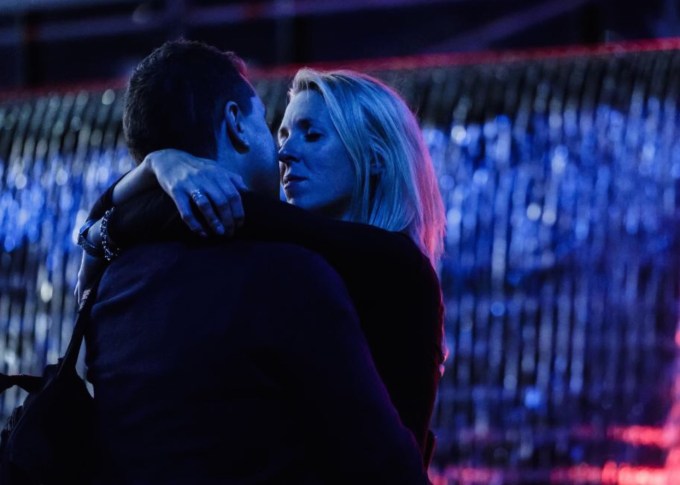
Few subjects intrigue and inspire people more than love, and yet it remains a baffling, misunderstood emotion.
We carefully reserve saying “I love you” but even this, often monumental, decision hides more complex thoughts and feelings that can be painful to admit.
Quite often what we are really saying, philosopher Alain de Botton says, is “I need you”, “you make me feel safe” or “wanted”.
Saying those three words is the simplest way we’ve found to admit our own essential vulnerability.
The English philosopher is travelling around Australia, dispensing his brand of relationship advice on the back of his latest book The Course Of Love.
A spookily accurate analysis of a relationship, the story about a couple falling for each other and navigating their way through marriage, children and ageing, delves into what motivates feelings.
When I catch-up with de Botton, he’s bouncing about on the balls of his feet and, despite being halfway through a dozen interviews, is clear-eyed and energised, keen for conversation.
With books on subjects as diverse as religion for atheists, status anxiety and the therapeutic benefit of art, plus his School Of Life where he gives relationship advice to couples and families, the 46-year-old has become a dab hand at analysing modern existence.
“I think there is a great hope that love can somehow solve some of the incompleteness of other areas of our lives and that’s a beautiful idea but it’s also quite a dangerous idea,” he says. “There is only so much that your partner can ever solve.
“It’s a hangover from a childhood belief that the parent can make it all OK.
“The first people that we love are these incredible, impressive, capable people … and I think there is this idea that our lovers, who are competent in many areas, are going to be able to make it all OK.”
He adds: “Of course at some point you realise they can’t and one choice is to throw them overboard and the other is to accept that with lots of areas of life they can put an arm around us.
“But they can’t spare us the ultimate fate that we’re headed towards, which is death, decline and failure at a cosmic level, and it’s tremendously hard.”
De Botton says that in the past people turned to God for the same sense of protection and love, but society had increasingly placed this expectation on intimacy in a relationship.
“God was always patient, could always understand, could always forgive,” he opines.
“We take those hopes to love with a human and it’s much trickier there.
“Society only gives us one model: the couple. And it really censors anyone who can’t make that work.”
It has been 12 years since I last sat down with de Botton and he appears to have aged very little.
The setting is different, not his grey-toned, impeccably ordered London home, but a plush hotel in downtown Sydney. The harbour, like a souvenir tea towel, is laid out before us with all its kitsch adornments.
He bemoans Brexit, “they’ve lost their minds”, before coming back to the topic.
“To love is to extend understanding to another person and in the face of a considerable number of obstacles, including the other person’s obtuseness, bad moods, peculiar behaviour and depression,” he says.
“It is a mutual process. People say love is communication, communication only matters because what you’re trying to do is understand.
“I think emotions will probably destroy you if you don’t analyse them.
“They are powerful things. Applying reason is good.”
For the next 20 minutes de Botton raps out punchy but thoughtful answers on how couples miscommunicate and end up resenting each other, their inability to express dissatisfaction and the danger of falling into caustic, destructive behaviour.
“Our own insignificance is one of the hardest things to have to accept,” he says.
“Children and adolescents are kept going by a very basic sense of their own importance and what happens in middle age is you really realise ‘I am a temporary grain of sand’.
“Love, I think, in that sense, is a slight illusion. But we need illusions to keep going.”
Feeling a sense of “connection”, he maintains, is key, and can be channelled through things such as work or the love of your children, rather than a romantic relationship.
“The most exciting moments are when someone goes ‘I get that, I understand that, I see you and I can relate’, and then suddenly the world seems less lonely and isolated.”
And so we ascribe love more importance than life, and tell ourselves it is vaster than death.
It is our defiant riposte to the universe — an alliance of like-minds indifferent to the unknown.
(Originally published in The Daily Telegraph)
 rtg
rtg 