When people talk about the innocence of childhood they aren’t usually referring to the gender pay gap.
But I’m going to draw that bow. It’s not as long as you think.
Because up until the end of school, the end of your childhood, the concept of potentially having a job that is worth more if you’re a bloke never crosses your mind.
I recall my graduation year at high school, a bog standard co-ed public on the South Coast, and the even balance among the students across all subjects. There was no marked difference.
Across the board boys and girls were either equally competent, equally brilliant or equally not made for school. My mate Anthony was dux in our graduation year, but another friend Katie was nipping at his heels.
We had no concept either that among the teaching staff there was any difference in competence, ability or intelligence. Because there wasn’t.
It turns out, though, that school was some kind of egalitarian utopia. Because once you start earning a wage a very different picture emerges.
Talk to experts and they’ll tell you the slow diminution of women begins when they enter the workforce or tertiary education, and continues steadily through their working lives.
Inevitably more and more are put off certain vocations by the male culture that has developed in them.
For men it is the opposite, entry to a club where everything seems slightly easier than it should.
In today’s workforce you hear more and more about redressing the balance and of programs mentoring women in the office. The completely incorrect implication of that being that women somehow haven’t kept up, or can’t play the game, or just aren’t good enough.
How did we get to this point? Or more precisely, how have we always been at this point and why has more not changed?
Men know, from as far back as we can remember, that women are intellectually on a par with us. That our ‘female peers’ are exactly that, equals.
We know it from science and we know it intuitively.
And yet the gender pay gap persists, as does the under-representation of women in company boardrooms and in politics.
There are only minor signs of improvement.
In this country the official wage gap has wound back only 0.6% from what it was in 1994.
And the Saturday Telegraph’s own investigation into the basic expectations of some employers shows just how transparent many industries are about paying women less than men.
Women, of course, are inevitably blamed for their own predicament. They’re allegedly not vocal enough, or cunning, or they are “too nice”.
It’s a bit like boys getting away with bad behaviour because they are boys. Men do too.
Men get away with being loud, overbearing or intractable because they are men, and it’s their nature.
The responsibility of women being paid fairly, equally, lies with the leadership of any organisation.
Offer anyone an advantage in the workplace and they’d be stupid not to take it, which is why responsible management is so vital. A management sensible enough to vanquish outdated practices and brave enough to see justice performed.
Part of it is appreciating the different attributes women and men bring to the workforce and rewarding them equally.
The subtle, but unrelenting, talking-over of women in the workplace, and the acceptance of it, will ultimately be to the detriment of our whole society.
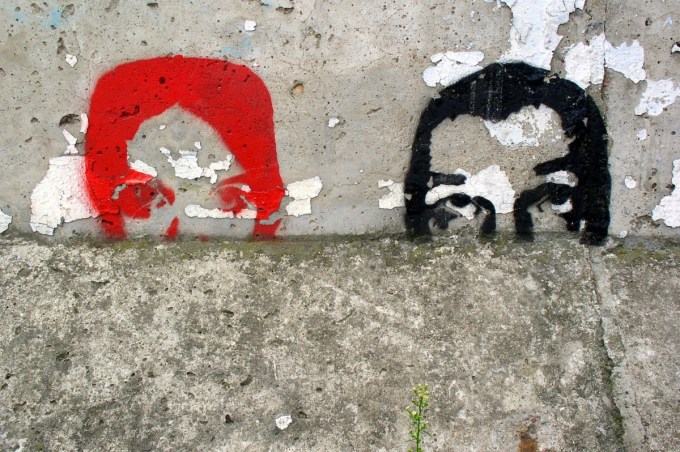
(Originally published in The Daily Telegraph. Illustration: Street art on Berlin Wall)
 rtg
rtg 