You can support both Israelis and Palestinians

In Britain a debate is raging over what constitutes anti-Semitism after it was reported Labour leader Jeremy Corbyn had attended an event eight years ago where Israeli policies towards the Palestinians were compared with the Nazis persecution of the Jews.

At the event Corbyn attended, controversially on Holocaust Memorial Day in 2010, the comparison was made by Hajo Meyer, a Jewish survivor of Auschwitz, and one of many Jews who are supportive of the Palestinians and critical of Israel’s treatment of them.

As some use the stigma of anti-Semitism to quash any criticism of Israel, it’s a valid but highly volatile area of discussion.

The charge of hypocrisy by Israel has arisen on and off over the years in reaction to events in the Occupied Territories and the inability of some to marry the idea of a people who went through the Holocaust carrying out what, at times, have appeared oppressive acts or heavy-handed reprisals against another people.

The Israelis have always argued it is necessary to ensure their security, a position they arrived at after all their neighbours attempted to drive them out of the region.

There are two distinct sides to this coin.

But let’s firstly be completely clear on any comparison with the Nazis during World War II.

The Holocaust not only ended the lives of six million Jews, it involved a level of dehumanisation, of maltreatment and torture that is still today difficult to put into context with what we know people are capable of.

There have been genocides that have killed more and particularly sadistic individual crimes that bear comparison, but not to the level conducted  by the Nazis.

The treatment of prisoners of war by the Japanese in the Pacific or their murderous sacking of Nanjing, while similar, again, were not the extensively drawn out, top to bottom assault on hope, health and happiness endured by Europe’s Jews.

The word ‘evil’ is overused, but not in the case of the Nazis. Their actions defied the very definition of human.

While there are valid grievances about Israel’s part in virtually incarcerating the Palestinian people in Gaza and the West Bank, the building of illegal settlements and the refusal to allow the return of refugees, they do not compare with Nazi Germany.

That doesn’t, however, in any way devalue the suffering of people such as Palestinian refugee Olfat Mahmoud. We feature her story this week, a long fight for repatriation to her homeland.

But we also tell the tale of WWII photographer Mike Lewis, who documented the horrors that the liberating British and Canadian armies uncovered at the Bergen-Belsen concentration camp in 1945.

Modern-day Israel is a state with a fortress mentality, an “us versus them” ethos, that has been forged as much by the anti-Semitic treatment of Jews during, before and after WWII, as it has been by the Arab-Israeli wars.

But being supportive of both Palestinian rights and of Israel are not mutually exclusive positions. A fair outcome for both is still achievable and some day will happen.

The danger is allowing the discussion to be dominated by extremes.

The Nazis were evil. Of that there can be no doubt.

The Israelis and the Palestinians, while at loggerheads now, are normal people, with normal fears, normal hurts and a mutual need for a safe and shared future.

(Originally published in The Daily Telegraph)

Decimation is not a model for fixing the world

Power shifts in the Middle East are rarely subtle (often they’re accompanied by large explosions), but their true motivations are usually complex and, quite often, well-concealed.

We’ve got used to disruption and death in that part of the world. We shouldn’t have.

There has been an unconscionable meddling in the affairs of countries in the Middle East, but there is also the danger those tactics will be expanded elsewhere.

One of the most sinister propositions yet has been the US talking openly about the ‘Libyan model’ in reference to North Korea.

It refers to regime change by force, leaving a shell of a country to fight among itself, rebuilding by foreign contractors (lining their pockets), little aid and less attention.

“That was a total decimation,” US president Donald Trump said candidly yesterday.

Before the violent unseating of Colonel Muammar Gaddafi, Libya was the most prosperous country in North Africa and by most measurements stable.

With attacks by foreign-backed rebels it descended into what the West was quick to label “civil war”, but was actually Libya fighting a small insurgency in one pocket of the country.

Claims by NGOs and rebels in 2011 that Gaddafi’s military was massacring civilians by shelling towns were ultimately proved to be untrue. But they provided the pretext for the US to push for a UN Security Council mandate enforcing a no-fly zone to protect civilians.

As a journalist working on a Fleet Street tabloid at the time I fielded many nightly reports from the ground of rebels breaking the ceasefire as the Libyan military stood back.

And yet it was the claims of the US government that Gaddafi was responsible that became the accepted narrative in the media.

The UN mandate was then cynically used by a coalition, led by the Americans, British and French, to bomb the Libyan army into submission and create a corridor for the rebels straight to Tripoli.

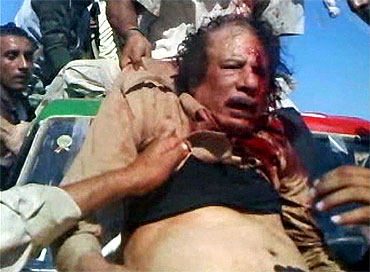
By the end of 2011 Colonel Gaddafi’s brutal, undignified murder by those rebels had been videoed on a phone and shared around the world, and Libya had descended into hell.

Today, the country is divided between two competing governments and a variety of Islamist rebel and tribal groups recognising no authority.

In other words, it is a compete mess. And for what?

The ‘Libyan model’ that Donald Trump and his national security advisor John Bolton speak of does not provide solutions, only worse problems. And a compliant and gullible media has done itself no justice by accepting unfounded claims as fact.

Take a closer look at how much actual evidence (as opposed to claims and unverified intelligence reports) has been presented that the Syrian government is responsible for chemical weapons attacks. 

It may surprise you.

Former US president Barack Obama has been pilloried for derailing a budding war on Bashar al-Assad, and allowing Vladimir Putin time to sneak in and provide a permanent and effective deterrent against any significant military action by the US.

But the truth is Obama’s defiance of his own State Department saved Syria from an even more bloody and pointless period of destruction than currently exists there.

Ousting Assad and leaving the Syrians to the fate of the jihadist groups that would fill the void would have created another Libya.

Whereas Obama’s policies sought to create more balance in the Middle East, a deal to stem Iran’s nuclear program balanced against the anti-Iranian alliance between Israel and Saudi Arabia, Trump has ripped up the 2015 deal with the mullahs and given his material support to Benjamin Netanyahu.

The message to everyone across the region is the US is on the front foot in the Middle East. It has already shown with Syria it will push to the point of risking a fight with Russia.

So, the US’s canonisation of Jerusalem as Israel’s capital this week, while further stifling the hopes of an independent future for those incarcerated in Gaza and the West Bank, was really about ratcheting up pressure on Iran, where Bolton would also like to see regime change.

North Korea doesn’t need the ‘Libyan model’, nor does Iran, nor does Syria.

But is it coming? Stay tuned.

(Originally published in The Daily Telegraph. Screenshot of Colonel Gaddafi’s death)

Attacking North Korea would see hundreds of thousands dead on both sides

The ABCs of a war with North Korea make bleak reading.

A for Artillery. B for Barrage. C for Casualties (M for Mass). etc.

And if you want to add maths to the lesson try this: 300,000 dead South Koreans and US servicemen, hundreds of thousands of dead North Koreans.

And that, according to experts, would be in the first 90 days of fighting.

Nevermind that it might spiral out of control and suck in other countries: China, Russia… ourselves.

Despite Kim’s ballistic missile tests and Donald Trump’s proclamation to the UN that he is prepared to “totally destroy North Korea” no sane analysis of the situation predicts an attack by either country.

Well before the current crisis over Kim Jong-un’s nuclear programme North Korea had been deemed too dangerous to confront. Bristling with conventional weaponry, as well as possibly chemical weapons, the toll of war with the North had ruled out all but a diplomatic solution.

But with hawkish calls for North Korea to be ‘dealt with’, the US’s UN ambassador Nikki Haley talking up confrontation and Malcolm Turnbull pledging the support of Australia, analysts around the world mostly agree even a precision pre-emptive strike by the US would only prompt a retaliatory attack on the South, and blow up the entire region.

The notion that Kim is crazy and on a death-by-cop style suicide mission over-simplifies the brinkmanship both sides are employing.

Regional security expert Franz-Stefan Gady, of the EastWest Institute in New York, says: “Even without the use of DPRK weapons of mass destruction, civilian casualties in the larger Seoul metropolitan area might surpass 100,000 within 48 hours and that’s just the low-end estimate.

“Many of these casualties would be foreigners including Chinese Australians and Americans.

“US and Republic of Korea forces would shower North Korea with a combination of cruise missiles, bombs, and artillery rounds; Hundreds of thousands of North Koreans would die in this firestorm.

“DPRK would primarily launch WMD missiles against military targets in South Korea and Japan. A special target would be the US bomber force on Guam.”

In layman’s terms it would be like an international version of Waco, but much, much worse.

North Korea has the second largest army in Asia, some 1.19 million troops and another 600,000 reservists. There are 8,600 artillery batteries around the country, most arranged around the demilitarised zone that separates North and South.

Furthermore, war and the termination of trade with the North would fuel a huge refugee crisis, with estimates of a million or more displaced people flooding across North Korea’s border with China.

Of the 150,000 troops the US has stationed around the world, about 29000 are in South Korea and another 47000 in nearby Japan.

Unless the US is prepared to use the doomsday option of nuclear weapons against North Korea, potentially killing hundreds of thousands of people, the only real option is targeted sanctions and a negotiated peace treaty with Kim.

Jingdong Yuan, a North Korea analyst at Sydney University, said the US has no option but to negotiate.

He says: “China could, if it wanted to, have a very severe impact on North Korea’s economy because 90% of North Korean trade is with China.

“But North Korea could then open its border with China to millions of starving refugees. That is why China is not willing to go to that extreme.”

Professor Yuan says Kim Jong-un is sabre rattling to negotiate his own security and, despite the rhetoric, sees the country’s nuclear weapons programme as defensive. Getting the US, Japan, Russia and China to the negotiating table with Kim is vital.

“Right now is not the time to further escalate because there really is no good outcome there,” he said. “Diplomacy, too, will be seen as appeasement. Some specific stringent sanctions are needed that leave enough room for North Korea to see it as incentive to come to the table.”

There have been numerous previous provocations by North Korea that could have prompted retaliation. In 1968 the country’s navy captured the USS Pueblo, killing a US serviceman in the process. There were naval clashes in 2002 in the Yellow Sea and the South Korean corvette Cheonan was sunk in 2010 with the loss of 46 lives.

Since the end of the Korean War there has been no peace treaty between North Korea and the South and its allies. Reconciliation initiatives, such as the 1972 Joint North-South Korean Communiqué, the 1991 Joint Declaration of South and North Korea on the Denuclearisation of the Korean Peninsula, and the 2000 North–South Joint Declaration, all ended with disappointment.

But 64 years after the war ceased, Korea still serves as a buffer zone which separates the economic interests of the China and Russia dominated Eurasian continent from the US-dominated Pacific rim.

American political analyst Robert E. Kelly writes: “So ritualised are North Korea war-scares that the interesting parts are not the rehearsed statements and events themselves, but how people react to them.

“One regularity I have noticed increasingly is the tendency of Western analysts in particular to, for lack of a better word, freak out over North Korea.

“North Korea has this effect. People kinda’ lose their minds and say gonzo stuff they wouldn’t say about other foreign policy problems.”

He says the US has escalated the problem.

“South Koreans are barely paying attention,” he adds. “The South Korean president and then foreign minister both went on vacation in early August, at the peak of the Kim Jong-un – Donald Trump war of words.”

South Korea is used to living with the provocations of the North.

Furthermore North Korea has become an increasingly paranoid state, convinced that it lacks the full support of China and Russia, while potentially being targeted by the US, which conducts annual war games off its coast and stations troops just over its border.

It is worth remembering that during the Korean War, North Korea was effectively levelled.

The US dropped 635,000 tons of bombs and 32,557 tons of napalm on it. Almost every main building in the country was destroyed and the populace effectively moved underground to survive the bombardment.

Of 22 major North Korean cities 18 had more than half their area destroyed. Bombing of Pyongyang was only halted because there were no worthwhile targets left. About one in seven of nine million North Koreans were killed.

And it is against this background that North Korea views the United States.

Kim Jong-un sees having a viable nuclear deterrent as a way of safeguarding his regime, and the speed at which he is developing its missile programme has taken the major powers by surprise.

“It seems that both Koreas are destined to live in the perpetual fear of war without really experiencing it,” opines Dr Leonid Petrov of the Australian National University.

He believes that as well as there being a humanitarian disincentive to take on North Korea, the strategic problems caused by a unification of the divided countries would change the power balance in the region.

Dr Petrov adds: “If the North and South are unified, peacefully or otherwise, the presence of US troops will be questioned not only in Korea but in Japan as well. US security alliance structures across the Pacific will crumble, followed by economic and technological withdrawal from the region.

“Even the new Cold War against China and Russia won’t help Washington prevent the major rollback of American influence in Asia and the Pacific.”

With America out of the picture Russia and China, he surmises, will resume a power struggle for regional hegemony.

“The unification of Korea would open a new era of regional tensions, which nobody is really prepared to endure,” says Dr Petrov.

“If North Korea is deliberately targeted or attacked and destroyed that would trigger processes far beyond our imagination and control and inevitably lead to tectonic shifts in politics, security and economy of the region, which collectively produces and consumes approximately 19% of the global Gross Domestic Product.

“By removing one piece from the current imperfect but undoubtedly stable structure, one risks a domino effect that is likely to come around the globe and hit those who would dare to trigger this cataclysm.

“One needs to be hell-bent on self-destruction to contemplate such a scenario.”

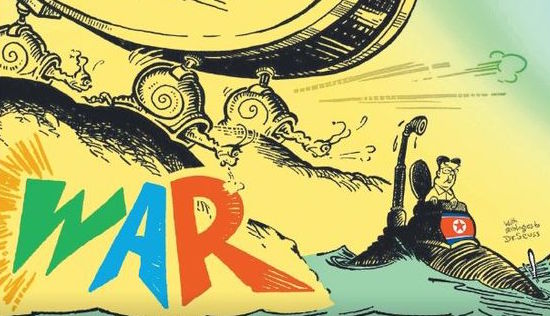
(Originally published in The Daily Telegraph. Illustration by Terry Pontikos)
Ukraine reporting shows bias of Western media

In the space of a few months Ukraine has been embroiled in two uprisings.

Both have appeared equally legitimate, both have been bloody and both have had the backing of differently aligned foreign governments.

So why has the media characterised the US-backed one as a democratic right and the other as troublemaking by Russia?

And why does one bloody crackdown provoke press outrage and another not?

Reporting on Ukraine has been singularly one-sided with the media and the government moulding public perceptions by omitting information, or slanting it one way or another.

At the height of the first uprising in February Viktor Yanukovych was portrayed in the strongest terms as a corrupt leader responsible for killing civilian protestors. Those civilian deaths were seen as a catalyst for a change of government by force.

There has been no such outrage expressed for the more than 100 pro-Russian separatists killed by the new government, the most recent in heavy-handed attacks on Donetsk.

The Maidan protests, backed by the US, Germany and Britain, have been given fair, at times favourably biased, coverage, while those of pro-Russians have been scandalously under-reported or ignored.

More so the language used to describe each varies damningly.

It has been accompanied by a concerted and completely over-the-top demonisation of Russia, which culminated last week in Prince Charles comparing Vladimir Putin to Hitler and ‘Red’ Ed Miliband seeming to support the remarks.

Opponents of Yanukovych were often described in the media as peaceful protesters, despite scenes of some of the most ferociously violent attacks on Ukraine’s police – attacks for which the only UK parallel might be the Broadwater Farm riots in which PC Keith Blakelock was murdered.

In Kiev 16 police officers were killed by protesters. Can you imagine the reaction to that if it had occurred in Britain?

By contrast the western media routinely describes pro-Russian separatists as rebels, militants, insurgents, Chechens, terrorists, militia.

It is often slyly suggested they have less claim on being Ukrainian, that they are insurgents from across the border or puppets of Russia, despite the overwhelming evidence that they are local, multi-generational Ukrainian residents with real gripes against the new right-wing government.

Earlier this month a fire in the Odessa Trade Union building killed 38 pro-Russian protesters, but the media quickly accepted the Kiev government’s claim they were killed by a blaze they had begun.

Pictures of teenagers merrily making molotov cocktails outside the building didn’t change the media’s attitude. Nor was there much comment on the chants about roasting ‘Colorado beetles’ (a derogatory term for the pro-Russians) that rang out as the protesters burned. Video showed those trying to flee the blaze set upon by right-wing thugs.

The apparent strangulation murder of a pregnant women in the same building in a room in which government supporters unfurled a flag out the window, has not been investigated or commented on in the press.

And though video evidence emerged on the web of government supporters in collusion with police staging false attacks dressed in pro-Russian armbands it was not written about or reported in the mainstream media.

The truth about what happened at Odessa has only emerged through social network sites.

Instead there was an overriding willingness by press, broadcasters and online news groups to not blame government supporters for the deaths and to quickly move on.

By comparison the shooting of civilians during riots in Kiev against Yanukovych were denounced in the harshest of terms around the world. Germany and the US piled pressure on the government with threats of sanctions, and when Yanukovych eventually retreated from the capital an arrest warrant was issued accusing him of ‘mass murder’.

Days later, when a leaked EU phone call raised the prospect some civilians may have been deliberately shot by the Maidan opposition to inflame the situation, little was said. An investigation by the new authorities into deaths in Kiev during the protests has so far gone nowhere.

Each day across Ukraine’s restive east more and more pictures are posted on Twitter of the bodies of civilians  – middle aged women, casually dressed men – lying dead by the roadside.

But how many do we see in the press, on TV or online news agencies?

Typically such reports are omitted or tempered with claims of trouble being stirred up by Russian infiltrators – legitimising the killings.

It’s a common propaganda technique, but we see it more and more from our governments and our media.

While the referendum in Crimea and the east for more autonomy was decried as illegal by the West and reported as such, the election of a new government in Kiev has been given legitimacy by the world’s media, even though breakaway regions boycotted the vote.

Residents in those regions have now been dubbed ‘bandits’ and ‘terrorists’ by the newly elected hardline president Petro Poroshenko.

Underlying the entire conflict are claims the US encouraged the Maidan revolution to create another Nato state on one of Russia’s most sensitive borders, and where its Black Sea Fleet is moored at Sevastopol in Crimea.

In the press Russia’s subsequent annexation of Crimea was denounced as a shameless land grab and Vladimir Putin accused of trying to rebuild the old Soviet Union.

Despite there being a majority of Russian citizens living in Crimea and clear parallels with the Nato-backed independence of Kosovo, relations between Russia and the US deteriorated to the point of talk about a new Cold War.

That has filtered down to the man in the street and one in the palace.

Ironically, the groups now in control in Ukraine are more right-wing than any European government since the Nazis.

But this bias in the media has existed for a long time and extends beyond the Ukraine today.

Reports on the Syria conflict are horrendously one-sided. Unsubstantiated charges of chemical weapons use by the Assad government are reported as fact.

The killing of pro-Assad voters at an election booth last week given no more than lip service.

Yes Assad has committed some terrible acts, but what of the al-Qaeda groups ranged against him? What of the beheadings, the mass killings, the torture and religious discrimination they have brought with them?

When rebels fighters deliberately cut off the water supply to 2.5million residents of Allepo a fortnight ago, only The Independent reported on it. Even Ban Ki Moon’s condemnation of this act went unreported in the mainstream media.

Similarly there has been no outrage about the Kiev authorities attempts to cut off the water supply to the Crimea.

These are actions that can force a humanitarian crisis, and yet there is no outrage and the general public remain uninformed.

Going back to the reporting on the Balkan wars, Serbia was demonised and accused of ethnic cleansing and running rape camps. The latter was not proven and the former described tactics used across the board by all sides in the conflict.

And while the massacre by the Bosnian-Serb army at Srebrenica is the worst and defining atrocity of the wars, little is ever mentioned of the 50 villages razed to the ground and 5,000 Serb civilians murdered by muslim raiding parties in the same region in the run-up to it.

Decades on Serbia is still characterised simplistically as the bad guy while equally reprehensible war crimes committed by other sides barely get mentioned. To do that would muddy the narrative that the media demands.

Having worked in Fleet Street for almost two decades I know there is no one pulling the strings. There is no secret plot to subvert particular information while promoting the other.

No one calls up editors to exert pressure, and nor do the editors dictate to their journalists. And yet with great predictability they fall in line with a prevailing mood.

The media promotes a concept of good and bad, with no in-between.

It needs a simple, familiar narrative for its readers to understand (perhaps for its journalists too), one that is often, although not exclusively, still based on old world prejudices.

Known story patterns are repeated with rare deviation.

Passion, outrage and righteous indignation sell papers and (today) get page hits.

But what of the full facts? What of the other side of the story?

Our written history is at risk if it is based on the perception given by media and governments pushing their own blinkered or negligent agendas rather than the true, full story.

Nowhere is this hypocrisy more evident than in the current reporting on Ukraine.

(Originally published in The Huffington Post)

Salivating press won’t let fantasy get in way of ‘serial killer’ story

Her story came out of the blue. A seemingly unnecessary, unprompted confession to a local newspaper reporter that she had committed anywhere between 22 and 100 murders.

In the general run of things such admissions are normally made to detectives, psychologists or prison pastors, and checked over before any such notion is taken to the press and the public.

But from the out self-confessed serial killer Miranda Barbour’s story was front page news.

More than two months after her arrest Sunbury’s unprepossessingly named newspaper The Daily Item obtained an interview with the 19-year-old after much shenanigans with local prison authorities.

By this time, while not known outside of East Coast America, Barbour was already big news in the small Pennsylvania town.

Nestled behind an imposing flood wall on the Susquehanna River near the point it empties into Lake Augusta, Sunbury has a population of less than 10,000 people, limited job opportunities and a burgeoning drugs problem.

For a small place it has its fair share of problems with residents more than twice as likely to be the victim of violent crime than the national average. But while having a disproportionate number of rapes and assaults the murder of Troy LaFerrara on 11 November last year was still out of the ordinary.

The 42-year-old married man was lured by an advertisement for sex on the Craigslist website and allegedly stabbed to death by Miranda Barbour as her husband of three-weeks, Elytte, strangled him with a cord from the backseat of their car.

The Daily Item seized on the tale, running some 36 stories in the paper and online between Barbour’s arrest and her eventual ‘confession’ to reporter Francis Scarcella.

Because of the couple’s supposed interest in Satanism the paper ran at least two stories reporting on and theorising about Satanic links to the murder.

Barbour having read the extensive coverage of her case in the Item wrote a letter to the paper requesting a meeting on 7 January. It was initially denied by the Northumberland County Prison authorities but after calls for staff to be stood down for breaching the prisoner’s rights it went ahead on 14 February.

It may be fair to surmise that at this point Barbour had already made up her mind about ‘revealing all’ to the paper and had either held back from talking to the authorities or never intended to, despite another five weeks passing.

She told the Item she was a serial killer and had stopped counting after 22 murders, but added that she had killed less than 100 people.

Barbour also claimed to be able to pinpoint each of the murders and lead investigators to the bodies.

By going to the press first she ensured her outlandish claim would get prominent exposure even if it later fell apart under scrutiny.

Police had no choice but to take it seriously and investigate fully, especially as they already had one murder on their books she had been charged for.

Within hours The Daily Item’s grisly scoop was making headlines around the world and Barbour was being billed as possibly the worst serial killer in America’s rich history of psychopaths.

In the UK the Express asked ‘Is this the world’s worst serial killer?’ (Harold Shipman.. Luis Garavito anyone?)

But despite the police having had no time to test the validity of her claims few media outlets cast doubt on the story.

Having played on fears of Satanism in the weeks following the ‘thrill killing’ of LaFerrara The Daily Item’s prison interview revealed sensational claims of Barbour’s induction into a Satanic cult at the age of 12 in North Alaska and her first murder committed the following year with the man who had recruited her.

Despite professing to be one of the devil’s acolytes Barbour contradictorily told the paper she only killed ‘bad people who do bad things’ and so was justified.

For most law enforcement officers, however, the mere mention of Satanic cults is generally met with eye rolling. A popular unfounded fear in middle America the existence of such groups in any real sense is extremely rare. It is far more common that claims turn out to be the figment of the imagination of delusional, often mentally unstable individuals.

The killing of LaFerrara too did not sit easily with the tale of a young girl committing regular murders for several years without raising an eyebrow of suspicion or leaving a trail of bodies behind her, as she claimed to have done across Alaska, Texas, North Carolina, Pennsylvania and California.

To get away with such a spree would require extreme care and cunning.

But the LaFerrara murder was anything but clever. The alleged killers, having placed a traceable ad on Craigslist, were in phone contact with the victim and left their 2001 Honda CRV dripping with blood. Not even the cleaning fluid and towels they were caught on CCTV buying shortly after the murder were enough to wipe away the evidence. And having killed LaFerrara they then dumped his body in an alleyway where it was quickly found.

This was the most telling indication that Miranda Barbour had made up her killing spree.

But the media attention did not abate and, instead, latching on to her claim to have only killed ‘bad people’ some media firms enthusiastically branded her ‘The Dexter killer’, after the fictional TV serial killer who murders only other baddies.

Nevermind insulting the dead and that her only known ‘alleged’ victim LaFerrara had done nothing worse than answer an online sex ad.

To this day Barbour has provided no credible evidence to detectives of any murder other than the one she has been charged with.

As scepticism grows around her story, the infamous murders of her home state serial killer Robert Hansen (the story of which was recently made into the movie The Frozen Ground with Nicholas Cage) might have inspired her to make up the story. Her incarceration also coincided with British serial killer Joanna Dennehy’s boastful and unapologetic admissions of three brutal knife murders of men she felt slighted by.

While inquiries continue, the question remains could she have been involved in any previous killing?

Given her frenzied attack on LaFerrara, you may say it’s possible.

But if she has, it cannot be on the industrial scale claimed and it’s more likely the police have caught her at the start of a spree rather than the conclusion of one – her claims being nothing more than attention-seeking fantasy.

For the media, who too readily embraced a big story that defied all conventional logic, the question is will they be more scrupulous next time or have they, in the drive to sell more copies and generate more online page hits, forever sacrificed getting it right first time round in favour of enticing in readers?

(Originally published in The Huffington Post)

Groundhog Day for the Middle East

We’ve seen it all before. It’s like Groundhog Day, the location is different – Syria not Iraq or Libya – but the rhetoric remains the same.

While the discredited ‘Weapons of Mass Destruction’ mantra is gone, in its place the same humanitarian tipping point pared down – chemical weapons.

It is widely agreed that historic stockpiles of chemical weapons still exist in military facilities in Syria, but there has been no evidence of the Assad regime carrying out the attack on Ghouta or any other locations.

There have been indications, however, over the past year that Syrian rebels themselves may have obtained, tested and even used chemical weapons.

In May it was reported members of Syria’s militant Al Nusra group were arrested in Turkey with 2kg of sarin. While in July a Turkish jihadist site claimed rebels had obtained chemical weapons from a military base they had overrun in Allepo.

Further back in 2012 of last year the purported rebel faction Kateebat A Reeh Sarsar (Brigade of Chemical) released a propaganda video showing poison gas tests on rabbits.

The video showed an array of chemicals from the Tekkim company, including sodium nitrite, potassium permanganate and potassium chlorate (all oxidisers that can be used in the creation of gas). Masked militants threatened to use them on Assad’s people if the West did not intervene.

But this isn’t talked about.

William Hague instead insists the rebels have no chemical capabilities and do not possess the ‘weapons systems’ or motivation to deliver them.

In saying this he ignores documented evidence of the rebels use of median range rockets, never mind the fact sarin nerve gas (if that’s what it is) can be disseminated into the atmosphere using a simple handheld humidifier (something the Japanese doomsday cult Aum Shinrikyo demonstrated in its 1994 attack over a wide area in Matsumoto that killed eight and injured 200).

On other points the Foreign Secretary has misled.

“Over the past year we have seen evidence of the repeated small-scale use of chemical weapons by the Syrian regime,” he said.

In actual fact there has been no documented evidence of the Syrian government using chemical weapons against the rebels, only the claims of the rebels.

An investigation in May by the UN Independent Commission of Inquiry on Syria into an alleged attack by the Syrian government on a rebel area concluded that it was in fact probably carried out by the rebels.

The UN’s Carla del Ponte, one of the world’s most respected war crimes investigators, said: “There are strong, concrete suspicions but not yet incontrovertible proof of the use of sarin gas, from the way the victims were treated. This was used on the part of the opposition, the rebels, not by the government authorities.”

Despite this previous finding of rebel groups possibly gassing their own people and then blaming Assad, Britain, France and the US have stuck steadfastly to the line that the rebels could not kill their own people.

No evidence has been produced, nor a motive for the Syrian government carrying out an act that would almost guarantee Western military intervention.

For it to happen on the day weapons inspectors arrived made even less sense.

Over the past few months the Syrian government has staged several convincing defeats of the rebels, recapturing the city of Qusair and the Baba Amr district of Homs.

Though the New York Times reported in February that large shipments of arms, paid for by Saudi Arabia, had been smuggled to the rebels across the Jordanian border, the Government still enjoys overwhelming military superiority.

It begs the question: Why would the Assad regime need to deploy chemical weapons at all?

Since Saddam Hussain’s gassing of the Kurds in Halabja in 1988 there have been few more incendiary actions to initiate then a chemical attack. Any government in the world understands the significance of it, but so does the opposition.

The prospect of Colonel Gaddafi using chemical weapons was also raised in the build-up to bombing Libya, further demonising a regime that had primarily been criticised for shelling rebel towns in its civil war. Gaddafi was repeatedly accused of breaking a ceasefire with rebels, even though it was clear from reports by journalists on the ground that the rebels were continuing to attack government positions.

Rebel groups have learnt how to get the upperhand in the PR war against their enemy, particularly where it fits in with foreign policy objectives in the West. Such tactics have been honed since the Yugoslav conflict, when Bosnia and Croatia, and then the rebel ‘Republic of Kosovo’ were represented by American PR firms such as Ruder Finn, who lobbied on their behalf in the US.

Unquestioning acceptance of the inaccurate and of the unsubstantiated has become the norm.

Even the alleged death toll of up to 1,300 from the chemical weapons attack in the suburbs of Ghouta remains unproven and backed mainly by YouTube footage. Doctors Without Borders have independently estimated 355 dead.

And yet the higher undocumented figure is still repeated ad nauseum to further dramatise the tragedy and increase the drive for military action.

Without wanting to suggest there wasn’t a gas attack (because there clearly was) there has been a lack of the most basic factual indicators including no autopsy findings of the physiological changes that sarin gas causes in the human body. In the rebel-controlled area where it occurred facts are being obscured.

What we have had are the highly emotive pictures of dead children, evidence of a brutal atrocity but on what scale and carried out by whom?

Last night’s reluctant decision by the government to delay missile strikes and allow UN weapons inspectors more time may only prove a hiccup in the snowballing momentum to bomb Syria.

The US say they believe the Assad regime has perpetrated chemical weapons attacks based on samples taken from various sites, but again this is not proof of who did it. Instead the very existence of chemical weapons is being taken as a tacit example of the Syrian government’s culpability.

Perhaps the most galling aspect of Hague and David Cameron’s bullish pursuit of military action against Syria is its transparency.

They use the same tactic Tony Blair employed in the build-up to the 2nd Iraq War – ‘repeat an accusation enough and you can pass it off as fact’. Perhaps like Blair the PM wants to believe the public too callow to tweak to this lack of substance.

In the meantime Blair, the Middle East’s so-called envoy for peace, is advocating missile strikes on Syria by employing the bogus assertion that by not taking action we instead dither and allow a humanitarian crisis to unfold.

“We have collectively to understand the consequences of wringing our hands instead of putting them to work,” he intoned in his most evangelical pronouncement yet.

Hague has parroted the same view stating we “cannot allow diplomatic paralysis to be a shield”.

Blair also claimed Syria would become a breeding ground for extremists, ignoring video footage of summary executions of soldiers and civilians by the rebels, some factions of whom have vowed to wipe all Alawite Shias off the face of the earth.

And much like Blair’s ‘Dodgy Dossier’ claim, prior to the 2003 invasion of Iraq, that Saddam Hussain could launch chemical weapons strikes on UK targets within 45minutes, Hague has more subtly introduced the concept of a direct threat to the UK.

“We must proceed in a careful and thoughtful way, but we cannot permit our own security to be undermined by the creeping normalisation of the use of weapons that the world has spent decades trying to control and eradicate,” he wrote in the Telegraph.

The lone voice of common sense has been Russia, which quite rightly has asked for evidence before action.

There is a long and chequered history of opposition groups providing false information to the West or staging outrages to justify military assistance.

Iraqi defector Rafid Ahmed Alwan al-Janabi admitted he made-up WMD claims that were the basis for the invasion of Iraq – in order to oust Saddam. And in Libya rebel claims of massacres of the civilian populace were not supported by recorded mortality rates.

It must be asked if the chemical attack in Ghouta was planned by Syria’s rebels to escalate US and European intervention, paving the way for the type of rout we saw in Libya.

If Iraq taught us nothing else it should be that our leaders respect the truth and not regard manipulation of the facts as a justifiable means to an end – the means to a war.

(Originally published in The Huffington Post.)