We’re all in this together

Time catches up with you. Fast.

I recall fragments of conversations with Heather. Happy, optimistic, edgily anarchic interactions. Her, splattered in paint.

At high school there were two teachers who made a big difference for me and the way I saw the world.

One, Mike Willis, taught English and swaggered around like a cowboy.

‘Just get on with it,’ was his barked catchphrase. For a man with a big heart it surprised everyone when it stopped abruptly in his mid-50s.

Wise, even as a relatively young bloke, at school he was an ally as much as an educator.

When I visited his wife Denise a year after his death, Mike’s car keys and wallet had been left in the same spot on the kitchen counter where he had last put them down.

His car, parked on the front lawn, had not been moved. Grass grew high under the wheel arches.

The heart is slow to heal.

This week I learned of the death of the other influence in my school life.

Heather Pulsford taught me art, but more than that was a like-mind, a sounding board and a friend.

She was that way not just to me, but to many people in her life and among the arts community that was her stomping ground.

I last saw her two years ago. By then, quite old, Heather had been sick for a while and was using a ventilator at night to breathe while she slept.

Still fiery in her manner, she was nonetheless frustrated at being so constrained.

For a woman with a big brain and a need to be busy all the time, and to socialise with others, it was a devastating come down.

Weakened by pneumonia she succumbed in a hospital on the South Coast with her family around her.

A public Facebook post on her death has been inundated with tributes from friends, family, the community and her former students.

I know she will have sensed that sweeping wave of support even as she was bed-bound and cursing being let down by her body and her health.

In the news we usually only hear stories about the wrong type of relationships that go on between teachers and students.

But most of us benefit in our childhood from those few genuine mentors that take an interest in you at a time in which you struggle with a growing sense of both your independence and isolation.

Those internal monologues we all have, echo too infrequently in the spoken ruminations of others.

Some like to say ‘the universe will provide’ – but it does more than that. The universe wants us to succeed.

And, I don’t feel by coincidence, it puts people in our way that help us grow and that sustain us through the hard times to come.

We have these people dotted around us: at school, at work, in our family, among our friends and loves.

The abiding theme that religion and science seems to agree upon is that there is a destiny to life, no matter how we interpret that.

We are made to go forward, to create and build, to better ourselves and along the way help others do the same.

It’s not teamwork, it’s community, whether large or small.

When I was a kid, Heather was part of my little community and I thank her for sending me spinning off in the right direction.

(Originally published in The Daily Telegraph)

Where the big trees are

Three and-a-half metres across and 111 hand spaces around, a solid column of wood, 17 storeys high rises straight up out of the bush above us.

Here in the bird quiet of Myall Lakes National Park, the kids have momentarily shut off Roblox and put their phones down to marvel at the huge old eucalypt. And I have too, craning my neck back, and back … and still further, to see its top.

At 76m high The Grandis, a 400-year-old flooded gum, is NSW’s tallest tree despite having its crown smashed by lightning on a couple of occasions.

Surrounded by numerous other giants of a similar age and diameter, it reigns as the king of the forest at Bulahdelah on the state’s Central Coast.

And like most of the country’s living giants, finding it requires a bit of bush bashing — in this case the gully of big trees takes a long drive down a dirt track off the Pacific Highway.

Since seeing the 1952 Kirk Douglas film The Big Trees, about California’s giant redwoods, I’ve been fascinated with the majesty of these ancient colossi.

But not many Australians know that five of the world’s 10 tallest trees are in Australia, including the second tallest in the world — Centurion, a giant mountain ash eucalypt in Tasmania’s Arve valley — that comes in just under 100m. Only the 115m Hyperion coast redwood in Humboldt Redwoods National Park, California, is greater.

“In Australia there’s none of the national pride that Americans enjoy with both the redwoods and the giant sequoia,” says Steve Pearce, 39, of Hobart-based Tree Projects.

“The Americans are so much more enthused by the symbolism of their giant trees than Australia.”

Pearce, who with arborist Jen Sanger travels the world researching and photographing giant trees, is among a growing band of tree lovers trying to preserve Australia’s old-growth forests.

But height is not the only measure of greatness in trees: age, circumference, spread and historical significance all have their place.

The Huon pines of Tasmania, which can live for 3000 years, and the prehistoric Wollemi pine, discovered 150km northwest of Sydney in 1994, which can live for 1000, are among the oldest in the world.

We talk of “the bush” in Australia, but about 19 per cent of the country’s land mass is forested — 147 million hectares of rainforest, melaleuca, eucalypt, acacia, mangrove, casuarina and callitris — with climates varying from alpine, desert and tropical.

Among those zones exist a huge variety of mega-flora, from the karris eucalypts of Western Australia, which can reach 90m, to the boabs of the Northern Territory, which swell to 5m or more in diameter.

In NSW the Old Bottlebutt red bloodwood near Port Macquarie is the largest of its kind in the southern hemisphere, while Middle Brother National Park on the mid-north coast is home to the giant blackbutt trees Benaroon and the Bird Tree, the biggest of their species with girths of 15m and 11m respectively.

Sydney’s huge Moreton Bay figs are so plentiful few are considered for historic preservation, sometimes resulting in controversy. Two years ago Randwick’s 150-year-old Tree of Knowledge was cut down to make way for the light rail expansion.

And there are the historic trees, planted by early settlers, or engraved with directions, like the Mermaid boab.

It was named by English Admiral Phillip Parker King after his ship the HMC Mermaid beached at Careening Bay in the Kimberley. The inscription by the ship’s carpenter, marking its name and the year (1820) is still clearly visible 198 years later.

In Carramar, Western Sydney, the Bland Oak is a local institution. Planted by Dr William Bland in 1842 it has just been added to the National Trust’s register, which documents and protects more than 2000 significant trees.

Graham Quint, the director of Conservation at the National Trust of Australia, says many of the country’s big trees have been lucky to survive on “road reservations” where the roads haven’t been extended. “They cleared the rainforests for the farms and suburbia and these big trees are sort of left there as remnants,” he adds.

“It is almost impossible to grow another one like that now. They are the remnants of the old forests, some growing for hundreds of years. If you tried to grow one now without the protection of the rainforest they would never get to that height.”

The National Trust combines protecting historic streets of trees, such as King George V Memorial Ave’s oaks in Tamworth and trees planted by early explorers.

“The problem with school playgrounds is the threat of branches dropping from coral trees and eucalypts in particular, which will just fall over without warning,” Quint says. “It’s balancing public safety. And we tend not to list the Moreton Bays because they are so common.”

He adds preserving great trees in Australia is made harder by the elements.

“The bigger the tree the more likely, with white ants and all the problems we’ve got here, bushfires and high winds, the harder to keep them alive. In Japan, they prop them up.”

Sydneysider Derek McIntosh, a retired quantity surveyor, started the National Register of Big Trees website a decade ago. “When you’re touching a tree, looking at the bigger older ones, you think ‘they’re a survivor’,” the 77-year-old says.

“There’s a great depth of love and recognition of trees and their importance.”

As a child growing up in South Africa, McIntosh developed a love of trees from his father who would take him into the Kruger National Park to look at the wildlife.

He now documents what he calls champion trees, the biggest of the genus around Australia.

“Farmers are the major custodians of our trees and plants. I go to these farming properties and many of them have survived because they’ve been protected from loggers and urban sprawl,” he says.

“We have this perception of gum trees being everywhere in this country, but there is a huge variety.”

Arborist Jan Allen, from the Veteran Tree Group Facebook site, says: “Our main concern has been the loss of older trees within urban areas. We are trying to touch the general populace and get some appreciation for these old trees, to understand their importance.

I don’t think a lot of Australians really know the calibre of trees we have

“The old trees are often the biggest and the best in terms of wildlife and being the centre of an ecosystem. They are often performing very well, even in an urban environment.”

Allen, who lives in Currumbin Valley on the Gold Coast, started the group as a social club with other arborists six years ago after being inspired by Great Britain’s Ancient Tree Forum.

“We could see people advocating for urban trees but no one in particular advocating for older trees,” she says. “But we also need to ensure new generations of trees are planted and encouraged, and to get to the stage where they provide the right habitat that is missing.”

Sanger, 34, who runs tree-climbing clinics, says: “Tree climbing is that next level and it can be quite a magical, Zen-like experience getting up there and exploring a tree.

“Walking along the forest floor it’s very dark and shady, but when you’ve actually climbed up in the tops of these trees it’s more like being in an open field and it’s bright and sunny and there’s insects buzzing around.”

Pearce adds: “I don’t think a lot of Australians really know the calibre of trees we have.

“That’s just a fact of modern life and people having short attention spans. I’d challenge anyone not to feel slightly relaxed if they did spend time out in a forest or even a park.”

Originally published in The Daily Telegraph as ‘Land of the Giants: Australia’s great trees need more recognition’, on September 14, 2018.

You can support both Israelis and Palestinians

In Britain a debate is raging over what constitutes anti-Semitism after it was reported Labour leader Jeremy Corbyn had attended an event eight years ago where Israeli policies towards the Palestinians were compared with the Nazis persecution of the Jews.

At the event Corbyn attended, controversially on Holocaust Memorial Day in 2010, the comparison was made by Hajo Meyer, a Jewish survivor of Auschwitz, and one of many Jews who are supportive of the Palestinians and critical of Israel’s treatment of them.

As some use the stigma of anti-Semitism to quash any criticism of Israel, it’s a valid but highly volatile area of discussion.

The charge of hypocrisy by Israel has arisen on and off over the years in reaction to events in the Occupied Territories and the inability of some to marry the idea of a people who went through the Holocaust carrying out what, at times, have appeared oppressive acts or heavy-handed reprisals against another people.

The Israelis have always argued it is necessary to ensure their security, a position they arrived at after all their neighbours attempted to drive them out of the region.

There are two distinct sides to this coin.

But let’s firstly be completely clear on any comparison with the Nazis during World War II.

The Holocaust not only ended the lives of six million Jews, it involved a level of dehumanisation, of maltreatment and torture that is still today difficult to put into context with what we know people are capable of.

There have been genocides that have killed more and particularly sadistic individual crimes that bear comparison, but not to the level conducted  by the Nazis.

The treatment of prisoners of war by the Japanese in the Pacific or their murderous sacking of Nanjing, while similar, again, were not the extensively drawn out, top to bottom assault on hope, health and happiness endured by Europe’s Jews.

The word ‘evil’ is overused, but not in the case of the Nazis. Their actions defied the very definition of human.

While there are valid grievances about Israel’s part in virtually incarcerating the Palestinian people in Gaza and the West Bank, the building of illegal settlements and the refusal to allow the return of refugees, they do not compare with Nazi Germany.

That doesn’t, however, in any way devalue the suffering of people such as Palestinian refugee Olfat Mahmoud. We feature her story this week, a long fight for repatriation to her homeland.

But we also tell the tale of WWII photographer Mike Lewis, who documented the horrors that the liberating British and Canadian armies uncovered at the Bergen-Belsen concentration camp in 1945.

Modern-day Israel is a state with a fortress mentality, an “us versus them” ethos, that has been forged as much by the anti-Semitic treatment of Jews during, before and after WWII, as it has been by the Arab-Israeli wars.

But being supportive of both Palestinian rights and of Israel are not mutually exclusive positions. A fair outcome for both is still achievable and some day will happen.

The danger is allowing the discussion to be dominated by extremes.

The Nazis were evil. Of that there can be no doubt.

The Israelis and the Palestinians, while at loggerheads now, are normal people, with normal fears, normal hurts and a mutual need for a safe and shared future.

(Originally published in The Daily Telegraph)

Decimation is not a model for fixing the world

Power shifts in the Middle East are rarely subtle (often they’re accompanied by large explosions), but their true motivations are usually complex and, quite often, well-concealed.

We’ve got used to disruption and death in that part of the world. We shouldn’t have.

There has been an unconscionable meddling in the affairs of countries in the Middle East, but there is also the danger those tactics will be expanded elsewhere.

One of the most sinister propositions yet has been the US talking openly about the ‘Libyan model’ in reference to North Korea.

It refers to regime change by force, leaving a shell of a country to fight among itself, rebuilding by foreign contractors (lining their pockets), little aid and less attention.

“That was a total decimation,” US president Donald Trump said candidly yesterday.

Before the violent unseating of Colonel Muammar Gaddafi, Libya was the most prosperous country in North Africa and by most measurements stable.

With attacks by foreign-backed rebels it descended into what the West was quick to label “civil war”, but was actually Libya fighting a small insurgency in one pocket of the country.

Claims by NGOs and rebels in 2011 that Gaddafi’s military was massacring civilians by shelling towns were ultimately proved to be untrue. But they provided the pretext for the US to push for a UN Security Council mandate enforcing a no-fly zone to protect civilians.

As a journalist working on a Fleet Street tabloid at the time I fielded many nightly reports from the ground of rebels breaking the ceasefire as the Libyan military stood back.

And yet it was the claims of the US government that Gaddafi was responsible that became the accepted narrative in the media.

The UN mandate was then cynically used by a coalition, led by the Americans, British and French, to bomb the Libyan army into submission and create a corridor for the rebels straight to Tripoli.

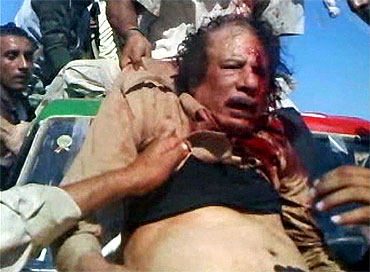
By the end of 2011 Colonel Gaddafi’s brutal, undignified murder by those rebels had been videoed on a phone and shared around the world, and Libya had descended into hell.

Today, the country is divided between two competing governments and a variety of Islamist rebel and tribal groups recognising no authority.

In other words, it is a compete mess. And for what?

The ‘Libyan model’ that Donald Trump and his national security advisor John Bolton speak of does not provide solutions, only worse problems. And a compliant and gullible media has done itself no justice by accepting unfounded claims as fact.

Take a closer look at how much actual evidence (as opposed to claims and unverified intelligence reports) has been presented that the Syrian government is responsible for chemical weapons attacks. 

It may surprise you.

Former US president Barack Obama has been pilloried for derailing a budding war on Bashar al-Assad, and allowing Vladimir Putin time to sneak in and provide a permanent and effective deterrent against any significant military action by the US.

But the truth is Obama’s defiance of his own State Department saved Syria from an even more bloody and pointless period of destruction than currently exists there.

Ousting Assad and leaving the Syrians to the fate of the jihadist groups that would fill the void would have created another Libya.

Whereas Obama’s policies sought to create more balance in the Middle East, a deal to stem Iran’s nuclear program balanced against the anti-Iranian alliance between Israel and Saudi Arabia, Trump has ripped up the 2015 deal with the mullahs and given his material support to Benjamin Netanyahu.

The message to everyone across the region is the US is on the front foot in the Middle East. It has already shown with Syria it will push to the point of risking a fight with Russia.

So, the US’s canonisation of Jerusalem as Israel’s capital this week, while further stifling the hopes of an independent future for those incarcerated in Gaza and the West Bank, was really about ratcheting up pressure on Iran, where Bolton would also like to see regime change.

North Korea doesn’t need the ‘Libyan model’, nor does Iran, nor does Syria.

But is it coming? Stay tuned.

(Originally published in The Daily Telegraph. Screenshot of Colonel Gaddafi’s death)

Call the term ‘disruption’ what it really is – cheating

It’s a term that has been tediously shoved down our throats for the past few years like a mantra — ‘disruption’.

Like “innovator” or “agile”, it often accompanies ­descriptions of new tech start-ups shaking up the traditional system, but has also become a sort of shorthand for ignoring the rules.

This, we’ve been encouraged to think, is something we should be grateful for — lifting us out of our ­ignorant ways — rather than what it often is: a cheat.

Disruption is nothing new. It has always been a feature of business growth and of society’s evolution. We just didn’t call it that.

We knew it by other less dramatic terms, like best practice, change or improvement.

The repackaging of the word “disruption” as something new and radical is akin to the recent attempt by a Newcastle cafe to dress up Vegemite on toast as some kind of a la carte offering.

It’s like your coffee being more ­expensive because it’s served by an uncommunicative, apron-wearing bloke with a waxed moustache.

Hans Christian Andersen nailed it back in 1837: The Emperor’s New Clothes.

It is nothing more than what university professors might describe as a postmodern deconstruction of what occurs in the business world everywhere and always has.

When you can get away with it.

Because the main benefit for the businesses reaping enormous profits on the back of the ideology of “disruption” has been to bypass the usual rules.

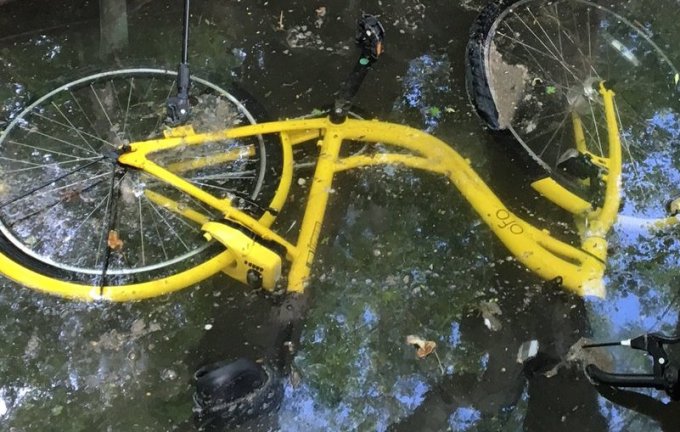
The disrupters of the world, from Uber to the firms responsible for all those discarded bicycles in your street and clogging up waterways, have used loopholes to bamboozle authorities into accepting a system of reduced or vanquished standards.

So while the poor Luddites of our taxi industry, constrained by regulations designed to both ensure public safety and keep the taxman happy, are having the values of their business slashed and their livelihoods diminished, Uber merrily undercuts the market to drive out the opposition.

Despite grabbing a lion’s share of the world taxi business by “disrupting” traditional services with lower fares and untrained “citizen” drivers, studies show Uber X drivers earn half the minimum wage.

For a company that has never been in profit (it lost $4.5 billion last year) you can bet fares will rise once it has no one left to compete with.

This week the House of Representatives voted to ban Lottoland, a “synthetic” lottery that, rather than having a cash jackpot at its disposal, bets on the outcome of big lotteries and uses insurers to pay off whatever large wins (effectively losses) it incurs.

It is based in the tax haven of ­Gibraltar and, unlike existing lotteries that help fund charities, it pays no tax.

While it lists donating to charity on its website, most of those “donations” are actually sponsorships whose primary purpose is to advertise Lottoland.

At the same time newsagents, ­already under strain from diminished sales, have lost revenue they would get through traditional lotteries.

In less than 25 years Amazon, the e-commerce juggernaut, has made its founder Jeff Bezos $112 billion and the richest person in the world.

It is a new arrival here, but in America, where the company made $5.6 billion last year, it paid no tax at all.

Social networks meanwhile have used “freedom of speech” as a way to dodge responsibility for removing inappropriate content, while at the same time harvesting our data for profit and manipulating the information we receive.

Tuesday night’s Budget foreshadowed a raft of new measures to stop companies like Amazon, Facebook, Google and Apple from shifting profits offshore and shirking paying tax here.

With barely a complaint from a public mesmerised by their shiny ­offerings, these companies have raided the retail landscape like plundering Vikings.

I’m all for progress and not for maintaining institutions that don’t work, but I’m also pretty sure when the smoke clears we are going to find we are paying the same and getting less, and a few shrewd companies will have made a mint at our expense.

(Originally published in The Daily Telegraph)

The rime of the Australian ball tamperer

Like the ancient mariner Trevor Chappell finally emerged this week from his decades-long exile of public opprobrium to pass on his curse.

With a glittering eye the villain of the underarm bowling incident of ’81 gleefully announced he was no longer the most hated man in Australian sport.

He cast it off, more happy to be rid of the albatross around his neck than sorry for what awaited the disgraced Australian cricket captain Steve Smith.

Smith, the player feted as our greatest batsman since Don Bradman, this week held two of the worst press conferences of his life.

Naively thinking a manly admission of guilt could get him ahead of the controversy, he set off.

He’s not good at facing the press anyway, but even by his lacklustre standards the train departed the station and promptly derailed.

By week’s end Smith had reverted to a boy, bawling his eyes out and blubbering for forgiveness from a steely public that had already made up its mind.

The brightest star, and future of the country’s Test team, had lost sight of the gap between perception and reality.

For the truth is there are 101 ways to cheat at cricket and pretty much everyone has done it.

The national team’s ball tampering is in the headlines, but the message to take whatever advantage you can in the game begins at an early age.

In under 16s cricket, playing in the local final, I remember the opposition coach beating the ground violently with a mallet and screaming at his young charges when they failed to slow down the game enough, allowing another over that saw us tie with them. Before that, they had run down the clock with their time-wasting, strangling our opportunity to win.

You can call that tactics, but it’s not sporting. It wasn’t fair.

Playing grade cricket, where you often have to double up as an umpire adjudicating against your own players, I learned fast: Don’t ever give an lbw.

Having raised the finger to my own captain when he was struck plum on the pads, cowering against the stumps, I got the mother of all dressing downs in front of the team back on the sidelines.

And, when it was my turn to bat, my aggrieved teammate came out to umpire and immediately gave me out, caught, even though the ball had sailed past my bat without a connection. He’d asked one of the opposition players (who was happy to oblige) to appeal the first ball I swung at and missed.

It was an important lesson. Cricket is firstly about winning and secondly about loyalty to your team. Not honour. Not fair play.

It’s treated that way by everyone involved, from the grounds staff that prepare a pitch to favour the home side to the deliberate scuffing of the ball to achieve swing; the sledging that greets a new batsman at the crease, or the unwillingness to walk when you’re out.

It’s just not cricket!

Well, it is actually. That’s very much what cricket is.

And it is against that background that our national team has come unstuck.

There is a gaping chasm between public perceptions of the game and an often brutal reality. The same reality that saw cricket arrogantly close its ranks at the inquest into Phillip Hughes’ death. Nothing to see here.

Everything that has happened in this past week has clung to that ethos.

The decision to rough up the ball with sandpaper (why on Earth choose bright yellow?), the man-child captain invoking a mysterious ‘leadership group’ to explain away his decision.

It would be churlish to cite the numerous examples of cheating in international cricket, the match fixing, the drugs, the slinging.

Or, even just the huge level of hypocrisy exhibited in the comments of some former players who are no saints themselves.

The cheats’ wheel of misfortune has landed on most countries, and now it’s our turn.

A sadder and a wiser man, Steve Smith has learnt it the hard way.

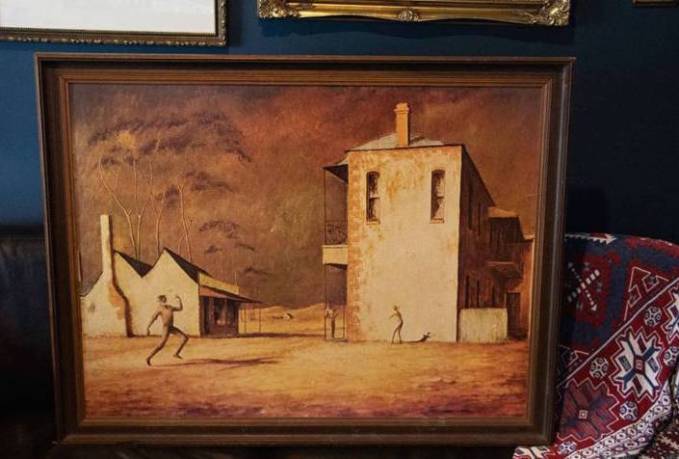
(Originally published in The Daily Telegraph. Painting: The Cricketers by Russell Drysdale)

Pay discrimination against women is issue of our time

When people talk about the innocence of childhood they aren’t usually referring to the gender pay gap.

But I’m going to draw that bow. It’s not as long as you think.

Because up until the end of school, the end of your childhood, the concept of potentially having a job that is worth more if you’re a bloke never crosses your mind.

I recall my graduation year at high school, a bog standard co-ed public on the South Coast, and the even balance among the students across all subjects. There was no marked difference.

Across the board boys and girls were either equally competent, equally brilliant or equally not made for school. My mate Anthony was dux in our graduation year, but another friend Katie was nipping at his heels. 

We had no concept either that among the teaching staff there was any difference in competence, ability or intelligence. Because there wasn’t.

It turns out, though, that school was some kind of egalitarian utopia. Because once you start earning a wage a very different picture emerges.

Talk to experts and they’ll tell you the slow diminution of women begins when they enter the workforce or tertiary education, and continues steadily through their working lives.

Inevitably more and more are put off certain vocations by the male culture that has developed in them.

For men it is the opposite, entry to a club where everything seems slightly easier than it should.

In today’s workforce you hear more and more about redressing the balance and of programs mentoring women in the office. The completely incorrect implication of that being that women somehow haven’t kept up, or can’t play the game, or just aren’t good enough.

How did we get to this point? Or more precisely, how have we always been at this point and why has more not changed?

Men know, from as far back as we can remember, that women are intellectually on a par with us. That our ‘female peers’ are exactly that, equals.

We know it from science and we know it intuitively. 

And yet the gender pay gap persists, as does the under-representation of women in company boardrooms and in politics.

There are only minor signs of improvement.

In this country the official wage gap has wound back only 0.6% from what it was in 1994.

And the Saturday Telegraph’s own investigation into the basic expectations of some employers shows just how transparent many industries are about paying women less than men.

Women, of course, are inevitably blamed for their own predicament. They’re allegedly not vocal enough, or cunning, or they are “too nice”.

It’s a bit like boys getting away with bad behaviour because they are boys. Men do too.

Men get away with being loud, overbearing or intractable because they are men, and it’s their nature.

The responsibility of women being paid fairly, equally, lies with the leadership of any organisation.

Offer anyone an advantage in the workplace and they’d be stupid not to take it, which is why responsible management is so vital. A management sensible enough to vanquish outdated practices and brave enough to see justice performed.

Part of it is appreciating the different attributes women and men bring to the workforce and rewarding them equally.

The subtle, but unrelenting, talking-over of women in the workplace, and the acceptance of it, will ultimately be to the detriment of our whole society.

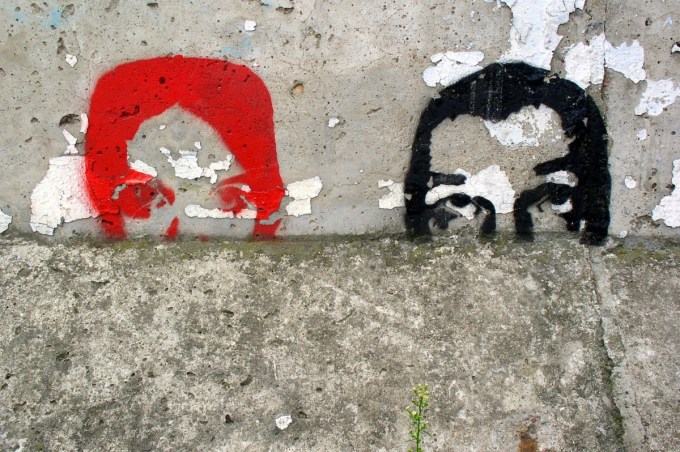
(Originally published in The Daily Telegraph. Illustration: Street art on Berlin Wall)

Flight Club: The underground drone racers of Sydney

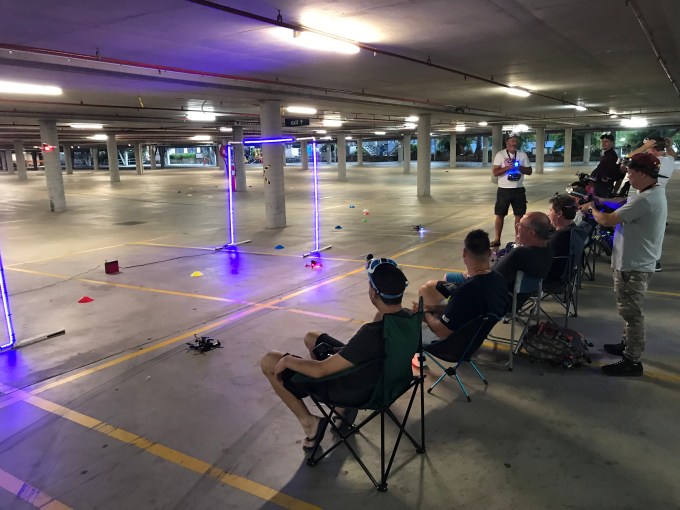
In a basement carpark in Sydney’s west, it’s getting on midnight and the air is filled with the squealing whirr of tiny rotors.

Under the low, strip-lit ceiling, coloured lights, red and blue, flash past at speeds of up to 80km/h.

The machines bank around the cement pillars, ducking and swooping, their engine revs maxing out as they hit a straight stretch and top speed.

A collection of more than a dozen enthusiasts, all men, from their early 20s to mid-50s, are sitting on fold-up chairs or tinkering with battery packs and GoPro cameras.

The racers, their faces partly obscured by virtual-reality goggles, stand in their midst, oblivious to everything going on around them, their focus on the first-person view in their headsets.

This is drone racing — an underground circuit mixing video gamers and model makers who meet in carparks, warehouses and abandoned buildings around Sydney.

They tee up meetings on social media and arrive at predesignated locations for sessions that last about five hours, with four racers competing against one another at a time.

“Underground racing is huge in Sydney and we’ve seen a lot more doing it in Melbourne,” says Jason Warring, a 41-year-old industrial designer from the Sutherland Shire.

His backpack is covered in small drones with five-inch propellers and silicon bumpers so they can safely skid across the concrete floor when they land or crash.

He builds them himself, spending between $400 and $700 on each, but you can build a good racing drone for as little as $200. A motor costs $20, a frame $30, camera $20-$60, and flight controller $60.

Live video from the drone feeds back to the goggles via an aerial, then to a transmitter before reaching the racer, for whom the action is like being in a video game.

“When you’re learning to fly in here it can be costly,” Warring says, indicating the overhead sprinklers and pylons. “Concrete’s not forgiving.

“It reminds me of skateboarding back in the ’80s and ’90s. But now I’m kinda old so I’m not jumping fences and that sort of thing now.

“Sometimes the police drive by but they usually leave us alone. We self-police and don’t bother anyone, so we’re not often moved on.”

Before a race the droners do a walkaround, pointing out any obstacles and laying down cones to mark the course.

“Once I saw one clip a sprinkler and set it off, but usually there’s not much to damage in places like this,” Warring says.

Phil Lea, 46, a production manager from Oatlands in Western Sydney, grew up building model aeroplanes and now constructs drones with his dad on the kitchen table. He also builds LED poles to make the gates that racers fly through.

“This is a bit of relief,” he says. “You get out of the hustle and bustle of life. It doesn’t affect anybody.

“It takes a while to get used to. The only thing letting us down is the batteries. The top guys last two to three minutes. I last four, five, six minutes but I’m not as hard on the throttle.”

Sam, a 28-year-old engineer with a medical devices firm, says: “These drones are built for speed so they’re more manoeuvrable and the classes are based on prop size.

“All the racing is happening on a five-inch class. The ones you see in the parks are a little larger, like the Phantom, which is seven inch.

“So they’re spinning slower, a slower motor, a larger prop. They’re getting like 15-20, maybe 30 minutes of airtime. We’re getting about two, three minutes tops.”

“We kinda soft police — we basically have plenty of rules around where we’re flying, where we land, where we take off from. We only put three to four in the air at a time.

“So some of the guys are spotting — watching what’s going on — and the other guys are racing.

“We do take a lot of care not to damage any property, and always spotting — letting people know if cars are coming or people walking by.”

NSW police are occasionally called out to public nuisance disturbances involving remote piloted aircraft but the responsibility for policing them remains with the Civil Aviation Safety Authority (CASA).

CASA authorises a number of associations, including the Model Aeronautical Association of Australia (MAAA) and the Australian Miniature Aerosports Society (AMAS), which organise official drone racing events.

Legislation requires drone operators to keep their machines within sight unless they have permission.

“This means being able to orientate, navigate and see the aircraft with your own eyes at all times, rather than through a device such as FPV (first-person view) goggles or on a video screen,” a CASA spokeswoman says.

The tight requirements are one reason unlicensed events have taken off.

Dave Purebred, the founder of FPVR drone racing, has hundreds of registered members who compete in official events around Australia for purses of up to $20,000. (The world’s richest drone race, Dubai’s World Drone Prix, offers a $250,000 first prize.)

Purebred says a lack of spaces in NSW is another reason for some drone racers bypassing official events to seek out what he calls “bando runs”, where abandoned buildings are used.

“All the states work together,” he says. “It’s just the accessibility to field and clubhouses that other states have. Brisbane has six temporary drone-safe flying fields to try it out. Victoria is also very open to the whole idea. They see the value of giving clubs allotments of land to do it safely.

“In Sydney, a combination of a few things, including archaic policy, has slowed it up from becoming a bigger sport. We can’t actually take off from council land here. But we can fly over it. It doesn’t make a lot of sense.”

NSW has four registered drone racing clubs, with events up and down the coast, in three classes (rookie, pilot and pro) held in open fields where drones fly through various hoops and around obstacles.

“In Sydney, we’ve got one of the largest clubs,” Purebred says. “There are hundreds of racers around NSW, as well as many more who don’t consider themselves up to spec yet.”

Kevin Dodd, the secretary of the MAAA, which has 10,000 members, says his association is working with CASA on education and safety. Dodd says many drone users don’t fully understand their liability for damage or infringing people’s privacy.

“Drone racing is growing at a massive speed,” he says. “It is a game changer, like digital cameras were when first introduced.

“It would be wonderful if more councils supported the sport or, over time, as drone racing becomes more established, we expect more and more councils will embrace it.

“It is a very popular sport with our youngsters. So from a community point of view, we expect councils will progressively embrace drones.”

Of the 18 racers assembled in the carpark, many are engineers and designers.

Jack Su, a 33-year-old IT expert, says: “The tech that’s behind it has opened it up. You’re a pilot inside the drone.

“I race at least once a week. You can build a drone for $200. But once you start getting serious you want to have a whole fleet of them.

“They all handle differently based on the frame geometry, just like in a race car where you have different weights and different body shapes that affect its aerodynamics and its performance parameters.

“A micro-drone weighs the same as a cheeseburger. We pick the right drone for the right track. It’s about more than just flying.”

(Originally published in The Daily Telegraph)

You cannot be Sirius?

Sydney sometimes seems like Los Angeles in the 1930s, a developer’s town, where politicians fete big business and nothing stands in the way of making money.

Take the sell-off of social housing in Millers Point, Dawes Point and The Rocks. These are areas in our past associated with the city’s tenements and working class, but today are sought after spaces for millionaires’ homes, hotels and apartments snapped up by rich foreign investors.

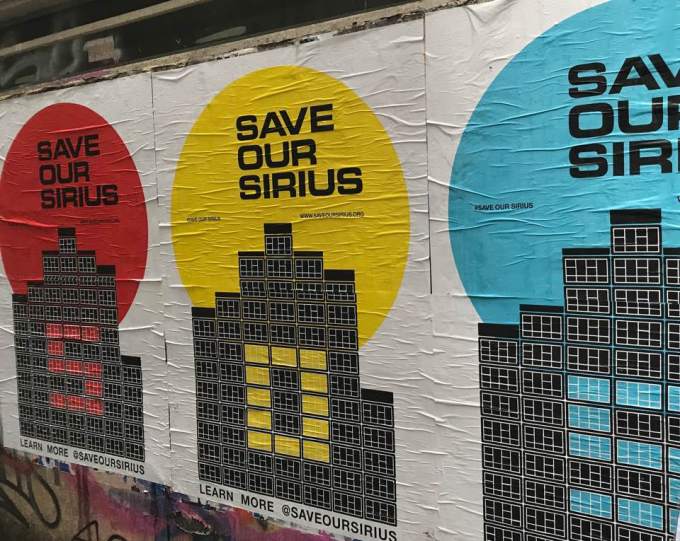
The Sirius building was once a historic housing project that both represented a utopian vision for the poor and also – sitting next to the Coathanger with the best views in town – of the inclusivity of Sydneysiders to all walks of life. This week it too went on the sale block.

Pru Goward, the minister for families, gushed at the “incredible views” from one of the flats as the last resident, blind 91-year-old Myra Demetriou, was given her marching orders.

Whether it was the views or just dollar signs that filled Goward’s vision is unclear. The NSW government wants $100 million for Sirius, which will pay for more social housing on the outskirts of Sydney.

In Millers Point, the poor have been moved out of 90 homes, mostly terrace houses, sold for $252 million. It’s claimed it will fund 1500 new social housing flats in Penrith, Jannali, Campbelltown, Northmead and a number of other areas away from the coveted views and lifestyle of Sydney’s harbour suburbs.

And I know there are plenty of people who think that’s fair enough. A better allocation of resources.

And why should the poor get a water view when anyone else has to be a multi-millionaire? Right?

Except for that nagging moral belief in an inclusive society. After all, we still like to see ourselves as the caring ‘fair go’ country. Don’t we?

The government spin is it’s ‘ending the days of concentrating disadvantage’, but what it’s actually doing is creating rich enclaves where no one ever has to be bothered by someone down on their luck.

It is often through familiarity that we understand other people, other ways of life and of thinking. Remove that and you’re living in a bubble.

It’s a fake argument to say demolishing and selling off a building like Sirius is justified to build more social housing flats. You can apply that argument to practically anywhere (Sell off the prime Macquarie Street real estate of Parliament House and move it to Campbelltown).

The Sirius building represents more than the disappearing architectural heritage of this city. It was originally built to rehouse displaced residents of The Rocks as the area was redeveloped.

This week Goward held out the faint hope that Sirius (in structure at least) might remain, by giving developers the option to either renovate the existing building (like the Barbican or Isokon in London) or knock it down and build a lower structure beneath the deck of the Harbour Bridge.

The reality is the Modernist block, which has a Vegemite-like love it or hate it quality, will be razed by any buyer and replaced with featureless contemporary glass and steel apartments with multi-million-dollar price tags.

But the real tragedy of the Sirius is that even in the not too-distant late 1970s, when it was constructed, Sydney was still a city that valued the place of all people – rich, poor and in-between.

Not any more.

(Originally published in The Daily Telegraph)
Awkward talks with your children – Part 71: Sexting

I first had the conversation with my daughter when she was nine.

To her it was “excruciatingly awkward” (her own words to my wife and I) and “unnecessary” (she insisted).

We weren’t talking about the birds and the bees, it was about revenge porn and sexting — nude photos sent by mobile phone.

It went along the lines of: “Don’t ever, ever, ever send a picture of yourself undressed to anyone.”

Friends I mentioned it to thought I was overreacting.

It’s the type of topic no Enid Blyton book can prepare a parent for talking about with their offspring.

I didn’t, by the way, think this was something my daughter had encountered.

At the time she didn’t even have a mobile phone. But many of her friends did (some since the age of six).

While sharing sexts is a problem, the fact is you don’t even need to own a mobile to end up a victim of sexting.

There was a time when someone standing around a change room with a camera would set off alarm bells, but today everyone accepts camera phones in any situation.

Pictures shared knowingly or taken innocently, or as a joke, can have devastating, long-term implications.

Moreover, the pressure to sexualise childhood interactions starts young.

More than a third of teens aged 13 to 15 have sent a sexual image, while over 60 per cent have received one.

Primary schools now bring in the police to explain cyber bullying and sexting.

While everyone wants their kids to have an idyllic childhood and not have to need to talk about this stuff, the times are such that we do.

Children have to be warned, and warned early, not just that they can be bullied and victimised in this way, but that through immaturity they can find themselves in the role of perpetrator.

Sharing sexts can also leave the sender open to criminal prosecution for disseminating child pornography and a place on the sex offenders’ ­register.

Pornography has been around for centuries, but was never ubiquitous in the mainstream way it, arguably, is now.

It ranges from the pornification of modelling that brands like Victoria’s Secret have led, to TV shows like Geordie Shore portraying relationships as a careless merry-go-round of beds and partners.

For anyone of an impressionable age, viewing relationships in this way or through the prism of pornography sends a bunch of harmful messages.

At an age where important relationships are being formed with friends, family and at some point love interests, trust is a fragile but vital commodity.

Building those relationships in the right way fortifies us against the inevitable let-downs of life. Why else as people grow older are they prone to well-up over random recollections of a parent’s kindness or faithfully sentimentalise a first love?

Trust. It’s hard won and painfully lost.

Schools can educate, but are not ultimately responsible for getting through to boys and girls to respect the rights and feelings of others, and to guard against the easy exploitation that comes with the digital age.

So teach your children well, and don’t shy away from the occasional cringingly awkward conversation that may head off something worse.

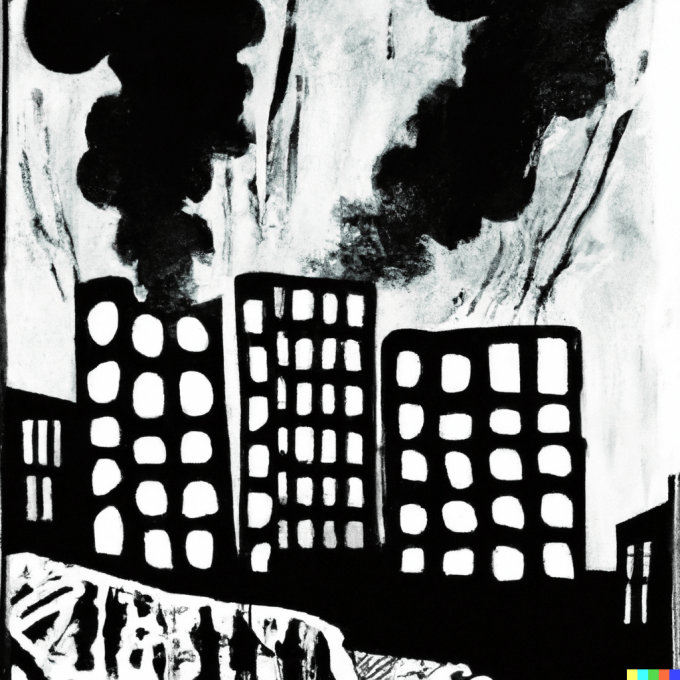
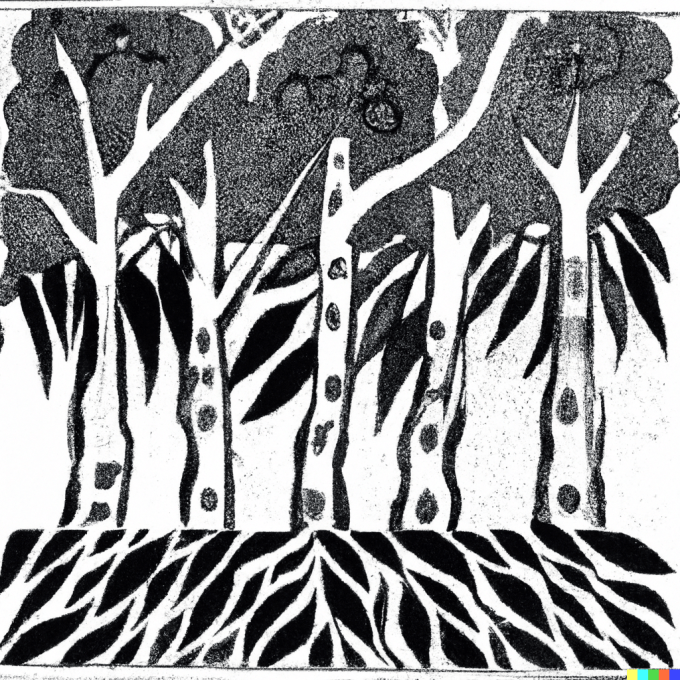
(Originally published in The Daily Telegraph.  Illustration by Nicholas Robertson)