We’re all in this together

Time catches up with you. Fast.

I recall fragments of conversations with Heather. Happy, optimistic, edgily anarchic interactions. Her, splattered in paint.

At high school there were two teachers who made a big difference for me and the way I saw the world.

One, Mike Willis, taught English and swaggered around like a cowboy.

‘Just get on with it,’ was his barked catchphrase. For a man with a big heart it surprised everyone when it stopped abruptly in his mid-50s.

Wise, even as a relatively young bloke, at school he was an ally as much as an educator.

When I visited his wife Denise a year after his death, Mike’s car keys and wallet had been left in the same spot on the kitchen counter where he had last put them down.

His car, parked on the front lawn, had not been moved. Grass grew high under the wheel arches.

The heart is slow to heal.

This week I learned of the death of the other influence in my school life.

Heather Pulsford taught me art, but more than that was a like-mind, a sounding board and a friend.

She was that way not just to me, but to many people in her life and among the arts community that was her stomping ground.

I last saw her two years ago. By then, quite old, Heather had been sick for a while and was using a ventilator at night to breathe while she slept.

Still fiery in her manner, she was nonetheless frustrated at being so constrained.

For a woman with a big brain and a need to be busy all the time, and to socialise with others, it was a devastating come down.

Weakened by pneumonia she succumbed in a hospital on the South Coast with her family around her.

A public Facebook post on her death has been inundated with tributes from friends, family, the community and her former students.

I know she will have sensed that sweeping wave of support even as she was bed-bound and cursing being let down by her body and her health.

In the news we usually only hear stories about the wrong type of relationships that go on between teachers and students.

But most of us benefit in our childhood from those few genuine mentors that take an interest in you at a time in which you struggle with a growing sense of both your independence and isolation.

Those internal monologues we all have, echo too infrequently in the spoken ruminations of others.

Some like to say ‘the universe will provide’ – but it does more than that. The universe wants us to succeed.

And, I don’t feel by coincidence, it puts people in our way that help us grow and that sustain us through the hard times to come.

We have these people dotted around us: at school, at work, in our family, among our friends and loves.

The abiding theme that religion and science seems to agree upon is that there is a destiny to life, no matter how we interpret that.

We are made to go forward, to create and build, to better ourselves and along the way help others do the same.

It’s not teamwork, it’s community, whether large or small.

When I was a kid, Heather was part of my little community and I thank her for sending me spinning off in the right direction.

(Originally published in The Daily Telegraph)

New Literalism: How internet misfittery is warping the news

Someone apologised on Tuesday, although they hadn’t done anything wrong.

Unusual you might say, but it’s something we’re going to see a lot more of.

The reason for that is we have come to a time when misinformation, supposition and the tidal bores of online outrage are treated in the media with the same reverence as fact – provided they have an audience.

In the massively expanded and ever expanding world of online social networking and commentary there is now a sizeable section of the community who take everything they find on the internet at face value and who do not inquire. This amorphous, shape-shifting group regards what they see online, mistakes and all, literally and farms it out as fact to their connections.

Context has been thrown away for many people online and in its place is a new and dangerously ignorant reality.

By the time art collector Dasha Zhukova issued her grovelling apology on Tuesday afternoon for having been photographed sitting on a Bjarne Melgaard chair in the form of a black woman, millions of people around the world had already got a completely wrong opinion of her.

It was fuelled by the media, who reported the ‘outrage’ of regular people, which it then stoked and re-reported on. Many publishers seemed to leave out crucial information that would have explained the context of the photo, perhaps to not diminish the suggestion of racism.

Some punters even thought the chair was a real woman, made to pose semi-naked in subjugation.

And as if the existence of the picture, published digitally on the pop culture website Buro 24/7 about Garage magazine (of which Zhukova is editor), might not be enough to stir people up, others proffered that it had been doubly offensive coming on Martin Luther King Day (or MLK Day).

Nevermind that this was a Russian website and MLK Day is only celebrated in the US, and oddly Hiroshima and Toronto, and that elsewhere in the world few people are aware of it.

Online those boundaries are forgotten and made indistinguishable.

The digital community in the US, and quick to follow the media, quickly concluded this was some added racist slight by backward Europeans.

And because of this US-centric addition to the controversy the rest of the world suddenly was given the impression that the entire event had occurred in America rather than in cyberspace somewhere over the Urals.

Few people saw it for what it was – an edgy piece of political art designed to underline Zhukova’s serious industry credentials as a collector of modern art.

Not everyone’s cup of tea, sure, but not a malicious or even clumsy act of bigotry.

Created by the New York-based Norwegian artist and sculptor Bjarne Melgaard the piece first appeared at a Paris exhibition last year, titled Empire State, New York Art Now.

Because it deliberately and closely referenced the 1960s forniphilia (human furniture) works of British sculptor Allen Jones, who created similar works with white women as subjects, it was not at the time regarded as racist.

At the height of Pop Art Jones, now aged 76, created a series of furniture pieces based on bound white women, that inspired the sexualised female props in Stanley Kubrick’s A Clockwork Orange.

But in Tuesday’s digital furore few knew this or bothered to find it out. Instead this one unexplained picture fuelled a completely unnecessary racism row.

Zhukova, the partner of billionaire Roman Abramovich, and the publishers of Buro 24/7 fell on their swords, aware once the ball was rolling no sensible explanation would be enough to satisfy the online hornets’ nest that had been stirred up. While drawing a line under it their apologies, though, only gave those way-off claims of racism the appearance of credibility.

On Wednesday, the story is front page news and the truth even more obscured amidst the blustering, ignorant hubbub.

But this is hardly an isolated incident.

Increasingly misinformation peddled online is being repeated enough to make people believe it. And if enough people believe it the media starts to report it as though it were real.

In the past week a picture reportedly of a Syrian child sleeping between the graves of his parents swept the internet. It seemed to perfectly and dramatically underline the futile loss of lives in the Syrian conflict and further condemn the country’s leadership.

The only problem was it wasn’t a Syrian child and they weren’t graves. The picture set up and taken in Saudi Arabia by an artist had been appropriated because it fit the subject matter the original disseminator wanted to convey.

When photographer Abdul Aziz al Otaibi contacted the person who had first deliberately misrepresented it on Twitter as an example of Syrian atrocities, the response he got was: “Why don’t you just let go and claim it is a picture from Syria and gain a reward from God.”

The damage, in any case, had already been done with more people viewing the viral image than will ever read the truth about it.

On a less important level this week there was also the ‘bikini bridge’ hoax, picked up by the mainstream media as fact.

Writing in the Telegraph, Radhika Sangani noted: “Apparently all it takes for the internet to believe something is a trend is a few celebs tweets, blog posts and a hashtag.. behind all of this is something much darker: we all believed it because it sounds plausible.”

And commenting on the number of hoax YouTube videos reported as fact in the press last year Caitlin Dewey in the Washington Post described 2013 as “the year the media decisively elevated social media phenomenon, real or imagined, to the level of actual news”.

She cited the cheapness of sourcing it, the growth of social media and the lust for page views – tactics pioneered by high turnover news sites like Mail Online.

The often valueless sourcing of opinion from Twitter has meant you can find anyone online for comment on a particular angle to a story.

Gone are the days where a journalist would always seek out an expert in a field for their view. Now they take their pick from any number of anonymous postings, no matter how ill-informed, biased or stark-raving mad they are.

Reaction, any reaction, is reportable, no matter how right or wrong it is.

And now that everyone has a voice to express themselves the new literalists even make objections to the use of metaphors. No article can run online today describing a rivalry as a ‘war’ without several po-faced readers commenting self-righteously that war is nothing like that and the author’s an idiot for suggesting it.

The value of harnessing an online audience for news outlets has never been greater. We now measure the success and therefore the value of companies by the membership or readership they command. And it is so large now papers and broadcasters are unable to preclude it from mainstream news.

Unfortunately the upshot is facts, context and the full story have increasingly become a casualty.

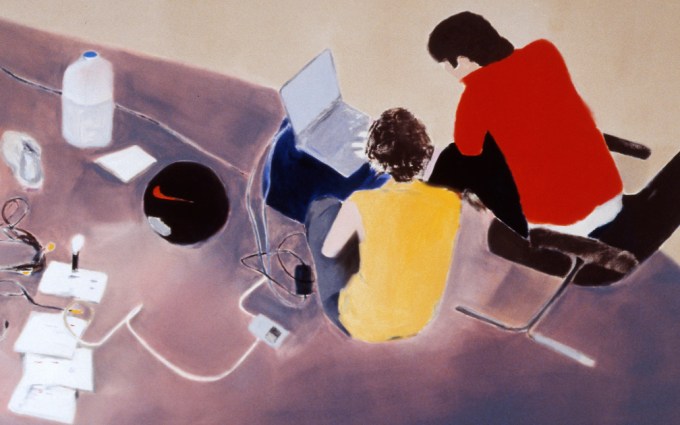
(Originally published in The Huffington Post. Illustration: Internet Painting by Miltos Manetas)

Hermaphrodites fight for rights and recognition

“I grew up with no role models,” says XXXora, as she flicks her black hair from her face.

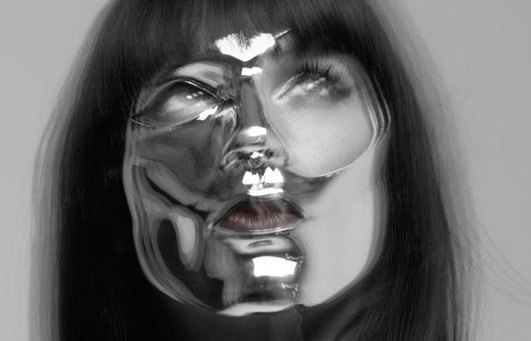
“I’ve had to live in the binary. Now I only ever dress in black and white. It’s my political statement. I do wear a silver mask. It makes me feel comfortable, safer, confident, I feel very vulnerable not having anything.”

I describe XXXora as ‘she’ and ‘her’ because it’s simpler for me to do that. I’ve not been taught any other way and I’m not sure how to explain her accurately with the appropriate personal pronoun. This is the loophole in the gender ‘binary’ that treats all people as either male or female.

The 33-year-old artist looks, acts and dresses like a woman, but she knows she is more than that, being one of the 30,000 plus people in the UK born with ambiguous sex organs – male and female.

Raised as a boy by her working-class Spanish parents she grew up in Ealing, West London, consciously uncomfortable wearing male clothes. She went through art school at Goldsmith’s College living as a man but later switched to a female persona, with which she more readily identifies.

Now comfortable in herself XXXora is in a stable relationship for the first time and is using her art to further inform and campaign on rights for ‘unisex’ people (the newly preferred term). 

She no longer refers to her previous male identity, but rejects being described as either male or female – and wants the government to recognise her as both, with a legal addition to official gender categories.

Exhibiting over the past two years, her art work focuses on androgyny and naturally occurring hermaphroditic species – flora and fauna, which she uses to bring greater awareness and promote more debate on the topic.

Her latest show, the Captured Hermaphrodite, finished on Friday in the City of London and she was last week nominated for an emerging talent prize at the Southwark Art Awards.

“Most people do not realise quite the number of hermaphroditic species that occur naturally in the world and so this show is an entertaining yet also an educative experience,” she says.

“My physical aesthetic and my work is always in black and white.

“I will continue to enforce these unnecessary binary limitations on my work and appearance until the UK recognises the hermaphrodite in law and adds a third box to the category of gender in passports, following in the footsteps of countries like Australia, New Zealand and India. 

“Evidence that the hermaphrodite exists is obviously overwhelmingly supported by science yet our society and its laws still ignore people like me.”

And she is not alone in wanting change. 

There is a growing recognition of the inadequate and often damaging treatment given to children born with both male and female sexual organs.

The medical community has long regarded hermaphrodism as something that can be ‘solved’ (Disorders of Sex Development – DSD) by corrective surgery or by picking what gender to raise a child based on the extent of their physical development. This is usually decided not long after birth and within the first 18 months of a child’s life.

Damagingly, it doesn’t take into account a person’s natural sexual inclination, which does not manifest until much later. And so many unisex children, like XXXora, are raised as a gender they don’t identify with, leading to confusion, depression and feelings of shame. 

To further complicate the situation it has been accepted medical practice in some quarters to keep the truth from the individual and sometimes the parents.

Dr Jay Hayes-Light, of the UK Intersex Association, says one in 2,000 people worldwide are born with ‘ambiguous’ sexual organs, making it a more common phenomenon than cystic fibrosis or autism.

He adds: “Currently, the UK does not recognise gender markers other than ‘male’ or ‘female’ on official documents such as passports although it is likely that this will change in the future.

“Those intersex people who identify as neither male nor female are in the minority in the UK. 

“Most intersex people do have a distinct gender identity as either male or female (irrespective of anatomy). What is important however, is that the government acknowledge that some do reject binary sex labels.”

Back in 2004 Dr Naomi O’Keefe, a psychologist from Argosy University in California, testifying on human rights violations against hermaphrodites, noted that much psychological harm was done to intersex people because society continued to keep it hidden behind a veil of secrecy and shame.

Meanwhile, Zwischengeschlect.org, a human rights advocacy group based in Germany, has attacked what it calls the extermination of hermaphrodites through corrective surgery, arbitrary decisions made at birth about the most appropriate sex to raise children and an unwillingness to speak about the issue.

It noted: “By the end of the 20th Century, after 50 years of systematic surgical and hormonal ‘corrections’ and ‘repairs’, as a species hermaphrodites are virtually extinct, both in real life and in public perception.” 

The group advocates respecting the physical integrity of unisex people and the self-determination of children born with atypical genitals.

The term hermaphrodite derives from the mythological Hermaphroditus, the son of Greek gods Hermes and Aphrodite, who was fused with the nymph Salmacis.

While there are lesser manifestations of it, ‘true’ hermaphrodites have a completely different chromosomal make-up to men and women with their karyotype having both XX and XY chromosome pairs.

In her art XXXora (her pseudonym a reference to chromosomes not porn) also focuses on human subjects that are androgynous, either by nature or deliberately. Stars like David Bowie, Marilyn Manson and Lady Gaga or women political leaders who take on male traits: Margaret Thatcher, Golda Meir, Hillary Clinton.

“These for me are the only role models I could even grasp,” she says. “People who displayed androgyny. The question is did these people display androgyny viscerally, are they innately androgynous, or did they manipulate their gender variance for other reasons.

“Performers like Lady Gaga have used that androgyny to further their careers.” 

Other works by XXXora include an oak tree (another hermaphrodite species) intertwined with bodies. There is a recurrent theme of torture in her art that draws on Hieronymus Bosch and Francis Bacon. Clerical liturgy is represented as insects, irritants attacking the populace – a comment on the church’s unwillingness to even acknowledge unisex people.

These images convey both optimism and pain, and while XXXora is outwardly well-spoken and quite flamboyant (recently disrupting a Damien Hirst launch at Blain Southern’s Candy exhibition in Hanover Square by leaping into a large pile of sweets – an untitled work by Felix Gonzales-Torres) there is an awkward shyness there at times that hints at her struggles.

She intends to create works for the rest of her life on the theme, taking as her inspiration the thousands of naturally occurring dual sex species.

“When I was younger I was put into a boys school,” she says. “I had predominantly male organs so therefore the decision was made that I had to live like that, but it’s not my instinct in any way shape or form. Sexually, I feel completely feminine.

“My works show the slaughterhouse of being a hermaphrodite today.”

(Originally published in The Huffington Post. Photo of XXXora)