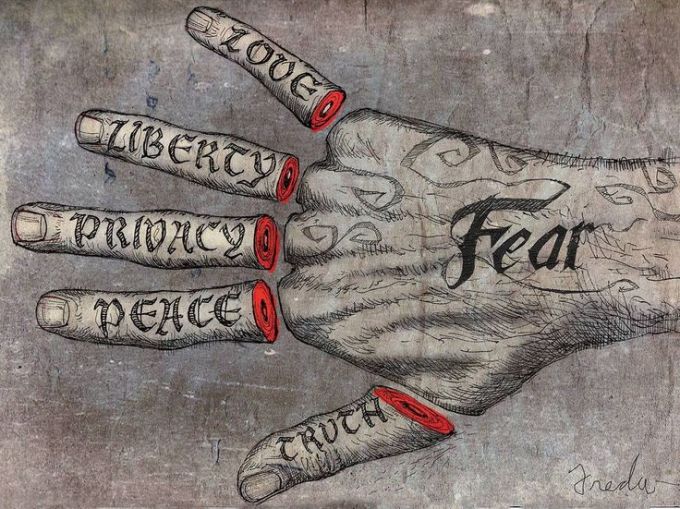
The Brexit disaster, immigration and the rise of the right

It’s been a long time since I was punched in the gut. I’d almost forgotten about it, but it came back to me in a rush on Friday – a vision of an older boy standing over me in the first grade having loosed his right fist into my stomach for no reason I could recall. 

The feeling was not just pain but helplessness, psychological more than physical. How do you combat the irrational?

That’s what I felt as the Brexit vote unfolded, helplessly watching a great contemporary culture inexplicably sabotage itself, a sick feeling overcame me.

Make no mistake about it, Britain has sold the family cow for the promise of a few ‘magic’ beans. But there will be no goose laying golden eggs at the top of this beanstalk.

As an Aussie, who lived in England for nearly two decades, I feel depressingly privileged now to have witnessed such a diverse but inclusive period in that country’s history.

When I first moved there in 1997 British cuisine was among the least enviable in the world. Dining habits barely extended beyond a night out at the local curry house. British chefs were figures of fun.

But fast forward to today where the main cities thrive on a variety of foods and the top chefs are lauded worldwide: Heston Blumenthal anyone?

Britain’s embrace of Europe and the cross fertilisation of ideas came from being the hub of globalisation between Europe and the rest of the world. London’s bourse and the country’s involvement in the EU as one of the three big players, also made it the key European financial centre.

Travellers from the Americas and Asia regarded the UK capital as the natural pivot point for the rest of Europe. 

Politically it was looked to, not just by European countries, but importantly by the US and China as perhaps the most influential ally in the region. 

Immigration was the central gripe of the ‘leave’ campaigners, but I witnessed only benefits.

Polish workers improved the building trade for the better. In the ‘90s I listened to one horror story after another about British tradies taking someone’s money, ripping out a bathroom and then disappearing for six months. These weren’t stories I read in the consumer section of newspapers, they were firsthand accounts from people I socialised with. The Poles brought a strong work ethic to Britain, showed up on time, stuck to what they said they were going to do and charged about a third less. When Brits talk about immigrants stealing their jobs, this is the type of thing they allude to. The ones complaining are those who lost easy money treating customers like mugs. 

The hardest working, most meticulous tradesman I ever dealt with was a Czech guy who fixed our windows in London. There every morning at 8am with his own sandwich. When he hurt his back one day he still kept to his schedule. Our experience with his British counterparts had been paying too much for an often poor job and an expectation they would get coffee every two hours, lunch and sometimes even that we’d flush the toilet after them.

As bad as being out of Europe is for Britain, though, there’s potentially a greater problem internally. While Donald Trump has given encouragement to redneck sentiment in the US, Nigel Farage has emboldened it in the UK.

What’s more the anger from those who voted ‘in’ at those who voted ‘out’, and visa versa, will further fester and disrupt unity.

The ‘leave’ campaign presented an argument of ‘us or them’ – as in Britain or Brussels, Englanders or immigrants – but with a clear split of views that’s not what’s manifested. It’s going to be Brit v Brit, the left v the right, the new world v the old, progress v nostalgia, sense v instinct. And everyone will be worse off.

Young white men were witnessed on the London underground yesterday aggressively chanting ‘You’re going home, you’re going home” at any non-white passersby.

Trending on Google in Britain after the vote was ‘What is the EU?’

We’ve seen the complacent end of a golden period for Britain that may take a generation or more to reestablish.

(Originally published in The Sunday Telegraph)
Could Jo Cox’s death save Britain from catastrophe?

Days out from the Brexit vote that will decide if Britain stays in the EU or goes it alone, the murder of MP Jo Cox seems to be doing what the heads of state, churches and financial institutions had been unable – to galvanise the ‘remain’ vote.

Her death has ignited a new debate over the nature of the campaigning, of the use of xenophobic language and imagery, and of the manipulation of the public with fear campaigns and falsehoods peddled as fact.

Through the first two weeks of June the majority of polls had the ‘leave’ camp ahead in the vote by anywhere between 1% and 10%, but days after Cox’s killing the ‘remain’ campaign had begun to shore up.

Yesterday a Financial Times poll had them neck and neck on 44% with the rest undecided. And a YouGov poll for the Sunday Times had the remain vote edging ahead 44-43.

There have been notable defections too.

Baroness Warsi, the former Conservative party chair who had supported leaving the EU, on Monday switched camps saying: “Are we prepared to tell lies, to spread hate and xenophobia just to win a campaign? For me that’s a step too far.”

Her decision was motivated in part by the attack on Cox but also by a UKIP billboard campaign suggesting hordes of Syrian refugees are waiting to descend on the country’s borders – imagery likened to anti-Semitic Nazi propaganda from the 1930s.

The choice between staying one of the three big players in Europe or dropping out and into an uncertain future of rewriting laws, trade agreements and regulatory barriers, will have the biggest single impact on the country, since it joined the Common Market in 1973.

And while the last referendum on membership in 1975 had yielded a clear 67% majority in favour, this campaign has been very different.

Marked on both sides by hysterical language and sniping, by misinformation and jingoism, it has left the Tory government of David Cameron floundering at the real possibility the British public will on June 23 vote to exit the European Union.

The benefits of remaining in the EU are clear, unequivocal and documented. The challenges of now going it alone and of reversing decades of infrastructure would be immense and are impossible to properly quantify.

But the ‘leave’ camp has succeeded in turning a complex, and to many people inscrutable, debate into a straightforward dichotomy –  us or them?

It’s a choice that embodies every unfounded prejudice and fear: Britain or Brussels? Refugees or jobs? Control or imposition? Safety or crime?

But by taking such a black and white view the campaign to exit the EU, led by UKIP’s Nigel Farage and the former Conservative Mayor of London Boris Johnson, has also copped the brunt of outrage at the killing of Cox.

The gunning down of the 41-year-old mother of two outside her constituency surgery last Thursday, by  a man who later declared in court ‘Death to all traitors’, was a wake-up call to a lot of previously disengaged voters.

Cox, a moralistic, straight-speaking Northerner, who spoke out for refugees, and whose liberalism chimed with many young people, was an innocent caught in the crossfire. An example of modern, inclusive Britain extinguished by a reactionary, nationalist presence that belonged to a different age.

‘Is this what we can expect?’ seemed to be the subtext of the stunned outpouring of revulsion at the crime.

Britain has a rich history of standing for freedom and equality, from London being one of the first safe havens of escaped slaves to the working class rioters who effectively snuffed out Oswald Mosley’s fascist black shirt movement at the 1936 Battle of Cable Street.

The appeal of a nostalgic Little Britain of bobbies on the corner, saccharine Enid Blyton adventures and explorers claiming new records, remains imbued in the consciousness of older generations of Brits. But while that idyll is equated by some with the leave campaign, its foundation is built on the values of fairness and doing right.

It would be simplistic and wrong to say the shooting of Cox is the only reason for a turnaround in the fortunes of the ‘remain’ campaign. It isn’t. The economy has always been and will remain the chief driver in the debate.

But in a campaign characterised by lowest common denominator attacks, this tragedy cut through the rhetoric to a deeper understanding of what type of place Britain is and should always aspire to be.

It is a terrible thing to have to find good amidst hurt and defeat – to console oneself with silver linings – but the sacrifice of Jo Cox may yet save Britain from an even more far-reaching tragedy.

Tough play shining a light on broken care home system

I had a friend years ago. We were close for a while, but she was complicated and when she was through with you that was it. So I knew her for a year then never saw her again. She was the same age as me, we were born a few days apart, and despite her not having seen anything at all of the world outside London and Slough she seemed to have lived a much longer life. She told me things that made my hair stand on end.

She’d been in the care system and she’d been raped. She’d been slashed with a knife by a gang. She had no connection with her two younger sisters, who had been abandoned with her, but had both been fostered out to a ‘nice’ family. For her the care system was a series of failed placements and homes where she was preyed upon by older children and on one occasion a carer.

If you met her in the street you’d never think she had a problem in the world because she had the brightest smile there was. But she’d beaten a crack habit, was semi-literate, dissolute and scarred permanently by her experiences. No amount of love or care, it seemed, could make any of it right again.

Working on a newspaper I learnt over the years that her story was not unique, but part of a pattern of abuse within a system where children could not be properly protected. The care system in Britain as a whole is a very poor substitute for the love and affection children need to develop.

In the past few days two things have reminded me of this: A powerful new theatre production about being in care and a warning from Barnados that served to validate what the play had to say.

The Finborough Theatre’s Fog, about a returned serviceman’s attempts to reunite his family after leaving his kids in care for a decade where they were abused, is harrowing. But it is a very matter-o-fact kind of harrowing. It tells us awful things that somehow aren’t as shocking as they should be, because in a way we have already come to accept that things like that occur when you are a ward of the state in Britain.

Barnados warned this week that children older than 10 in the care system are being “forgotten” and have become almost unplaceable among foster carers. The charity said 12,000 kids entering care last year (43%) were over 10, and while it didn’t give the figure on the number placed in foster homes, Government statistics tell us that just 3% of children aged over 10 in care were adopted out last year. Of these 84% were white, giving a less than 1% chance that a black or Asian child aged over 10 will find a home.

Some will be unfortunate enough to live out their childhoods in one of the 17 secure care homes for children that operate throughout Britain. In these the majority (66%) are detained or placed by the Youth Justice Board, while the vulnerable remainder are neglected or abused children who have been removed from their homes by local councils.

Throughout the wider care system a much higher figure of 62% are placed because of neglect or abuse. Just as worryingly, the standard of these childrens’ education is well below the norm, with just 45% attaining the basic level of education for their age. Barnardo’s say at least 8,750 new foster families must be found within the next year to avoid a catastrophic increase in the number of emotionally damaged children. And while homes are more likely to be found for babies and toddlers, UK adoption figures show that only 60 children under one were adopted out last year.

At the Finborough, on the outskirts of Chelsea in West London, hard-hitting Fog is selling out fast with its mixture of powerful acting and devastatingly pointed writing.

Penned by Tash Fairbanks, a 63-year-old feminist playwright, and her partner’s 27-year-old actor son Toby Wharton it is funny at times, disturbing and very, very real. It is also mesmerisingly sad.

Many people who have been in care may find it hard to watch.

Played by Wharton, in a riveting performance, the main character Gary or Fog (his nickname ‘F*** off Gary’) sets his sights low. He wants a big TV and a council block flat with a view. His dad Cannon (Victor Gardener) wants to provide much more, but can’t stomach working for £12k a year as a security guard. In the end Cannon’s half-hearted efforts will prove futile, an outcome the audience can sense from the first sighting of director Che Walker’s bleak concrete set.

Meanwhile sister Louise (Annie Hemmingway) has been ostracised by Gary and hates her father for leaving them. Going in the other direction, Gary’s best friend Mike (Benjamin Cawley) is doing well at school and heading for Oxford – he comes from a poor home but a supportive one, in the form of his nagging sister Bernice (Kanga Tanikye-Buah). There family provides the contrast between those with hope for a future and those crippled by their experiences.

While in care Lou has deliberately put herself in harms way to protect her younger brother from the predators around them. But her efforts have only mitigated the abuse. Hemmingway plays her bolshy and tough, but with a fraught tenderness. Her first appearance on stage made me well up, even though I knew little about her, such was the hurt she conveyed in her eyes. Her character is the only one that really cares about Fog and the audience knows intuitively that this ex-drug addict is the one hope he has – even though he rejects her. Lou has ‘put out’ in the children’s home ‘Brock House’ to protect Fog and been dubbed a whore, but she understands his pain and fear, as she shares it.

Some see the play as being about dad Cannon, about him being unable to adjust to coming back to a ‘Broken Britain’ that doesn’t care, to messed up kids he can’t get through to. There ARE real issues about returned soldiers in Britain – I see them everyday on my drive in to work, manning the check points at Docklands. War-hardened veterans forced to work in ‘by comparison’ Mickey Mouse security jobs, given no counselling for adjusting from a war zone to civilian life.

But this play is not about that, and it is only about Fog’s father in so much that it is to do with the effect his selfish desertion of his children has had. Played by the muscular, physically impressive Gardener, Cannon’s naïveté about the tough upbringing his children have endured provides the few moments where he shows his weakness. He’s a tough army man who can’t face up to the fact his kids have been abused in his absence…because of his absence.

Fog is a subtly rich play, at times a whirlwind of words, at others a bleak place of silence where pleas go unanswered. But for the verbose, black street slang spouting Fog, the script is remarkably restrained and often minimalistic in its detail. It releases information about the characters like secrets, and never labours explanation. But it gives us enough to piece together the tragedy of their lives. There are no formulaic responses, no cop outs and no pat ending.

That one-time friend of mine is out there somewhere, and hopefully in a better place, but the things that messed her up are still very real and they’re messing up a new generation of children.

Go see Fog – if you care.

Until January 28. The Finborough Theatre, 118 Finborough Road, London SW10 9ED. 020 7244 7439

www.finboroughtheatre.co.uk

(Originally published in The Huffington Post)