You can support both Israelis and Palestinians

In Britain a debate is raging over what constitutes anti-Semitism after it was reported Labour leader Jeremy Corbyn had attended an event eight years ago where Israeli policies towards the Palestinians were compared with the Nazis persecution of the Jews.

At the event Corbyn attended, controversially on Holocaust Memorial Day in 2010, the comparison was made by Hajo Meyer, a Jewish survivor of Auschwitz, and one of many Jews who are supportive of the Palestinians and critical of Israel’s treatment of them.

As some use the stigma of anti-Semitism to quash any criticism of Israel, it’s a valid but highly volatile area of discussion.

The charge of hypocrisy by Israel has arisen on and off over the years in reaction to events in the Occupied Territories and the inability of some to marry the idea of a people who went through the Holocaust carrying out what, at times, have appeared oppressive acts or heavy-handed reprisals against another people.

The Israelis have always argued it is necessary to ensure their security, a position they arrived at after all their neighbours attempted to drive them out of the region.

There are two distinct sides to this coin.

But let’s firstly be completely clear on any comparison with the Nazis during World War II.

The Holocaust not only ended the lives of six million Jews, it involved a level of dehumanisation, of maltreatment and torture that is still today difficult to put into context with what we know people are capable of.

There have been genocides that have killed more and particularly sadistic individual crimes that bear comparison, but not to the level conducted  by the Nazis.

The treatment of prisoners of war by the Japanese in the Pacific or their murderous sacking of Nanjing, while similar, again, were not the extensively drawn out, top to bottom assault on hope, health and happiness endured by Europe’s Jews.

The word ‘evil’ is overused, but not in the case of the Nazis. Their actions defied the very definition of human.

While there are valid grievances about Israel’s part in virtually incarcerating the Palestinian people in Gaza and the West Bank, the building of illegal settlements and the refusal to allow the return of refugees, they do not compare with Nazi Germany.

That doesn’t, however, in any way devalue the suffering of people such as Palestinian refugee Olfat Mahmoud. We feature her story this week, a long fight for repatriation to her homeland.

But we also tell the tale of WWII photographer Mike Lewis, who documented the horrors that the liberating British and Canadian armies uncovered at the Bergen-Belsen concentration camp in 1945.

Modern-day Israel is a state with a fortress mentality, an “us versus them” ethos, that has been forged as much by the anti-Semitic treatment of Jews during, before and after WWII, as it has been by the Arab-Israeli wars.

But being supportive of both Palestinian rights and of Israel are not mutually exclusive positions. A fair outcome for both is still achievable and some day will happen.

The danger is allowing the discussion to be dominated by extremes.

The Nazis were evil. Of that there can be no doubt.

The Israelis and the Palestinians, while at loggerheads now, are normal people, with normal fears, normal hurts and a mutual need for a safe and shared future.

(Originally published in The Daily Telegraph)
Lessons in the cost of silence

It seems wrong that the survivors of the Holocaust are generally only bracketed in the category of victims, and all that that implies. Helplessness, weakness.

Because in truth they are anything but that.

The survivor’s of one of the world’s worst ever acts of genocide have a strength that is difficult to put into words.

And the lessons they teach, cautioning against intolerance, have eclipsed the toxic legacy of Adolf Hitler and the Nazis.

Today their role in educating us about the environment that gave rise to the Holocaust and how governments can manipulate people against one another, is as important as ever.

Their input in teaching critical thinking is a rare boon for us here in Australia, but one with a finite window.

Now aged from their late 70s to 90s, when you meet these remarkable men and women you can’t help notice the twinkle in their eyes. The horrors they have witnessed have not suppressed their inner spirit.

To hear their accounts of survival under Hitler’s regime is much more powerful than to read it in a history book.

We all know the grim statistics. The six million Jews murdered in World War II, as well as the gypsies, Serbs and other persecuted minorities.

But for many Australians the reality of this seems very distant, an event that occurred, now, a long time ago, far away in Europe.

We would all like to think that we would not have stood by and let what was done to the Jews happen.

It’s unfathomable to us how so many could have turned a blind eye, while others were active in the persecution and many more showed little to no compassion for their countrymen.

Historians often cite British prime minister Neville Chamberlain’s disastrous appeasement of Hitler, but he was not alone. Appeasers, cowed into silence, in fear of conflict or punishment, were everywhere, at all levels.

And yet, Germany and other countries under the Nazi yoke, were highly educated, cultured places.

The way in which populations were manipulated over time – through propaganda and fear-mongering – to turn on the Jews remains an important and relevant historical lesson.

If it happened then, it could happen now. We are not that different from our forebears of the 1930s.

Speaking up, speaking out, both for ourselves and others, is not always easy.

Here on the streets of Sydney would you say something if you heard abuse yelled at a woman in a head scarf or two men holding hands.

Remind yourself of the cost of silence and, too, that one voice can inspire the courage in others to also speak out.

The Jews that survived the Holocaust, men and women such as Jack Meister, Yvonne Engelman, Olga Horak and Paul Drexler, have a white-knuckle story to tell, but also a powerful lesson in humanity and how quickly it can unravel.

If you have a bucket list of things you want to do in life, add something really meaningful to it and go down to the Sydney Jewish Museum in Darlinghurst Road and speak to a survivor. I tell you, it will blow your mind.

Listen to Olga explain how an act was passed overnight in her home country, the Slovak Republic, and authorities came the next day and took her 16-year-old sister from the family home. Hearing her say “we never saw her again, they sent her to Auschwitz,” will make your blood run cold.

Her account of life under the Nazis and their collaborators should be compulsory reading for all Australian school students. From her time at Bergen-Belsen (where Anne Frank died) and a meeting with ‘Angel of Death’ Dr Josef Mengele, to witnessing the devastation of the British firebombing of Dresden, Olga’s story is a rich microcosm of some of the key events of WWII.

And, though memories of that conflict recede in time, we should not waste the opportunity to learn from these incredible Australians in our midst.

They are people who lost almost everything, but rebuilt their lives here and, to this day, continue to contribute greatly to the community.

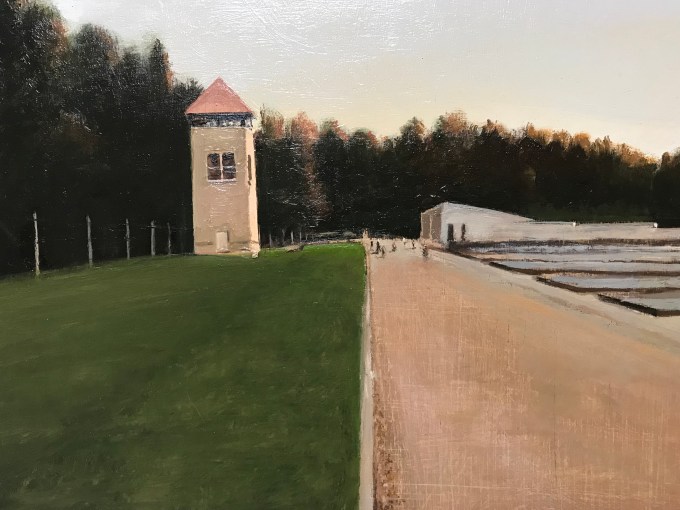
(Originally published in The Daily Telegraph. Painting: Dachau Memorial by Ivan Goodacre.)