Calling Aboriginal massacres what they were – war!

Sometimes they gunned them down or poisoned their bread or water. In other accounts groups were driven off cliffs into deep gorges.

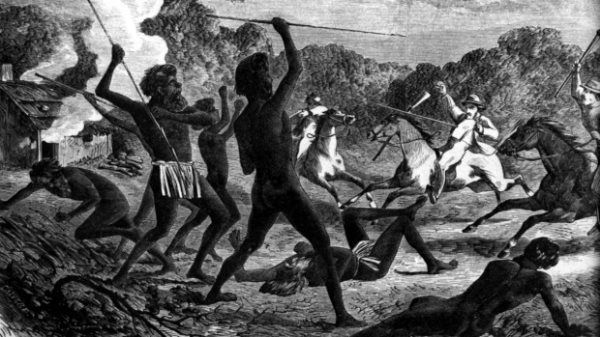
There were many gruesome ways to die if you were an Aboriginal in the ‘Frontier Wars’, which researchers say covered a time from 1788 to well past Federation.

In schools this has been taught as a bunch of disparate massacres – a byproduct of nation-building. Not a war, but a collection of executions of small groups by soldiers, farmers, sealers and various other ad hoc militia.

As poorly as American indians have been treated, US historians have at least painted a fair if unapologetic picture of a protracted, one-sided frontier war on a native population unwilling to cede their land to a superiorly armed invader.

The New Zealand Wars, too, were recognised as a conflict over a legitimate prize – ownership of land and the right to use it.

In Australia we’ve well-rehearsed the presentation of our history from a colonist’s perspective.

From the label terra nullius (nobody’s land) considered applicable to Australia since settlement, to the myth Aboriginals were entirely nomadic when there was plenty of evidence to the contrary (read Bruce Pascoe’s Dark Emu). All of these heavily-weighted descriptions favoured the colonists’ land grab.

The idea of ownership is at the heart of everything our society is built on. To have an asset is to have leverage. Leverage to eat well, to sleep safely, to raise a family and be proud of your place.

Ownership weaves our lives inextricably into the society around us.

Not owning anything is not encouraged in Australia.

And the idea of the indigenous population having no ownership of where they had lived, or of not being organised to defend what they had, is a very convenient perspective.

Professor Jakelin Troy, the director of Aboriginal and Torres Strait Islander Research at Sydney University, laments that the history of Aboriginals in Australia has been taught in isolation.

“Aboriginal massacres have been an open wound since 1788, no one talks about them,” she tells me.

“At least we have a recognition in this country of Aboriginal rights, but we need to teach all the things that have happened.”

To look fairly at the confrontations that occurred when Britain colonised this country, those convenient myths must be stripped back.

That includes acknowledging the indigenous population fought a real war to protect its rights – rights to land, rights to hunt and feed their families. Maybe not an organised war the way the British military would conduct them, but a war nonetheless.

Historian Lyndall Ryan’s ‘massacre map’ which has plotted over 250 such incidents is ample proof that the armed defence by Aboriginals of this land was taking place across the country at hundreds of sites.

You’ve probably heard of the Dharug warrior Pemulwuy, but what about these names: Windradyne, Jandamarra, Yagan or Bussamarai?

They all led a resistance by their tribes to settlers pushing into their territory, and there’s no good reason they shouldn’t be remembered in the same way Americans remember Geronimo, Cochise or Sitting Bull. Heroically.

Aboriginal culture has given plenty to be proud of, but more remains hidden behind this skewed history.

(Originally published in The Daily Telegraph. Illustration of The Battle of Parramatta.)

Meet the Gadigals

IF you’ve attended your child’s school assembly or gone to pretty much any official event in Sydney in recent years, you will have heard the “Welcome to Country” — a recognition of the traditional aboriginal tribe of the area.

Collectively known as the Eora Nation, there are about 29 clan groups, or tribes, in the Sydney metropolitan region, belonging to several major language groups, including Guringai, Darug, Dharawal and Gundungurra.

By far the most mentioned though, covering a swath of Sydney that takes in Port Jackson, the CBD, the inner west, the eastern suburbs and extending south to Botany Bay, is the Gadigal.

But exactly who are the Gadigal? And what does it feel like to be name-checked from international sporting events to the cutting of a ribbon at the local library.

“Pretty good,” Des Madden, a father of two from Western Sydney, says matter-of-factly.

“It’s a really special occasion, any welcome ceremony. The kids are very proud and they tell everyone.”

Des, 33, who works as an Aboriginal Programs officer at the Environmental Trust, is the youngest of 10 kids who grew up in Redfern and Marrickville.

He went to Cleveland Street High in Alexandria, playing junior rep league and tagging around with his dad Allen, who carried out heritage site surveys and taught him about their tribe.

He met his wife Nezmia, 31, a member of the Riverina Mahdi Mahdi tribe, a decade ago and they have two kids, a daughter Shyla, eight, and son Jobie, six, while also giving a hand bringing up their niece Jannali, five.

Des and his family don’t need any reminders of who they are or where they’re from and talk about it often.

While inner westies might associate Petersham with Instagrammed shots of Portuguese chicken, to the Maddens it’s just one of the boundaries of Gadigal country.

“Every time we’re close by we always mention, ‘we’re in Gadigal country now’,” says Des, who moved the family to Penrith seven years ago.

Nezmia, a business support officer, says: “We’ll tell the kids we’re not far now, and there’s always a sense of relief at being back in country.”

While the Maddens are a very ordinary family with ordinary worries (the mortgage, the heating bills, the kids’ homework), unlike most Sydneysiders they express a clearer affinity to the land and impart that to their children.

Des, who estimates there are about 50 or 60 Maddens living in Sydney, knows educating people about his tribe and others is important to keep traditions alive and continue to build on the positive steps being taken to recognise indigenous Australia.

His dad Allen, 69, who now officiates at some of the Welcome to Country ceremonies, remembers a very different scenario.

“I grew up in Redfern, which was very poor for both blacks and whites,” he said.

“We were all in the same boat, the working class mob. We’d drink together at the pub and we’d do what we could to make a living.

“Before land rights there was no real recognition of us as a people with a history. Now the younger generation are coming along and saying, ‘Hang on, we haven’t been told about this’. Aboriginal people were just stereotyped.

“It makes me feel very good that at last there is some recognition there and people know who we are and what we are.”

Nezmia adds: “My daughter was one of the flag bearers for the permanent flag flying at Government House and she was part of that and will always hold that very dear.

“We’re also very involved with their schools. If they’ve got homework or we know a certain subject is being taught we try to help the teacher out with Aboriginal perspectives.

“I think too, being in Sydney, it’s hard to keep that sense of identity in the city, everything’s so fast moving and changing before your eyes.

“It keeps you grounded knowing when you are coming back into Gadigal country.

“We try and remind the kids of what it would have looked like before. And that it was common to see the women out fishing in the boats in the harbour.

“We try to tell Shyla that so she has a sense of being a strong Gadigal woman.”

Just over 70,000 indigenous Australians live in metropolitan Sydney, about a third of the state’s 216,000 population, but only a small proportion are Gadigal.

The national census is yet to provide a breakdown of tribal affiliations.

Jakelin Troy, the director of Aboriginal and Torres Strait Islander Research at Sydney University, said there may be as few as 100 members of the original Gadigal clan living in Sydney today.

The Gadigal tribe that lived on the land for thousands of years before Arthur Phillip’s arrival in 1788, she said, bore many similarities to modern-day Sydneysiders.

“They would spend a lot of time at the beach and around the foreshores in summer and move inland in winter.

“Captain Cook came through in winter and commented that the area wasn’t heavily populated, but when Arthur Phillip sailed in the middle of summer he found the beaches full of people.”

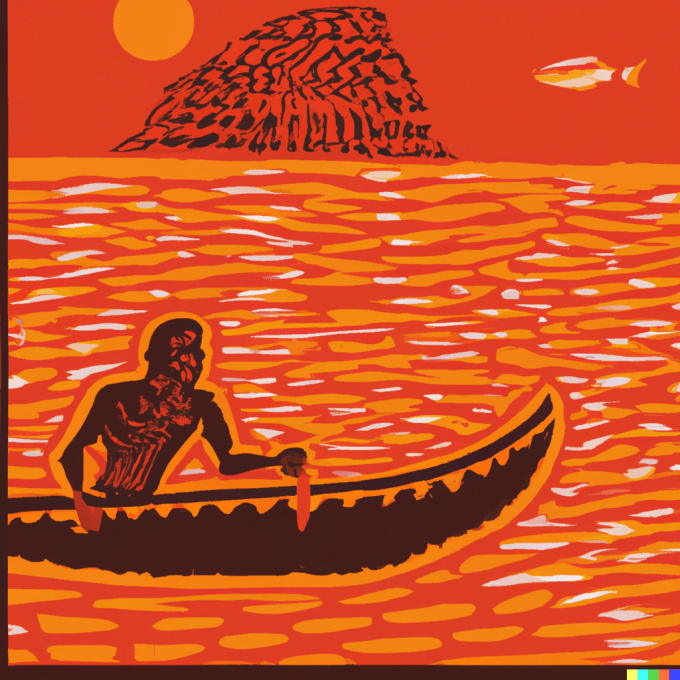
The Gadigal were primarily a fishing people, who made hooks from shells and carved bone, and often cast them from bark canoes paddled into Sydney Harbour.

“Sydney’s Aboriginals settled in areas very similar to the way immigrant communities settled in. Each different group had its own traditions and would invite each other over. It wasn’t that dissimilar from Vietnamese migrants settling in Cabramatta or Pakistanis in Lakemba.

“They were big meat eaters in winter and ate a lot of seafood in summer, when they would use the sandstone overhangs along the harbour for shelter,” said Ms Troy.

“When it got colder they had very lightweight and portable gunyas they would carry around and take further inland, where it was warmer.

“The First Fleet would not have survived without the knowledge the Gadigal people shared with them. They warned them off stone fish and showed them what leaves to avoid and how to prepare certain foods.

“I often come across something in day-to-day life in Sydney and think ‘the Gadigal taught us that’.”

She said Gadigal influences were evident in many words and place names we use today and, as the first language encountered by British settlers, they were exported back to Britain in descriptions of the land.

“It was pretty unique how the Gadigal people used to fish, and they would be all over the harbour gathering and hunting,” Des says.

“That’s the pretty unique connection with the Gadigal people that they belong to the waters as well. I’ve always felt a strong connection to the harbours and the foreshores.

“It’s quite special to be part of the Gadigal people given this was one of the first points of contact and from there things declined a bit with smallpox and other diseases.

“It’s special to be a part of that survival and continuation of culture.”

(Originally published in The Daily Telegraph)

No Australian should stand for inequality

Trash talk precedes most big fights. Boxers have to sell seats and the more bums on them the better their payday.

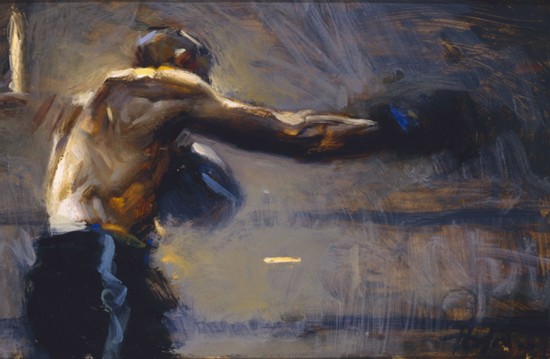
Anthony Mundine’s no stranger to that. He’s been stirring the pot his whole career, drumming up business, psyching out his opponents, giving the public the loud mouth anti-hero some genuinely hate, while others look beyond the words to the fighter, the athlete.

Unlike most scrappers, though, Mundine has rarely wasted these opportunities (which are fewer and further between for him) by talking up simple rivalries.

Five years ago he caused controversy by disputing fellow boxer Daniel Geale’s very Aboriginality.

There has never been anything mundane about Mundine.

Instead he’s used that time as a platform to push debate around indigenous life and to hopefully change it for the better.

He has vowed to sit down during the playing of the national anthem at his rematch with Danny Green on Friday night, calling it “disrespectful” to his people.

And as an Australian, let alone an Aboriginal one, he has every right to do that.

If, as is mooted, promoters get around this by having the anthem played before he enters the ring it would be another stain on this country’s already tarnished history of race relations.

It would be a greater disgrace than what some perceive is Mundine’s snub to Advance Australia Fair.

Mundine should absolutely be allowed to get in that ring and sit on his seat while the anthem is sung. As the headlining boxer he deserves to have that moment – to be more than a piece of meat, making a small fortune for the promoters.

He deserves to be able to rankle the masses and let them know where he stands as an individual, and maybe make them think a bit longer about what it really means to be Australian – both white and black.

Our headlining Aboriginal sportsmen are the ones who get the most column inches when they speak on these issues, even though they are shouted down.

Adam Goodes, one of the most eloquent sports people when talking about racism and the toll of white Australia on native Australians, has paid the price. Derided, bullied, beaten down.

The fact of the matter is there has never been a level playing field for Aboriginals and Torres Strait Islanders in Australia, and we have a long way to go before we get one.

It is not, as Barnaby Joyce insists, about having to say ‘sorry’ for ancestors like his who came to the country as immigrants and had nothing to do with colonial massacres.

It’s simply about recognising things are not fair and working towards making them so.

It’s kinda in the title: Advance Australia Fair.

Only the anthem doesn’t mean ‘fair go’ it means things being nice, good, palatable.

Well it’s not ‘nice’ that indigenous Australians live on average 17 years less than non-indigenous. Nor is it ‘good’ that Aboriginal women are 58 times more likely to be held in police custody than white women. It’s not ‘palatable’ that suicide rates among the indigenous population are three times higher than for everyone else. It’s certainly not ‘fair’.

That’s not the fairness Australia is meant to be about. It’s meant to be about equality.

Equality for blacks and whites, for Asians, for women, for gays and anyone else born with the same irrefutable rights as the next person.

Mundine will continue taking the hits and speaking his mind. And I hope for all Australians, come Friday, that he is allowed to sit on his stool as the anthem rings out and make his point.

That would really advance Australia fair.