The power of a good headline and how to capture your reader

In the age of digital news, the art of headline writing at times feels a bit irrelevant.

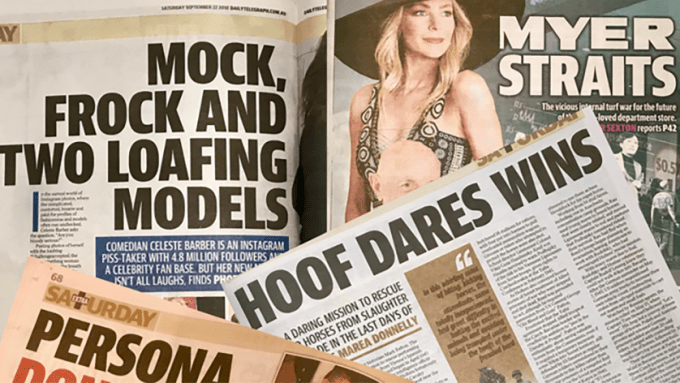
Wit and clever idioms have mostly been replaced with search engine optimised key words.  But both from a practical point of view and a creative one, good headline writing is more important than ever in the modern media.  A nod to the intelligence and knowledge of the reader, and despite having evolved to be more direct, clever headlines remain an important part of the overall tone of a story. 

From a distribution perspective, writing a headline containing the most likely search terms for the attached article is the key component of a digital article today.  And any content management system worth its salt allows both an SEO headline and one that can more creatively reflect a story.

Furthermore, the ability to tease a headline without making it look like clickbait is a skill in high demand in digital newsrooms and among social media editors.  For budding journalists, it is an essential element in their tool kit.

The Walkley Foundation’s annual awards for journalism have for the past couple of years recognised not just headlines but captions and hooks, to accommodate the many forms digital storytelling takes, from the splash to a tweet.

That the winners have remained, invariably, big production headlines from the front pages reflecting significant events, underlines the professional import of headlines in journalism and the impact of traditional media, even whilst in decline.

A good headline rings bells in readers’ heads. It forms synapsistic links with topics that give them a warm fuzzy feeling or tickle their funny bone because they get the reference and are in on it.  Great headlines can support a great story and great design or elevate a mundane yarn to a loftier place than it may otherwise have deserved.

I learnt this lesson early as a cadet reporter on Sydney’s Daily Telegraph-Mirror. Sent to Taronga Zoo with a photographer to capture the moment a newborn chimpanzee was presented to the world, I’d spent most of the day labouring over the writing of it; trying, too hard, to wring out a funny line. Instead all I could manage was a mediocre intro that the sub editor scoffed at loudly as I retreated to my VT100 (with its green screen and Geiger counter staccato, the staple of office computers at the time).

The next day when I opened the paper I was stoked to see above my re-written lead and a picture of the baby monkey and its mother, the title: ‘A chimp off the old block’.  That headline saved my terrible copy from being pushed to the back of the news section. It remains one of my favourite headlines and an example of how the wit of an organisation’s wordsmiths can capture a reader’s attention, bring a story alive and bolster the quality of the product.

Like that example, great headlines are remembered and sometimes come to epitomise an event. When rower Sally Robbins quit mid-race at the 2004 Olympics as her seven teammates continued to plunge their oars into the water, Melbourne’s Herald Sun bellowed, ‘It’s eight, mate, pull your weight’.  Sometimes it controversially reflects the cultural zeitgeist, as when The Sun in Britain, full of nationalistic fervour for the Falklands War, blasted ‘Gotcha’ across its front page, crassly reducing the sinking of Argentina’s General Belgrano to a comic book moment. Writing active, not passive, headlines draws in the reader, and is a discipline any journalist needs to understand if they want their stories read.

The contracting industry has been particularly harsh on sub editors, often cut from the business in large numbers and their roles subsumed into other areas or outsourced to time-poor, brand agnostic production staff in distant hubs.

So, the optimum environment for writing engaging, funny or clever headlines, has suffered and the media overall has been victim to a witticism bracket creep as words and their use have become plainer.

At The Australian Financial Review where subbing has been embraced again and a full team employed to bolster the paper’s standards, journalists write their own headlines and desk editors then tweak and tailor them individually to both print and web.

Understanding your readership and how it consumes news is at the forefront of the effort to engage with readers, to retain them and to grow a digital audience further afield and across demographics.

Finding the right headline for a subject requires a good general knowledge, an eye for associations and either a very sharp brain or some fast work on your keyboard comparing idioms and chasing thoughts down rabbit holes of words and rhymes, of assonance and alliteration.

Blog_headline_class_LD

WORD PLAY: Journalism students discuss headline ideas. 


Often it can require trying different lines, seeing what the words look like on the page or the preview, and changing tack if they just will not fit into the space.

Headlines can be effusive, or they can be spare, but above all else they must entice the reader to go on that ride with you, into the story.

Originally published by Macleay College on November 1, 2019.
Sex, lies & politics: The Peta Credlin – Tony Abbott ‘affair’

So were Tony Abbott and Peta Credlin at it?

The evidence ranged against them, one or two perceived moments of tenderness mostly not associated with a work relationship, a head rested on a shoulder, protective outbursts from the PM.

The rumour mills were so over-extended NSW Liberal MP Concetta Fierravanti-Wells felt the need to deliver an ultimatum to Abbott to deal with it.

“Politics is about perceptions,” she told him bluntly.

But should perceptions be enough to cost someone their job? And once it’s ‘out’ must the rumour-mongers be sated.

The question of sacking the Prime Minister’s chief of staff is a moot point now of course, but the ongoing damage to her career legacy is very much alive.

In the final days of the Abbott government, in the lead-up to that last brutal push to unseat him, it was not Abbott who was the target of the plotters.

He’d been given a walloping in the previous failed coup over the knighthood awarded to Prince Philip, weathered it and came back with an improved poll standing.

But when laying the groundwork for another go, it was Credlin who was identified as both the easier mark and the most effective means of undermining the PM.

She had directed his career from, at times, abject ineptitude in opposition to a decisive, commanding, if no-less controversial, presence in politics. He needed her there to govern.

The attacks on Credlin were almost nonsensical – an insult to the public intellect.

She was accused of having “too-high a profile” and the prime minister’s refusal to sack her for it was painted as being blinkered and an indication of internal rot.

Credlin was Abbott’s perceived Achilles heel –hurting her would leave him weaker.

Stubbornly, loyally he stuck by her. “Do you really think my chief of staff would be under this kind of criticism if her name was Peter?” he asked.

It was a good point.

In the UK, the close relationship between Tony Blair and his bullying mouthpiece Alastair Campbell didn’t produce calls for him to resign or be sacked. They too had a cosily iron grip on the agenda that left even the Treasurer on the outer. But Campbell was regarded as too dangerous to take on – a formidably strong lieutenant to the PM.

Credlin’s was a different story – she was a woman.

A seasoned political backroom operator she’d built a reputation in the Howard government as an astute strategist working for a number of MPs, then in opposition as top aide to Liberal leaders Brendan Nelson, Malcolm Turnbull and Abbott.

She had paid her dues many times over, and yet there have been fewer more transparent or malicious whispering campaigns carried out in politics than that on Credlin during the short reign of Tony Abbott.

The rumours about the pair had been the subject of gossip throughout politics and the media, but had never been aired publically until this week.

Privately Credlin was painted as a Delilah figure. She had her hooks in him, siren-like, fouling his judgment and poisoning his leadership.

I use that biblical comparison because the narrative of the scheming, manipulative women has been around for thousands of years. And it is routinely trotted out when critics can’t make conventional headway. See The Tragedy of Othello, Shakespeare knew it too.

In Australia we saw it with the jibes at Julia Gillard’s husband’s sexuality, and by association her own.

There is no question Credlin came to be widely disliked within the party and the control she exerted over the PM’s diary became a sticking point for many.

But the malignant undermining, the creeping, unsubstantiated sniggering at the morals of the government, went beyond all professional criticism.

I doubt there was any affair. This is politics and she was solely a means to get at Abbott.

Ukraine reporting shows bias of Western media

In the space of a few months Ukraine has been embroiled in two uprisings.

Both have appeared equally legitimate, both have been bloody and both have had the backing of differently aligned foreign governments.

So why has the media characterised the US-backed one as a democratic right and the other as troublemaking by Russia?

And why does one bloody crackdown provoke press outrage and another not?

Reporting on Ukraine has been singularly one-sided with the media and the government moulding public perceptions by omitting information, or slanting it one way or another.

At the height of the first uprising in February Viktor Yanukovych was portrayed in the strongest terms as a corrupt leader responsible for killing civilian protestors. Those civilian deaths were seen as a catalyst for a change of government by force.

There has been no such outrage expressed for the more than 100 pro-Russian separatists killed by the new government, the most recent in heavy-handed attacks on Donetsk.

The Maidan protests, backed by the US, Germany and Britain, have been given fair, at times favourably biased, coverage, while those of pro-Russians have been scandalously under-reported or ignored.

More so the language used to describe each varies damningly.

It has been accompanied by a concerted and completely over-the-top demonisation of Russia, which culminated last week in Prince Charles comparing Vladimir Putin to Hitler and ‘Red’ Ed Miliband seeming to support the remarks.

Opponents of Yanukovych were often described in the media as peaceful protesters, despite scenes of some of the most ferociously violent attacks on Ukraine’s police – attacks for which the only UK parallel might be the Broadwater Farm riots in which PC Keith Blakelock was murdered.

In Kiev 16 police officers were killed by protesters. Can you imagine the reaction to that if it had occurred in Britain?

By contrast the western media routinely describes pro-Russian separatists as rebels, militants, insurgents, Chechens, terrorists, militia.

It is often slyly suggested they have less claim on being Ukrainian, that they are insurgents from across the border or puppets of Russia, despite the overwhelming evidence that they are local, multi-generational Ukrainian residents with real gripes against the new right-wing government.

Earlier this month a fire in the Odessa Trade Union building killed 38 pro-Russian protesters, but the media quickly accepted the Kiev government’s claim they were killed by a blaze they had begun.

Pictures of teenagers merrily making molotov cocktails outside the building didn’t change the media’s attitude. Nor was there much comment on the chants about roasting ‘Colorado beetles’ (a derogatory term for the pro-Russians) that rang out as the protesters burned. Video showed those trying to flee the blaze set upon by right-wing thugs.

The apparent strangulation murder of a pregnant women in the same building in a room in which government supporters unfurled a flag out the window, has not been investigated or commented on in the press.

And though video evidence emerged on the web of government supporters in collusion with police staging false attacks dressed in pro-Russian armbands it was not written about or reported in the mainstream media.

The truth about what happened at Odessa has only emerged through social network sites.

Instead there was an overriding willingness by press, broadcasters and online news groups to not blame government supporters for the deaths and to quickly move on.

By comparison the shooting of civilians during riots in Kiev against Yanukovych were denounced in the harshest of terms around the world. Germany and the US piled pressure on the government with threats of sanctions, and when Yanukovych eventually retreated from the capital an arrest warrant was issued accusing him of ‘mass murder’.

Days later, when a leaked EU phone call raised the prospect some civilians may have been deliberately shot by the Maidan opposition to inflame the situation, little was said. An investigation by the new authorities into deaths in Kiev during the protests has so far gone nowhere.

Each day across Ukraine’s restive east more and more pictures are posted on Twitter of the bodies of civilians  – middle aged women, casually dressed men – lying dead by the roadside.

But how many do we see in the press, on TV or online news agencies?

Typically such reports are omitted or tempered with claims of trouble being stirred up by Russian infiltrators – legitimising the killings.

It’s a common propaganda technique, but we see it more and more from our governments and our media.

While the referendum in Crimea and the east for more autonomy was decried as illegal by the West and reported as such, the election of a new government in Kiev has been given legitimacy by the world’s media, even though breakaway regions boycotted the vote.

Residents in those regions have now been dubbed ‘bandits’ and ‘terrorists’ by the newly elected hardline president Petro Poroshenko.

Underlying the entire conflict are claims the US encouraged the Maidan revolution to create another Nato state on one of Russia’s most sensitive borders, and where its Black Sea Fleet is moored at Sevastopol in Crimea.

In the press Russia’s subsequent annexation of Crimea was denounced as a shameless land grab and Vladimir Putin accused of trying to rebuild the old Soviet Union.

Despite there being a majority of Russian citizens living in Crimea and clear parallels with the Nato-backed independence of Kosovo, relations between Russia and the US deteriorated to the point of talk about a new Cold War.

That has filtered down to the man in the street and one in the palace.

Ironically, the groups now in control in Ukraine are more right-wing than any European government since the Nazis.

But this bias in the media has existed for a long time and extends beyond the Ukraine today.

Reports on the Syria conflict are horrendously one-sided. Unsubstantiated charges of chemical weapons use by the Assad government are reported as fact.

The killing of pro-Assad voters at an election booth last week given no more than lip service.

Yes Assad has committed some terrible acts, but what of the al-Qaeda groups ranged against him? What of the beheadings, the mass killings, the torture and religious discrimination they have brought with them?

When rebels fighters deliberately cut off the water supply to 2.5million residents of Allepo a fortnight ago, only The Independent reported on it. Even Ban Ki Moon’s condemnation of this act went unreported in the mainstream media.

Similarly there has been no outrage about the Kiev authorities attempts to cut off the water supply to the Crimea.

These are actions that can force a humanitarian crisis, and yet there is no outrage and the general public remain uninformed.

Going back to the reporting on the Balkan wars, Serbia was demonised and accused of ethnic cleansing and running rape camps. The latter was not proven and the former described tactics used across the board by all sides in the conflict.

And while the massacre by the Bosnian-Serb army at Srebrenica is the worst and defining atrocity of the wars, little is ever mentioned of the 50 villages razed to the ground and 5,000 Serb civilians murdered by muslim raiding parties in the same region in the run-up to it.

Decades on Serbia is still characterised simplistically as the bad guy while equally reprehensible war crimes committed by other sides barely get mentioned. To do that would muddy the narrative that the media demands.

Having worked in Fleet Street for almost two decades I know there is no one pulling the strings. There is no secret plot to subvert particular information while promoting the other.

No one calls up editors to exert pressure, and nor do the editors dictate to their journalists. And yet with great predictability they fall in line with a prevailing mood.

The media promotes a concept of good and bad, with no in-between.

It needs a simple, familiar narrative for its readers to understand (perhaps for its journalists too), one that is often, although not exclusively, still based on old world prejudices.

Known story patterns are repeated with rare deviation.

Passion, outrage and righteous indignation sell papers and (today) get page hits.

But what of the full facts? What of the other side of the story?

Our written history is at risk if it is based on the perception given by media and governments pushing their own blinkered or negligent agendas rather than the true, full story.

Nowhere is this hypocrisy more evident than in the current reporting on Ukraine.

(Originally published in The Huffington Post)

Salivating press won’t let fantasy get in way of ‘serial killer’ story

Her story came out of the blue. A seemingly unnecessary, unprompted confession to a local newspaper reporter that she had committed anywhere between 22 and 100 murders.

In the general run of things such admissions are normally made to detectives, psychologists or prison pastors, and checked over before any such notion is taken to the press and the public.

But from the out self-confessed serial killer Miranda Barbour’s story was front page news.

More than two months after her arrest Sunbury’s unprepossessingly named newspaper The Daily Item obtained an interview with the 19-year-old after much shenanigans with local prison authorities.

By this time, while not known outside of East Coast America, Barbour was already big news in the small Pennsylvania town.

Nestled behind an imposing flood wall on the Susquehanna River near the point it empties into Lake Augusta, Sunbury has a population of less than 10,000 people, limited job opportunities and a burgeoning drugs problem.

For a small place it has its fair share of problems with residents more than twice as likely to be the victim of violent crime than the national average. But while having a disproportionate number of rapes and assaults the murder of Troy LaFerrara on 11 November last year was still out of the ordinary.

The 42-year-old married man was lured by an advertisement for sex on the Craigslist website and allegedly stabbed to death by Miranda Barbour as her husband of three-weeks, Elytte, strangled him with a cord from the backseat of their car.

The Daily Item seized on the tale, running some 36 stories in the paper and online between Barbour’s arrest and her eventual ‘confession’ to reporter Francis Scarcella.

Because of the couple’s supposed interest in Satanism the paper ran at least two stories reporting on and theorising about Satanic links to the murder.

Barbour having read the extensive coverage of her case in the Item wrote a letter to the paper requesting a meeting on 7 January. It was initially denied by the Northumberland County Prison authorities but after calls for staff to be stood down for breaching the prisoner’s rights it went ahead on 14 February.

It may be fair to surmise that at this point Barbour had already made up her mind about ‘revealing all’ to the paper and had either held back from talking to the authorities or never intended to, despite another five weeks passing.

She told the Item she was a serial killer and had stopped counting after 22 murders, but added that she had killed less than 100 people.

Barbour also claimed to be able to pinpoint each of the murders and lead investigators to the bodies.

By going to the press first she ensured her outlandish claim would get prominent exposure even if it later fell apart under scrutiny.

Police had no choice but to take it seriously and investigate fully, especially as they already had one murder on their books she had been charged for.

Within hours The Daily Item’s grisly scoop was making headlines around the world and Barbour was being billed as possibly the worst serial killer in America’s rich history of psychopaths.

In the UK the Express asked ‘Is this the world’s worst serial killer?’ (Harold Shipman.. Luis Garavito anyone?)

But despite the police having had no time to test the validity of her claims few media outlets cast doubt on the story.

Having played on fears of Satanism in the weeks following the ‘thrill killing’ of LaFerrara The Daily Item’s prison interview revealed sensational claims of Barbour’s induction into a Satanic cult at the age of 12 in North Alaska and her first murder committed the following year with the man who had recruited her.

Despite professing to be one of the devil’s acolytes Barbour contradictorily told the paper she only killed ‘bad people who do bad things’ and so was justified.

For most law enforcement officers, however, the mere mention of Satanic cults is generally met with eye rolling. A popular unfounded fear in middle America the existence of such groups in any real sense is extremely rare. It is far more common that claims turn out to be the figment of the imagination of delusional, often mentally unstable individuals.

The killing of LaFerrara too did not sit easily with the tale of a young girl committing regular murders for several years without raising an eyebrow of suspicion or leaving a trail of bodies behind her, as she claimed to have done across Alaska, Texas, North Carolina, Pennsylvania and California.

To get away with such a spree would require extreme care and cunning.

But the LaFerrara murder was anything but clever. The alleged killers, having placed a traceable ad on Craigslist, were in phone contact with the victim and left their 2001 Honda CRV dripping with blood. Not even the cleaning fluid and towels they were caught on CCTV buying shortly after the murder were enough to wipe away the evidence. And having killed LaFerrara they then dumped his body in an alleyway where it was quickly found.

This was the most telling indication that Miranda Barbour had made up her killing spree.

But the media attention did not abate and, instead, latching on to her claim to have only killed ‘bad people’ some media firms enthusiastically branded her ‘The Dexter killer’, after the fictional TV serial killer who murders only other baddies.

Nevermind insulting the dead and that her only known ‘alleged’ victim LaFerrara had done nothing worse than answer an online sex ad.

To this day Barbour has provided no credible evidence to detectives of any murder other than the one she has been charged with.

As scepticism grows around her story, the infamous murders of her home state serial killer Robert Hansen (the story of which was recently made into the movie The Frozen Ground with Nicholas Cage) might have inspired her to make up the story. Her incarceration also coincided with British serial killer Joanna Dennehy’s boastful and unapologetic admissions of three brutal knife murders of men she felt slighted by.

While inquiries continue, the question remains could she have been involved in any previous killing?

Given her frenzied attack on LaFerrara, you may say it’s possible.

But if she has, it cannot be on the industrial scale claimed and it’s more likely the police have caught her at the start of a spree rather than the conclusion of one – her claims being nothing more than attention-seeking fantasy.

For the media, who too readily embraced a big story that defied all conventional logic, the question is will they be more scrupulous next time or have they, in the drive to sell more copies and generate more online page hits, forever sacrificed getting it right first time round in favour of enticing in readers?

(Originally published in The Huffington Post)