You can support both Israelis and Palestinians

In Britain a debate is raging over what constitutes anti-Semitism after it was reported Labour leader Jeremy Corbyn had attended an event eight years ago where Israeli policies towards the Palestinians were compared with the Nazis persecution of the Jews.

At the event Corbyn attended, controversially on Holocaust Memorial Day in 2010, the comparison was made by Hajo Meyer, a Jewish survivor of Auschwitz, and one of many Jews who are supportive of the Palestinians and critical of Israel’s treatment of them.

As some use the stigma of anti-Semitism to quash any criticism of Israel, it’s a valid but highly volatile area of discussion.

The charge of hypocrisy by Israel has arisen on and off over the years in reaction to events in the Occupied Territories and the inability of some to marry the idea of a people who went through the Holocaust carrying out what, at times, have appeared oppressive acts or heavy-handed reprisals against another people.

The Israelis have always argued it is necessary to ensure their security, a position they arrived at after all their neighbours attempted to drive them out of the region.

There are two distinct sides to this coin.

But let’s firstly be completely clear on any comparison with the Nazis during World War II.

The Holocaust not only ended the lives of six million Jews, it involved a level of dehumanisation, of maltreatment and torture that is still today difficult to put into context with what we know people are capable of.

There have been genocides that have killed more and particularly sadistic individual crimes that bear comparison, but not to the level conducted  by the Nazis.

The treatment of prisoners of war by the Japanese in the Pacific or their murderous sacking of Nanjing, while similar, again, were not the extensively drawn out, top to bottom assault on hope, health and happiness endured by Europe’s Jews.

The word ‘evil’ is overused, but not in the case of the Nazis. Their actions defied the very definition of human.

While there are valid grievances about Israel’s part in virtually incarcerating the Palestinian people in Gaza and the West Bank, the building of illegal settlements and the refusal to allow the return of refugees, they do not compare with Nazi Germany.

That doesn’t, however, in any way devalue the suffering of people such as Palestinian refugee Olfat Mahmoud. We feature her story this week, a long fight for repatriation to her homeland.

But we also tell the tale of WWII photographer Mike Lewis, who documented the horrors that the liberating British and Canadian armies uncovered at the Bergen-Belsen concentration camp in 1945.

Modern-day Israel is a state with a fortress mentality, an “us versus them” ethos, that has been forged as much by the anti-Semitic treatment of Jews during, before and after WWII, as it has been by the Arab-Israeli wars.

But being supportive of both Palestinian rights and of Israel are not mutually exclusive positions. A fair outcome for both is still achievable and some day will happen.

The danger is allowing the discussion to be dominated by extremes.

The Nazis were evil. Of that there can be no doubt.

The Israelis and the Palestinians, while at loggerheads now, are normal people, with normal fears, normal hurts and a mutual need for a safe and shared future.

(Originally published in The Daily Telegraph)
Taking the Lucky Country for granted

There’s a skit the British comedian Michael McIntyre does about disabled parking spaces.

As non-disabled motorists cruising for an elusive spot we tend to look ruefully at those often empty reserved spaces right in front of the shops. And sometimes scrutinise those parking in them to satisfy ourselves they are legit.

“What do we want?” asks McIntyre. “For the door to open and a minute-and-a-half later someone falls out.” He then starts crawling across the stage shouting ‘get me a trolley’.

Peter Dutton’s comments on the Manus Island refugees who flew into New York this week (as part of the deal with the US), wearing sunglasses and looking like tourists, fell into the same basket.

“They’re economic refugees,” he told 2GB. “They got on a boat, paid a people smuggler a lot of money, and somebody once said to me that we’ve got the world’s biggest collection of Armani jeans and handbags up on Nauru waiting for people to collect it when they depart.”

Perhaps he wanted them in rags, walking on crutches… emaciated.

The detention centres in the North Pacific are certainly not holiday camps and even if you’re in agreement with the Manus and Nauru detainees being denied entry to Australia, it’s no time to gloat.

Weighing up the cost of compassion is very different from just being self-righteous.

It’s easy in the affluent country we live in to pontificate about economic refugees and how they don’t deserve what Australia has on offer because they weren’t born here.

Nevermind that our own birthright is a quirk of fate.

I commented to a colleague recently: ‘It’s good being a white bloke.’ He thought about it for two seconds and agreed.

If you’re a ‘white bloke’ born into the middle classes of Australia it doesn’t get much better.

You aren’t born smarter, you aren’t more able. But your path through life inevitably is smoother than if you were born black, or poor, or a woman.

In Australia we have developed an enormous sense of entitlement. We sneer at the poor and dispossessed, blame them for their own misfortune and equate worth with earning potential.

Throughout the 20th century, as immigration became the norm, it was de rigueur to refer to any immigrant or their offspring with some derogatory term, whether it was dago, or slope or Pom. Each new wave of migrants copped it. Each was made to feel that they hadn’t earned the right to be here.

The term ‘assimilation’ has been used like a blunt object to batter people into conforming and often renouncing their own heritage.

How many people do I know who became ‘proper Aussies’ never speaking of their background, brought up with that ignorant, spiteful word ‘wog’ ringing in their ears? Too many.

I’d ban it. Make it a hate crime. Make it like the ‘n’ word.

The ‘w’ word.

The children of immigrants in this country, who were bullied and belittled, will never get an apology. And what lesson did it teach us as a people?

Now, as we trade away human beings to Donald Trump like the unwanted assets of a shop liquidation, let’s not lower ourselves any further.

We are the Lucky Country, but we’ve forgotten what that means. Luck is not about being deserving, it’s providence — a cosmic flip of the coin.

We should never forget that.

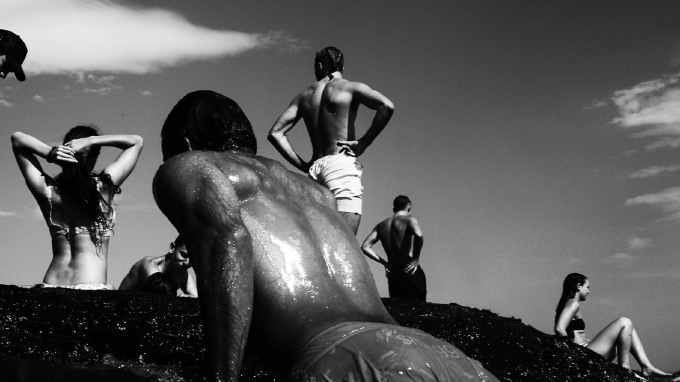
(Originally published in The Daily Telelgraph. Photograph by Paul Blackmore.)