Decimation is not a model for fixing the world

Power shifts in the Middle East are rarely subtle (often they’re accompanied by large explosions), but their true motivations are usually complex and, quite often, well-concealed.

We’ve got used to disruption and death in that part of the world. We shouldn’t have.

There has been an unconscionable meddling in the affairs of countries in the Middle East, but there is also the danger those tactics will be expanded elsewhere.

One of the most sinister propositions yet has been the US talking openly about the ‘Libyan model’ in reference to North Korea.

It refers to regime change by force, leaving a shell of a country to fight among itself, rebuilding by foreign contractors (lining their pockets), little aid and less attention.

“That was a total decimation,” US president Donald Trump said candidly yesterday.

Before the violent unseating of Colonel Muammar Gaddafi, Libya was the most prosperous country in North Africa and by most measurements stable.

With attacks by foreign-backed rebels it descended into what the West was quick to label “civil war”, but was actually Libya fighting a small insurgency in one pocket of the country.

Claims by NGOs and rebels in 2011 that Gaddafi’s military was massacring civilians by shelling towns were ultimately proved to be untrue. But they provided the pretext for the US to push for a UN Security Council mandate enforcing a no-fly zone to protect civilians.

As a journalist working on a Fleet Street tabloid at the time I fielded many nightly reports from the ground of rebels breaking the ceasefire as the Libyan military stood back.

And yet it was the claims of the US government that Gaddafi was responsible that became the accepted narrative in the media.

The UN mandate was then cynically used by a coalition, led by the Americans, British and French, to bomb the Libyan army into submission and create a corridor for the rebels straight to Tripoli.

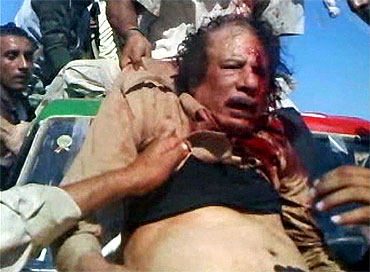
By the end of 2011 Colonel Gaddafi’s brutal, undignified murder by those rebels had been videoed on a phone and shared around the world, and Libya had descended into hell.

Today, the country is divided between two competing governments and a variety of Islamist rebel and tribal groups recognising no authority.

In other words, it is a compete mess. And for what?

The ‘Libyan model’ that Donald Trump and his national security advisor John Bolton speak of does not provide solutions, only worse problems. And a compliant and gullible media has done itself no justice by accepting unfounded claims as fact.

Take a closer look at how much actual evidence (as opposed to claims and unverified intelligence reports) has been presented that the Syrian government is responsible for chemical weapons attacks. 

It may surprise you.

Former US president Barack Obama has been pilloried for derailing a budding war on Bashar al-Assad, and allowing Vladimir Putin time to sneak in and provide a permanent and effective deterrent against any significant military action by the US.

But the truth is Obama’s defiance of his own State Department saved Syria from an even more bloody and pointless period of destruction than currently exists there.

Ousting Assad and leaving the Syrians to the fate of the jihadist groups that would fill the void would have created another Libya.

Whereas Obama’s policies sought to create more balance in the Middle East, a deal to stem Iran’s nuclear program balanced against the anti-Iranian alliance between Israel and Saudi Arabia, Trump has ripped up the 2015 deal with the mullahs and given his material support to Benjamin Netanyahu.

The message to everyone across the region is the US is on the front foot in the Middle East. It has already shown with Syria it will push to the point of risking a fight with Russia.

So, the US’s canonisation of Jerusalem as Israel’s capital this week, while further stifling the hopes of an independent future for those incarcerated in Gaza and the West Bank, was really about ratcheting up pressure on Iran, where Bolton would also like to see regime change.

North Korea doesn’t need the ‘Libyan model’, nor does Iran, nor does Syria.

But is it coming? Stay tuned.

(Originally published in The Daily Telegraph. Screenshot of Colonel Gaddafi’s death)

Faking it… A dirty campaign to undermine democracy

Fake news comes from all sorts of sources. It’s often characterised as originating with rogue operators, unscrupulous websites cadging a living from Google AdWords or YouTube plays. But it’s not always from them, sometimes it’s from government agencies or political leaders who we are told to trust. Of course, politicians telling lies, governments misleading is in no way a new thing. We used to call it propaganda, which suggested bias but was often outright lying. The Nazis were expert at it, but the ‘good guys’ often used it too.

Today we would call Baghdad cabbie Rafid Ahmad Alwan’s assertion that Saddam Hussein had mobile biological weapons labs as ‘fake news’. It was a charge that in 2003 the US and Britain used to justify the invasion of Iraq. Both governments had been told he was a congenital liar and his claims didn’t stack up, but they ran with the story anyway because it neatly fit their agenda.

This week we were treated to the unedifying claim Donald Trump watched Russian prostitutes urinate on each other in a Moscow hotel room. We were also told Russia was blackmailing the president-elect with a dossier of dirt – essentially making him some type of Manchurian candidate.

The entirely unsubstantiated information was compiled by ex-MI6 agent Christopher Steele, who runs a security company in London called Orbis Business Intelligence, for a political opponent of Trump’s.

The fact a US security agency may have leaked the information on the eve of Trump’s inauguration says a lot about the incumbent government’s desire to influence or derail the incoming government’s relationship with Russia.

Russia incidentally has been portrayed for the past four years as some kind of rogue, expansionist state, rather than one reacting to provocations from outside its borders.

Buzzfeed, which was handed the leaked info, did what pretty much any media company would do and ran it, saying the public could make up its own mind. Of course saying that whilst presenting no balancing information creates a dangerous environment for a large section of the population to believe it.

When information is presented with the caveat ‘make up your own mind’ it invites multiple interpretations. There’s also the distinct danger the reader will form an opinion based on what they might already think of the people involved, i.e. Trump is a gauche, chauvinist, therefore the allegations are believable.

But this is where governments and other agencies have always cleverly used the media to give fake news an air of credence.

We in the media, generally speaking, are better at repeating information than analysing it. Most media organisations lack the critical facility to scrutinise the motives behind leaked information, so happy are they just for the opportunity to set the agenda and break a big story.

The other insidious thing the release of the dodgy dossier on Trump did was to allow the media to validate the claim Russia was involved in hacking the Democrats and influencing the result of the presidential election.

The Democrats, still smarting at their loss, would love everyone to believe this was true. That their loss was the result of a conspiracy and that Trump is actually an illegitimate leader.

Trump had steadfastly denied Russian involvement, as had Russia, as had Wikileaks – which in October released thousands of the emails.

In terms of fake news we’ve seen this snowball effect before, in Libya and in the build-up to the second Iraq war, where one unproven claim gives way to another, to the point where there is a concession that some of it must be true. Where there’s smoke there’s fire – not always.

And so some of the media glibly reported Trump had accepted Russian involvement in the hacking of Clinton-aide John Podesta’s emails.

Trump, clearly feeling the pressure of attacks that had turned personal, said: “As far as hacking, I think it was Russia, but I also think we’ve been hacked by other countries, other people.” He then backtracked adding “you know what, could have been others also”.

The key allegation against Russia presented in the report by America’s Office of the Director of National Intelligence (ODNI) is the hack of the Democratic National Committee used identical methods to a previous alleged hack by Russia.

However, many hackers download pre-programmed scripts available on any exploit database and anyone using them would display the same features. A hacker in the US using a VPN (Virtual Private Network) located in Russia and accessible by anyone on the internet can appear to be staging the hack from Russia, despite being in the US.

Activist Alex Poucher, a professional hacker, claimed from his own detailed analysis of the ODNI report it was not possible to tell where the hack had originated or who was behind it.

He said: “At the end of the day, an insurmountable heap of circumstantial evidence is all this report is, without any proof to back up any of the claims whatsoever, except hearsay.

“I have personally [gone] over every aspect of the attack and what I can tell you, what I have found is that every aspect of the attack, the entry or the payload, is not particularly sophisticated. A 14-year-old script kiddy with download capabilities could have pulled off this hack.”

What we are left with are a lot of untestable allegations (hot air), all designed to discredit Donald Trump’s presidency.

All you can do is ask: Who benefits?

Ukraine reporting shows bias of Western media

In the space of a few months Ukraine has been embroiled in two uprisings.

Both have appeared equally legitimate, both have been bloody and both have had the backing of differently aligned foreign governments.

So why has the media characterised the US-backed one as a democratic right and the other as troublemaking by Russia?

And why does one bloody crackdown provoke press outrage and another not?

Reporting on Ukraine has been singularly one-sided with the media and the government moulding public perceptions by omitting information, or slanting it one way or another.

At the height of the first uprising in February Viktor Yanukovych was portrayed in the strongest terms as a corrupt leader responsible for killing civilian protestors. Those civilian deaths were seen as a catalyst for a change of government by force.

There has been no such outrage expressed for the more than 100 pro-Russian separatists killed by the new government, the most recent in heavy-handed attacks on Donetsk.

The Maidan protests, backed by the US, Germany and Britain, have been given fair, at times favourably biased, coverage, while those of pro-Russians have been scandalously under-reported or ignored.

More so the language used to describe each varies damningly.

It has been accompanied by a concerted and completely over-the-top demonisation of Russia, which culminated last week in Prince Charles comparing Vladimir Putin to Hitler and ‘Red’ Ed Miliband seeming to support the remarks.

Opponents of Yanukovych were often described in the media as peaceful protesters, despite scenes of some of the most ferociously violent attacks on Ukraine’s police – attacks for which the only UK parallel might be the Broadwater Farm riots in which PC Keith Blakelock was murdered.

In Kiev 16 police officers were killed by protesters. Can you imagine the reaction to that if it had occurred in Britain?

By contrast the western media routinely describes pro-Russian separatists as rebels, militants, insurgents, Chechens, terrorists, militia.

It is often slyly suggested they have less claim on being Ukrainian, that they are insurgents from across the border or puppets of Russia, despite the overwhelming evidence that they are local, multi-generational Ukrainian residents with real gripes against the new right-wing government.

Earlier this month a fire in the Odessa Trade Union building killed 38 pro-Russian protesters, but the media quickly accepted the Kiev government’s claim they were killed by a blaze they had begun.

Pictures of teenagers merrily making molotov cocktails outside the building didn’t change the media’s attitude. Nor was there much comment on the chants about roasting ‘Colorado beetles’ (a derogatory term for the pro-Russians) that rang out as the protesters burned. Video showed those trying to flee the blaze set upon by right-wing thugs.

The apparent strangulation murder of a pregnant women in the same building in a room in which government supporters unfurled a flag out the window, has not been investigated or commented on in the press.

And though video evidence emerged on the web of government supporters in collusion with police staging false attacks dressed in pro-Russian armbands it was not written about or reported in the mainstream media.

The truth about what happened at Odessa has only emerged through social network sites.

Instead there was an overriding willingness by press, broadcasters and online news groups to not blame government supporters for the deaths and to quickly move on.

By comparison the shooting of civilians during riots in Kiev against Yanukovych were denounced in the harshest of terms around the world. Germany and the US piled pressure on the government with threats of sanctions, and when Yanukovych eventually retreated from the capital an arrest warrant was issued accusing him of ‘mass murder’.

Days later, when a leaked EU phone call raised the prospect some civilians may have been deliberately shot by the Maidan opposition to inflame the situation, little was said. An investigation by the new authorities into deaths in Kiev during the protests has so far gone nowhere.

Each day across Ukraine’s restive east more and more pictures are posted on Twitter of the bodies of civilians  – middle aged women, casually dressed men – lying dead by the roadside.

But how many do we see in the press, on TV or online news agencies?

Typically such reports are omitted or tempered with claims of trouble being stirred up by Russian infiltrators – legitimising the killings.

It’s a common propaganda technique, but we see it more and more from our governments and our media.

While the referendum in Crimea and the east for more autonomy was decried as illegal by the West and reported as such, the election of a new government in Kiev has been given legitimacy by the world’s media, even though breakaway regions boycotted the vote.

Residents in those regions have now been dubbed ‘bandits’ and ‘terrorists’ by the newly elected hardline president Petro Poroshenko.

Underlying the entire conflict are claims the US encouraged the Maidan revolution to create another Nato state on one of Russia’s most sensitive borders, and where its Black Sea Fleet is moored at Sevastopol in Crimea.

In the press Russia’s subsequent annexation of Crimea was denounced as a shameless land grab and Vladimir Putin accused of trying to rebuild the old Soviet Union.

Despite there being a majority of Russian citizens living in Crimea and clear parallels with the Nato-backed independence of Kosovo, relations between Russia and the US deteriorated to the point of talk about a new Cold War.

That has filtered down to the man in the street and one in the palace.

Ironically, the groups now in control in Ukraine are more right-wing than any European government since the Nazis.

But this bias in the media has existed for a long time and extends beyond the Ukraine today.

Reports on the Syria conflict are horrendously one-sided. Unsubstantiated charges of chemical weapons use by the Assad government are reported as fact.

The killing of pro-Assad voters at an election booth last week given no more than lip service.

Yes Assad has committed some terrible acts, but what of the al-Qaeda groups ranged against him? What of the beheadings, the mass killings, the torture and religious discrimination they have brought with them?

When rebels fighters deliberately cut off the water supply to 2.5million residents of Allepo a fortnight ago, only The Independent reported on it. Even Ban Ki Moon’s condemnation of this act went unreported in the mainstream media.

Similarly there has been no outrage about the Kiev authorities attempts to cut off the water supply to the Crimea.

These are actions that can force a humanitarian crisis, and yet there is no outrage and the general public remain uninformed.

Going back to the reporting on the Balkan wars, Serbia was demonised and accused of ethnic cleansing and running rape camps. The latter was not proven and the former described tactics used across the board by all sides in the conflict.

And while the massacre by the Bosnian-Serb army at Srebrenica is the worst and defining atrocity of the wars, little is ever mentioned of the 50 villages razed to the ground and 5,000 Serb civilians murdered by muslim raiding parties in the same region in the run-up to it.

Decades on Serbia is still characterised simplistically as the bad guy while equally reprehensible war crimes committed by other sides barely get mentioned. To do that would muddy the narrative that the media demands.

Having worked in Fleet Street for almost two decades I know there is no one pulling the strings. There is no secret plot to subvert particular information while promoting the other.

No one calls up editors to exert pressure, and nor do the editors dictate to their journalists. And yet with great predictability they fall in line with a prevailing mood.

The media promotes a concept of good and bad, with no in-between.

It needs a simple, familiar narrative for its readers to understand (perhaps for its journalists too), one that is often, although not exclusively, still based on old world prejudices.

Known story patterns are repeated with rare deviation.

Passion, outrage and righteous indignation sell papers and (today) get page hits.

But what of the full facts? What of the other side of the story?

Our written history is at risk if it is based on the perception given by media and governments pushing their own blinkered or negligent agendas rather than the true, full story.

Nowhere is this hypocrisy more evident than in the current reporting on Ukraine.

(Originally published in The Huffington Post)