Where the big trees are

Three and-a-half metres across and 111 hand spaces around, a solid column of wood, 17 storeys high rises straight up out of the bush above us.

Here in the bird quiet of Myall Lakes National Park, the kids have momentarily shut off Roblox and put their phones down to marvel at the huge old eucalypt. And I have too, craning my neck back, and back … and still further, to see its top.

At 76m high The Grandis, a 400-year-old flooded gum, is NSW’s tallest tree despite having its crown smashed by lightning on a couple of occasions.

Surrounded by numerous other giants of a similar age and diameter, it reigns as the king of the forest at Bulahdelah on the state’s Central Coast.

And like most of the country’s living giants, finding it requires a bit of bush bashing — in this case the gully of big trees takes a long drive down a dirt track off the Pacific Highway.

Since seeing the 1952 Kirk Douglas film The Big Trees, about California’s giant redwoods, I’ve been fascinated with the majesty of these ancient colossi.

But not many Australians know that five of the world’s 10 tallest trees are in Australia, including the second tallest in the world — Centurion, a giant mountain ash eucalypt in Tasmania’s Arve valley — that comes in just under 100m. Only the 115m Hyperion coast redwood in Humboldt Redwoods National Park, California, is greater.

“In Australia there’s none of the national pride that Americans enjoy with both the redwoods and the giant sequoia,” says Steve Pearce, 39, of Hobart-based Tree Projects.

“The Americans are so much more enthused by the symbolism of their giant trees than Australia.”

Pearce, who with arborist Jen Sanger travels the world researching and photographing giant trees, is among a growing band of tree lovers trying to preserve Australia’s old-growth forests.

But height is not the only measure of greatness in trees: age, circumference, spread and historical significance all have their place.

The Huon pines of Tasmania, which can live for 3000 years, and the prehistoric Wollemi pine, discovered 150km northwest of Sydney in 1994, which can live for 1000, are among the oldest in the world.

We talk of “the bush” in Australia, but about 19 per cent of the country’s land mass is forested — 147 million hectares of rainforest, melaleuca, eucalypt, acacia, mangrove, casuarina and callitris — with climates varying from alpine, desert and tropical.

Among those zones exist a huge variety of mega-flora, from the karris eucalypts of Western Australia, which can reach 90m, to the boabs of the Northern Territory, which swell to 5m or more in diameter.

In NSW the Old Bottlebutt red bloodwood near Port Macquarie is the largest of its kind in the southern hemisphere, while Middle Brother National Park on the mid-north coast is home to the giant blackbutt trees Benaroon and the Bird Tree, the biggest of their species with girths of 15m and 11m respectively.

Sydney’s huge Moreton Bay figs are so plentiful few are considered for historic preservation, sometimes resulting in controversy. Two years ago Randwick’s 150-year-old Tree of Knowledge was cut down to make way for the light rail expansion.

And there are the historic trees, planted by early settlers, or engraved with directions, like the Mermaid boab.

It was named by English Admiral Phillip Parker King after his ship the HMC Mermaid beached at Careening Bay in the Kimberley. The inscription by the ship’s carpenter, marking its name and the year (1820) is still clearly visible 198 years later.

In Carramar, Western Sydney, the Bland Oak is a local institution. Planted by Dr William Bland in 1842 it has just been added to the National Trust’s register, which documents and protects more than 2000 significant trees.

Graham Quint, the director of Conservation at the National Trust of Australia, says many of the country’s big trees have been lucky to survive on “road reservations” where the roads haven’t been extended. “They cleared the rainforests for the farms and suburbia and these big trees are sort of left there as remnants,” he adds.

“It is almost impossible to grow another one like that now. They are the remnants of the old forests, some growing for hundreds of years. If you tried to grow one now without the protection of the rainforest they would never get to that height.”

The National Trust combines protecting historic streets of trees, such as King George V Memorial Ave’s oaks in Tamworth and trees planted by early explorers.

“The problem with school playgrounds is the threat of branches dropping from coral trees and eucalypts in particular, which will just fall over without warning,” Quint says. “It’s balancing public safety. And we tend not to list the Moreton Bays because they are so common.”

He adds preserving great trees in Australia is made harder by the elements.

“The bigger the tree the more likely, with white ants and all the problems we’ve got here, bushfires and high winds, the harder to keep them alive. In Japan, they prop them up.”

Sydneysider Derek McIntosh, a retired quantity surveyor, started the National Register of Big Trees website a decade ago. “When you’re touching a tree, looking at the bigger older ones, you think ‘they’re a survivor’,” the 77-year-old says.

“There’s a great depth of love and recognition of trees and their importance.”

As a child growing up in South Africa, McIntosh developed a love of trees from his father who would take him into the Kruger National Park to look at the wildlife.

He now documents what he calls champion trees, the biggest of the genus around Australia.

“Farmers are the major custodians of our trees and plants. I go to these farming properties and many of them have survived because they’ve been protected from loggers and urban sprawl,” he says.

“We have this perception of gum trees being everywhere in this country, but there is a huge variety.”

Arborist Jan Allen, from the Veteran Tree Group Facebook site, says: “Our main concern has been the loss of older trees within urban areas. We are trying to touch the general populace and get some appreciation for these old trees, to understand their importance.

I don’t think a lot of Australians really know the calibre of trees we have

“The old trees are often the biggest and the best in terms of wildlife and being the centre of an ecosystem. They are often performing very well, even in an urban environment.”

Allen, who lives in Currumbin Valley on the Gold Coast, started the group as a social club with other arborists six years ago after being inspired by Great Britain’s Ancient Tree Forum.

“We could see people advocating for urban trees but no one in particular advocating for older trees,” she says. “But we also need to ensure new generations of trees are planted and encouraged, and to get to the stage where they provide the right habitat that is missing.”

Sanger, 34, who runs tree-climbing clinics, says: “Tree climbing is that next level and it can be quite a magical, Zen-like experience getting up there and exploring a tree.

“Walking along the forest floor it’s very dark and shady, but when you’ve actually climbed up in the tops of these trees it’s more like being in an open field and it’s bright and sunny and there’s insects buzzing around.”

Pearce adds: “I don’t think a lot of Australians really know the calibre of trees we have.

“That’s just a fact of modern life and people having short attention spans. I’d challenge anyone not to feel slightly relaxed if they did spend time out in a forest or even a park.”

Originally published in The Daily Telegraph as ‘Land of the Giants: Australia’s great trees need more recognition’, on September 14, 2018.
One Tree, Three Years, Fifty Paintings

When artist Stephen Taylor’s mother and father and an ex love all died within a year of each other, his own life began to unravel.

Having spent years studying and teaching painting, quietly honing his craft, he suddenly crashed emotionally and psychologically, under the burden of his misfortune, unsure of his place in the world.

But for Taylor the answer to this identity crisis would take time and devotion. Without fully comprehending what he was doing the artist, now in his 40s, immersed himself in his work and developed an obsession with a single tree – one that would take over his life and define him.

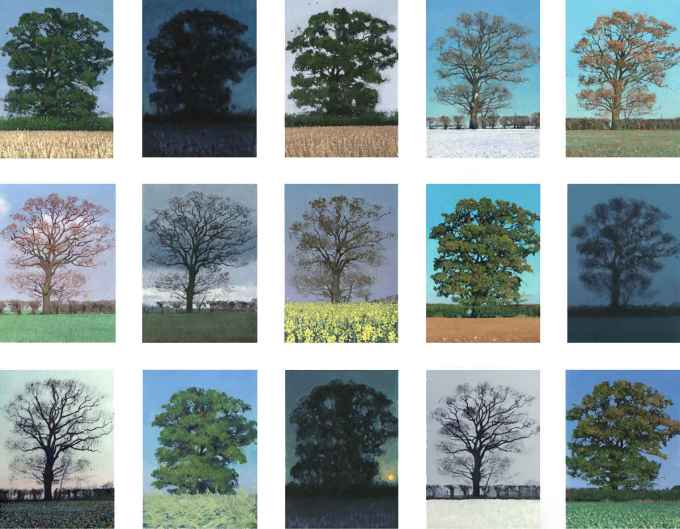
He cast himself into the wild, shunned company, and for three years set up his easel every day in a farmer’s field in East Anglia. Taylor assembled himself and his materials in front of a magnificent 250-year-old oak tree – one that he had picked out after examining numerous others in the area and decided it was ‘the one’.

Day after day he trudged through the wheat and rape, in all weathers and at different times of the day and night to paint the tree.

He painted it in detail and in abstract, he painted it so it filled his canvas, and he painted it as a distant dot on the horizon. Among the branches of the great tree he documented the inhabitants: crows, beetles, larks and lichen.

He sat, he lay on the ground, he stood on a ladder. His perspective, moreover, changed with the seasons, the one constant being the farmer and his tractor – who would appear in the distance occasionally, going about their enmeshed business with not so much as a wave or a snort of acknowledgement.

The philosopher Alain de Botton mentions Taylor in his book The Pleasures and Sorrow of Work, alluding to the tragedies which led him to this point and how the business of work had somehow helped him in a stoic, meditative way.

There have been many artists and writers who have dealt with their own sense of personal despair, their sense of failure or perhaps just the fear of failure, by walking alone into a field and lying down to die with a gun or a razor in their hand.

But the story of Taylor, his box of paints and the beat-up old Citroen he would coax through the English countryside each day to his field, bears little correlation to Vincent Van Gogh or Ernest Hemingway.

His is a story that is uplifting in its universal ethos that you do what you know, and you make all that you can of it.

Now, five years after Taylor packed up his easel and left the field for the last time, a book has been published of 50 of his paintings from that time.

Entitled simply Oak, it is itself a workmen like volume, full of analysis of sunlight and shadow, of gradients of paint and how the eye plays tricks on the mind. It is the diary of an artisan, obsessive in its chronicling of technique and the thought processes that led to the final image.

But on personal details it is scant, and on the subject of the tragedies he suffered – which had brought him to the field in the first place – he devotes just five lines in the entire book.

This is the measure of the man, rather than the artist. He does not seek out the limelight, which is why he has never spent much time in it. Nor does he seek some material advantage in mixing his personal life with his craft as a painter. That is too much a foreign concept to him.

What little we know of Taylor has been wheedled out of him by people more astute in the selling of paintings and books, and yet even that is slight and no more than a footnote to a great canvas.

I spoke to Taylor for just over an hour on the phone one day recently to fill in some of the blanks.

He had been living in Colchester at the time of his ‘mid-life crisis’ and when the paintings were made between 2003 and 2006, but now resides in Ely in Cambridgeshire.

Immediately prior to this Taylor’s mother Lillian, 70, died of a brain tumour and his father Jack suffered a stroke not long after, succumbing finally to a heart attack within the year, at the age of 76. In between Taylor’s former girlfriend, the woman he describes as being ‘the closest woman to me after my mother’, also died of a brain tumour. It’s still a sensitive point and he will say no more about her.

Taylor told me: “Father’s death was the last straw. You lose your sense of identity when you lose friends and family and I suddenly didn’t know who I was. I think it helps you to work out who you are if you know where you are, and I think that’s what was going on.

“I walked into this field one day and just sat down and started to paint. I painted the tree from every angle, in oils and watercolours, I drew it and photographed it. I did start to wonder why I felt it so easy to work in this field on my own for such a long period of time. I think I was trying to feel at home.

“I was trying to connect with something much bigger than me and all my concerns.”

Taylor, who studied at Leeds, Essex and Yale universities, said the process was cathartic and the tree was a link to pictures he grew up with in his family home in Wolverhampton, in the West Midlands.

His grandfather, a brewery worker, painted in his spare time, and a picture of an oak tree in a field hung prominently in Taylor’s boyhood home, alongside watercolours of birds painted by his father, a postman.

But his career as an artist had taken him around the world and, for prolonged periods, away from his family.

He added: “My family had been there for 100 years and when that was all finished I was left wondering ‘what am I going to do with my life?’ I went through a mid-life crisis brought about by the deaths of important people in my life that I was coping with.

“At the time I started painting the tree I didn’t think about why I was doing it, but looking back now I think I needed a sense of place. I had lost everything that anchored me. By taking this one little area of England and feeding off it spiritually I found some redemption. I got to know the history of the place and its links to John Constable. I built up this little world that seemed to confirm who I was.”

Taylor was aware, too, of the oak’s powerful symbolism, its solidity and defiance of time and change, adding: “The oak has a feeling of permanence.

“You find it crops up a lot in the paintings of Constable, in Virginia Woolf’s Orlando and also in War and Peace, where it takes on a symbolic meaning – the oak tree carries on and that helps Andre make sense of all the loss he’s had.

“And the paintings themselves are very much like ones in my family, ones my grandfather did. Painting was how we knew who we were.”

The time spent in the field also expanded his artistic range.

“I began to work on ways that would help me paint nature in a fresh way and to help me make visual contact with this new place,” he wrote in the book.

“By being in the field so often and by working so carefully in colours belonging to particular conditions, I had developed an understanding of the limitless of natural colour.”

Since the oak, Taylor has spent time in the Rheidol Valley in Wales where he took on a new project, determined to properly understand and depict falling water.

Now his attention has turned to the great expanse of clear sky over the rush-covered fens.

He speaks cheerily of his work and his life. He is keen to discuss theory, both traditional and that which is technologically innovative, and our conversation wanders over Cezanne and Pissaro, Constable and Warhol, colour grids and Adobe Photoshop.

“I embraced as much science as I could. I spoke to scientist friends and found ways to use science to help me see more clearly,” he said.

“You can define a field of colour using photoshop, pick out one colour and see where it falls across a landscape. That’s an amazing tool to analyse how light appears to the viewer.

“I think it’s important to embrace new technology where it helps our understanding of how we see objects and how we see them interact with other objects in a landscape.”

Painting the oak hasn’t given him all the answers though, it hasn’t eradicated problems from his life. He speaks ruefully, almost apologetically, about a rejected recent marriage proposal and how his unrequited love interest is happily ensconced in matrimony with another.

Such is life!

He is guarded about his age, because he feels artists, like every other profession, get pigeon-holed and discriminated against if they have not ‘made it’ within a decreed timetable for success.

But he is grounded once more and happy within his own skin.

He ended our conversation as breezily as it began, and on a positive note about reconnecting with his past and finding himself.

“What I got from my dad,” he said, “was how nice it is to be alive.”

Oak: One Tree, Three Years, Fifty Paintings By Stephen Taylor (Princeton Architectural Press £19.99)

(Originally published in The Huffington Post and mirror.co.uk)